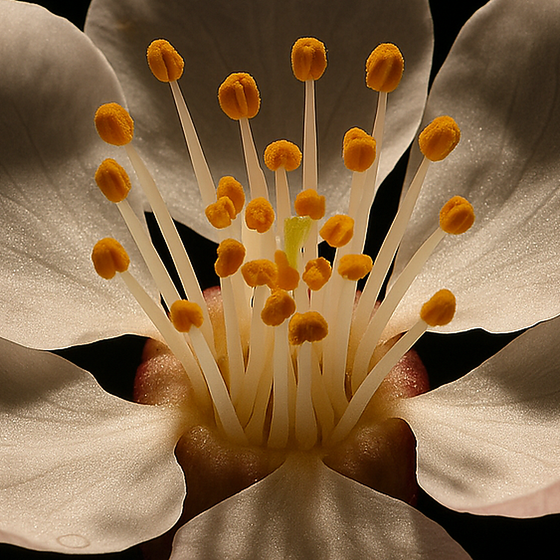
Prunus armeniaca is a small tree, 8 to 12 metres tall. Its flowers have five white to pinkish petals and measure 2 to 4.5 cm across. They are produced singly or in pairs in early spring, before the leaves. The flowers tend to open very early, in early March in western Europe, and spring frost can kill them. Among its six varieties, var. ansu is pink-flowered and var. meixianensis is double-flowered. Prunus mume, the flowering apricot, is a different species, native to southern China and widely cultivated for its beautiful blossom and edible fruit. The leaves of the apricot are ovate, 5 to 9 cm long, with a rounded base, a pointed tip and a finely serrated margin.
Fruit and Cultivation History
The fruit is a drupe similar to a small peach, from yellow to orange and often tinged red. Its single seed is enclosed in a hard, stony shell, often called a stone. The earliest archaeological evidence for apricots comes from the Kuahuqiao site (6,000-5,400 BCE) in East China. Archaeological evidence shows that apricot cultivation had occurred in Kashmir by the 2nd millennium BCE. Apricot stones from the Chalcolithic era have been found at Garni and Shengavit in Armenia. The apricot arrived in southwest Asia from Iran or Armenia during the third century BC. Within a few centuries, cultivation was established across Syria, Turkey, Greece, and Italy. Apricot cultivation in Andalusia is treated in Ibn al-'Awwam's 12th-century Book on Agriculture. In England during the 17th century, apricot oil was used in herbalism treatments intended to act against tumors, swelling, and ulcers. The species went through at least three independent domestication events: two from wild populations in Central Asia, in Kyrgyzstan and Kazakhstan, and one in China. The cultivated apricot spread westward by two main routes, one from Central Asia through West Asia to Mediterranean Europe and North Africa, the other from Central Asia into continental Europe. The English word apricot first appeared in the 16th century as abrecock and goes back, through Arabic and Greek, to a Latin phrase for an early-ripening peach. The tree needs 300 to 900 chilling units and tolerates winter temperatures as cold as -30 °C if it is healthy. In 2023 world production of apricots was 3.7 million tonnes, led by Turkey with 20% of the total, followed by Uzbekistan, Iran, Italy and Algeria. Apricot kernels contain amygdalin, a poisonous compound, at about 5% in bitter kernels and about 0.9% in sweet ones. Kernels of apricots grown in central Asia and around the Mediterranean may be substituted for bitter almonds.
Related Aroma Compounds
Benzaldehyde is a colorless liquid with a characteristic odor similar to that of bitter almonds and cherry. Its formula is C₆H₅CHO, a benzene ring with a formyl substituent. Benzaldehyde was first extracted in 1803 by the French pharmacist Martrès, who was studying amygdalin from bitter almonds. Almonds, apricot seeds, apple seeds and cherry seed contain significant amounts of amygdalin, a glycoside that breaks up under enzyme catalysis into benzaldehyde, hydrogen cyanide and two equivalents of glucose. Gamma-decalactone is a lactone and aroma compound with the formula C₁₀H₁₈O₂. It has an intense peach flavour and is naturally present in many fruits and fermentations. It is also called peach lactone and is a colorless to pale yellow liquid that boils at 281 °C, with a molar mass of 170.25 g/mol. Linalool is a naturally occurring terpene alcohol found in many flowers and spice plants. Its commercial uses rest mostly on its pleasant scent, floral with a touch of spiciness. It is an acyclic monoterpenoid and, together with geraniol, nerol and citronellol, one of the rose alcohols. Linalool exists as two enantiomers: the (S)-form is perceived as sweet, floral and petitgrain-like, the (R)-form as more woody and lavender-like. The ionones are derived from the degradation of carotenoids. They are aroma compounds found in a variety of essential oils, including rose oil. They belong to the rose ketones, a group that also includes damascones and damascenones. Chemically they are apocarotenoids, specifically C13-norisoprenoids, formed by oxidative cleavage of larger carotenoid molecules. Beta-ionone contributes significantly to the aroma of roses despite its relatively low concentration.
Related Materials
The flowers of Osmanthus fragrans carry the scent of ripe peaches or apricots. In a 2010 study, the essential oil of Osmanthus fragrans var. aurantiacus held the highest diversity of carotenoid-derived volatiles among the flowering plants investigated. Osmanthus fragrans is an evergreen shrub or small tree 3 to 12 m tall. Its small flowers are white, pale yellow, yellow or orange-yellow, have a strong fragrance, and are produced in clusters in late summer and autumn.