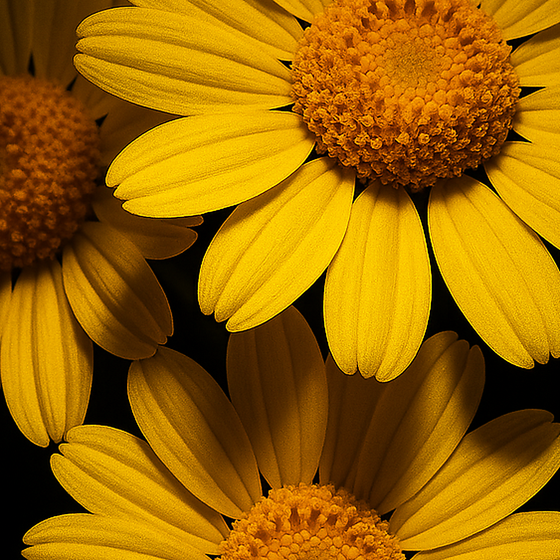
Acacia dealbata, commonly called silver wattle, blue wattle or mimosa, is a species with spherical heads of yellow to bright yellow flowers. The ylang-ylang tree, Cananga odorata, has flowers with six yellow petals. Spanish broom, Spartium junceum, bears fragrant yellow pea-like flowers. The flowers of Osmanthus fragrans are white, pale yellow, yellow, or orange-yellow, and have a strong fragrance. The flower of Narcissus poeticus has a ring of pure white tepals and a short corona of light yellow with a distinct reddish edge.
Explore all seven extraits in the Discovery Set.
Mimosa and cassie
The essence of the flowers of Acacia dealbata, called mimosa or in older texts cassie, is used in perfumes. Vachellia farnesiana, also known as Acacia farnesiana, is a shrub or small tree whose flowers are used in the perfume industry. The perfume essence of its flowers gave its name to the sesquiterpenoid farnesol. Scented ointments from cassie are made in India.
Ylang-ylang oil
Ylang-ylang oil contains linalool, germacrene, geranyl acetate, caryophyllene, p-cresyl methyl ether and methyl benzoate. Sesquiterpenes found in it include caryophyllene, germacrene and (E,E)-α-farnesene. The oil is one of the basic ingredients of macassar oil. It made up 29% of the annual export of the Comoros in 1998.
Broom
Spanish broom is native to the Mediterranean in southern Europe, southwest Asia and northwest Africa, where it is found in sunny sites, usually on dry, sandy soils. Its essential oil is known as genet absolute. The plant also produces a yellow dye.
History
Acacia dealbata was first formally described in 1822 by Johann Heinrich Friedrich Link. Vachellia farnesiana was first described by Europeans under the name Acacia Indica Farnesiana in 1625 by Tobias Aldini, from plants grown in Rome in the Farnese Gardens from seed collected in Santo Domingo. Narcissus poeticus was first described by Carl Linnaeus in 1753. Ylang-ylang was first described as Uvaria odorata in 1785 by Jean-Baptiste Lamarck. Acacia dealbata is allegedly the first plant to bloom in the aftermath of the Hiroshima atomic bomb in August 1945.