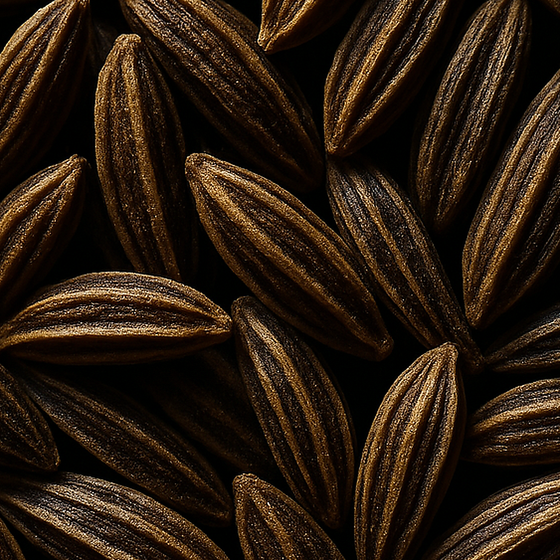
Кмин звичайний

НатуральнийПРЯНОЩІтеплий · пряний · свіжий
Ноти серцяПіраміда
4/5Сила
—Стійкість
5Походження
Зразок
Кмин звичайний як парфумерна сировина
Ноти серця
Carum carvi
Визначення

Dry, seedy, warm — the smell of toasted rye crust pulled from the oven. Caraway reads cleaner and lighter than cumin, with a faint minty coolness that cumin entirely lacks.

ДЕРЕВНИЙ ТРАВ’ЯНИЙ ЦИТРУСОВИЙ ПРЯНИЙ ТЕПЛИЙ М’ЯТНИЙ ЗЕЛЕНИЙ
PERSIAN CUMIN MERIDIAN FENNEL
Type
Складник
Olfactive family
Пряні
Source
dried fruits (mericarps)
Chemical class
complex natural (essential oil)
Інструменти
Піраміда
ВВерхні ноти
СНоти серця
ББазові ноти
4/5Сила
Висока
інтенсивність запаху
Країни-виробники
Нідерланди Фінляндія Польща Німеччина Єгипет

Запах

Warm, dry, seedy — immediately bread-like, with a faint cooling edge that distinguishes it from cumin's sweaty heat. Where cumin reads animalic and bodily, caraway is clean and toasted. Where anise is sweet and liquorice-dense, caraway is drier, more mineral, with a subtle herbaceous green note underneath the seed character.

On a blotter, the opening is bright with limonene-driven citrus lift, then the carvone warmth takes over within ten minutes — toasted grain, warm dough, a whisper of menthol. The dry-down is unexpectedly woody, quiet, with a faint earthy persistence that recalls dried hay.

Теруар і хемотипи

Докладно

Caraway is rye bread, kümmel schnapps, Scandinavian akvavit. The essential oil, steam-distilled from the dried fruits (commonly called seeds) of Carum carvi L. (Apiaceae, CAS 8000-42-8), is a two-component system: (S)-(+)-carvone (CAS 2244-16-8, C₁₀H₁₄O, MW 150.22) and (R)-(+)-limonene together typically account for 95% or more of the oil. The ratio between them varies with origin, cultivar, and harvest maturity. The United States Pharmacopeia monograph for caraway oil requires at least 50% by volume of d-carvone. Northern European cultivated caraway — from the Netherlands, Finland, Poland — tends toward 50–63% carvone with 33–45% limonene, the ranges set by ISO 8896. Egyptian and some Indian origins can produce oils with lower carvone content and proportionally higher limonene. Minor components include myrcene, trans-dihydrocarvone, and traces of carveol.

(S)-(+)-Carvone is the molecule that makes caraway smell like caraway. Its mirror image, (R)-(−)-carvone (CAS 6485-40-1), smells of spearmint — a textbook case of chirality-dependent olfaction. Same atoms, same bonds, mirror-image geometry, completely different perception. Leitereg, Guadagni and colleagues demonstrated this unambiguously in 1971, publishing in Nature the first rigorous proof that the two optical isomers of carvone produce distinct odours. The work involved chemical interconversion, independent synthesis, and resolution — supporting the view that olfactory receptors are shape-sensitive, not merely composition-sensitive.

Carum carvi is a biennial plant (annual cultivars exist) native to Europe and Western Asia. The Netherlands, Finland, Poland, and Germany are the principal commercial producers. Finland alone has supplied roughly 28% of world caraway exports, favoured by long summer daylight hours that boost essential oil accumulation in the seeds.

In perfumery, caraway oil is rarely used as a feature note. Its bread-like, seedy warmth is more valuable as a sub-threshold modifier — adding a toasted, slightly minty texture to aromatic and fougère compositions without announcing itself. No IFRA Standard covers caraway oil as such, and it is not among the oils named in IFRA Standard 089 on furocoumarins (cumin oil, by contrast, is restricted to 0.4%). Its carvone counts toward the IFRA Carvone Standard, and its limonene falls under the IFRA peroxide specification. In the EU, limonene and carvone must both be named on the label above 0.001% in leave-on and 0.01% in rinse-off products (Regulation 1223/2009, Annex III, as amended by Regulation (EU) 2023/1545).

Explore all seven extraits in the Discovery Set.

—

Related: Allspice · Anethole · Anise · Asafoetida · Baking Spices · Bay Leaf · Biryani · Carolina Reaper

Sources

  1. ISO 8896:2016, Essential oil of caraway (Carum carvi L.) — iTeh Standards preview
  2. Caraway Oil, USP 32–NF 27 monograph — United States Pharmacopeia (DrugFuture archive)
  3. carum carvi fruit oil, 8000-42-8 — The Good Scents Company
  4. Carvone, (+)-, CID 16724 — PubChem (NCBI)
  5. IFRA Standard: Carvone (Amendment 49) — IFRA
  6. IFRA Standard: Citrus oils and other furocoumarins containing essential oils (Amendment 49) — IFRA
  7. IFRA Standard: Cumin oil (Amendment 49) — IFRA
  8. IFRA Standard: Limonene (Amendment 29) — IFRA
  9. Fragrance allergens labelling — European Commission
  10. Commission Regulation (EU) 2023/1545 (fragrance allergens labelling) — EUR-Lex
  11. Leitereg et al., Evidence for the difference between the odours of the optical isomers (+)- and (−)-carvone, Nature 230 (1971) 455–456 — doi.org
  12. Carvone — Wikipedia
  13. Finnish farms look to caraway — Yle News
  14. Market analysis of caraway seed — CRC for Developing Northern Australia
  15. The Caraway Seed Is A Spice Worth Meeting — NPR

Цікавий факт

Carvone was first obtained pure from caraway oil in 1849 by the German chemist Franz Varrentrapp (1815–1877). Over a century later, Leitereg, Guadagni, Harris, Mon, and Teranishi published the definitive proof in Nature (1971) that the two mirror-image forms of carvone — identical in formula, bonds, and molecular weight — produce completely different smells: caraway and spearmint.

Отримання й хімія

Спосіб отримання

Steam distillation of the dried, crushed fruits (mericarps) of Carum carvi. Oil yield is 2–5% depending on cultivar, maturity at harvest, and distillation parameters. Biennial cultivars (the standard in Northern Europe) yield up to 5% oil; annual cultivars typically produce around 3.3%. A CO2 supercritical extract exists and retains a broader spectrum of non-volatile compounds, producing a rounder, less sharp olfactory profile than the steam-distilled oil. Cold-pressed caraway oil (fixed oil, rich in petroselinic acid) is a different product entirely, used in food rather than perfumery.

Формула
C₁₀H₁₄O (d-Carvone, MW 150.22; principal component, 50–63% under ISO 8896)
CAS
8000-42-8
Ботанічна назва
Carum carvi
Зовнішній вигляд
Colourless to pale yellow clear liquid
Сила запаху
Висока
Синоніми
PERSIAN CUMIN MERIDIAN FENNEL
Статус IFRA
Обмежено

No individual IFRA Standard exists for caraway oil, and it is not among the oils named in IFRA Standard 089 on furocoumarins (Amendment 49), unlike cumin oil (0.4%). Its carvone counts toward the IFRA Carvone Standard (Amendment 49; category 4: 0.59% carvone in the finished product), and its limonene must meet the IFRA Limonene specification (peroxide value below 20 mmol/L). EU: limonene (Annex III entry 88) and carvone (entry 333, added by Regulation (EU) 2023/1545) must be labelled above 0.001% in leave-on and 0.01% in rinse-off products.

Фізичні властивості
Температура спалаху
134.00 °F TCC (56.67 °C)
Відносна густина
0.900 to 0.920 @ 20.00 °C (oil, ISO 8896)
Показник заломлення
1.484 to 1.490 @ 20.00 °C (oil, ISO 8896)

У парфумерії

Heart-note modifier, used in sub-threshold doses to introduce a bread-like, toasted warmth without registering as 'caraway' to the wearer. At full concentration the note is immediately recognisable and potentially overwhelming; below 0.5% of a formula, d-carvone contributes a warm, seedy texture that reads as comfort rather than spice. In fougère compositions, caraway reinforces the lavender-coumarin backbone with dry warmth. In aromatic-herbal accords, it adds a toasted grain quality alongside rosemary and thyme. The limonene fraction (33–45% of the oil under ISO 8896) provides a subtle citrus lift that softens the heaviness. Synthetic d-carvone (widely available, CAS 2244-16-8) is the practical alternative to the essential oil — it delivers the characteristic caraway note without the variable limonene content or batch inconsistency. Dihydrocarvone and carveol, both minor constituents of the oil, are sometimes used independently as modifiers in flavour and fragrance work. No current PREMIEREPEAU fragrance features caraway as a listed ingredient.

Роль у формулі
01модифікатор
02компонент піднесення
03сполучний компонент
04натуралізатор
05формувач об’єму
06свіжість
Форми випуску
ефірна олія CO₂-екстракт синтетичний ізолят d-карвону

Див. також

6 ноти