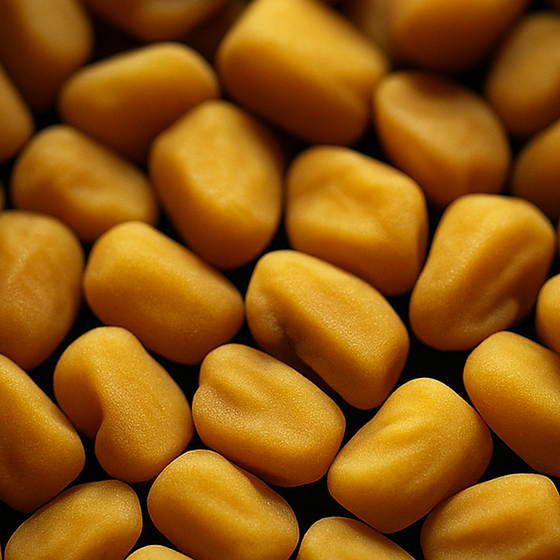
Fenugreek is an annual herb growing to a height of up to 60 cm. Its bean-like pods are 10 to 15 cm long and hold up to twenty small, grooved, yellowish-brown seeds. It is used as a herb in the form of dried or fresh leaves, as a spice in the form of seeds, and as a vegetable. India is the world's largest producer of fenugreek, with over 80% of its output coming from the state of Rajasthan. In 2011-12 India produced 121,775 tonnes of seed from 96,304 hectares and exported 21,800 tonnes. Within India, Rajasthan has the highest seed production, followed by Gujarat, Madhya Pradesh and Uttarakhand. Fenugreek is also grown in Argentina, Egypt and the Mediterranean region. The plant is cultivated in moderately cool, frost-free climates, and the preferred soil is loamy or sandy loam with a pH of 6 to 7 and good drainage. Its leaves are rich in protein, minerals and vitamin C and are used as a vegetable, and the seed is also sprouted. Fenugreek provides a green fodder that ruminants find palatable, and the seeds are fed to fish and domestic rabbits. In 100 grams, the seeds contain 9% water, 58% carbohydrates, 23% protein and 6% fat.
Sotolon is the chemical responsible for the distinctive maple syrup smell of fenugreek. It is a butenolide lactone and an extremely potent aroma compound. Sotolon is the major aroma and flavor component of fenugreek seed and lovage. Its formula is C₆H₈O₃ and its molar mass is 128.127 g/mol. Sotolon is also called sotolone, caramel furanone, sugar lactone and fenugreek lactone. It was first isolated from fenugreek in 1975. It is also present in molasses, aged rum, aged sake and white wine, flor sherry and roast tobacco. Sotolon can pass through the body relatively unchanged, and consumption of foods high in sotolon, such as fenugreek, can impart a maple syrup aroma to one's sweat and urine.
Constituents of fenugreek seeds include flavonoids, alkaloids, coumarins, vitamins and saponins. The most prevalent alkaloid is trigonelline, and the coumarins include cinnamic acid and scopoletin. The seeds are quite bitter and contain coumarin oil. They are composed of protein, starch, sugar, mucilage, minerals, volatile oil, fixed oil, vitamins and enzymes. The seed is traded as a spice, and in an oil extract form as oleoresin.
Fenugreek is believed to have been brought into cultivation in the Near East. Charred fenugreek seeds have been recovered from Tell Halal, Iraq, carbon dated to 4000 BC, and desiccated seeds from the tomb of Tutankhamun. In one first-century AD recipe, the Romans flavoured wine with fenugreek. In the first century AD, in Galilee, it was grown as a staple food. Its use as a fumigant in incense burning in religious ceremonies in Egypt has been reported. The English name derives, via Middle French, from the Latin for Greek hay. The compound sotolon was named in 1980, when it was found to be responsible for the flavor of raw cane sugar. Cato the Elder lists fenugreek with clover and vetch as crops grown to feed cattle. The second-century Mishnah, a compendium of Jewish Oral Law, mentions the plant under its Hebrew name tiltan. Fenugreek is believed to have been known in Indian cuisine 3,000 years ago, and it was also used for embalming. Sprouts grown from a single batch of seeds imported from Egypt into Germany in 2009 were suspected as the source of the 2011 outbreak of Escherichia coli O104:H4 in Germany and France.
Explore all seven extraits in the Discovery Set.
—
Related: Allspice · Anethole · Anise · Asafoetida · Baking Spices · Bay Leaf · Biryani · Caraway