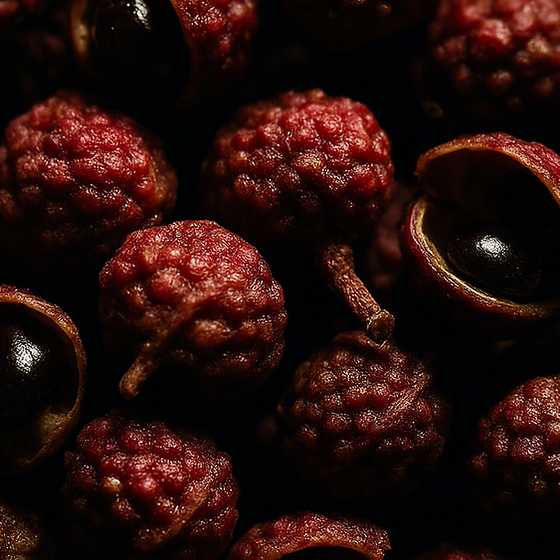
Sansho is a member of the family Rutaceae, which also holds citrus and rue. It is closely related to the Chinese Sichuan pepper, which comes from plants of the same genus. The branches grow pairs of sharp thorns. The plant is dioecious: the flowers of the male plant can be eaten as hana-sanshō, while the female flowers yield berries of about 5 mm. In autumn the berries ripen and burst, scattering the black seeds within.
Its natural range spans from Hokkaido to Kyushu in Japan, southern parts of the Korean Peninsula, and mainland China. Wakayama Prefecture is Japan's top production area for sanshō. A variety called budō sanshō is grown there and is so named because its berries form clusters like grapes. The Korean term sancho refers to a different species, Z. schinifolium. The plant is a host for the citrus butterfly Papilio xuthus, a swallowtail indigenous to Japan.
The numbing spiciness of sansho is due to the pungent compound hydroxy-α-sanshool. Hydroxy-alpha-sanshool has the molecular formula C₁₆H₂₅NO₂. Its structure resembles that of capsaicin, as both are fatty acid amides. The name sanshool comes from sanshō, the Japanese name of Japanese pepper, with the suffix -ol added to indicate an alcohol. Sichuan pepper from China belongs to the same family and has a similar numbing spiciness and citrusy aroma, but is a different species. The seeds contain remarkably high concentrations of glucosides of N-methylserotonin and N,N-dimethylserotonin.
Analysis of the essential oils from ripe fruit peel and leaf revealed over 100 volatile components. In the oil of the fruit peel the major components were 1,8-cineol (25.47%), limonene (11.91%), geranyl acetate (9.01%) and myrcene (6.15%). In the oil of the leaf they were citronellal (23.11%), 1,8-cineol (18.38%) and citronellol (6.04%). The characteristic content of the essential oil is determined mainly by monoterpenes in leaves and largely by sesquiterpenes in fruits. The percentages of the main constituents of the essential oil of both leaves and fruits varied with the season.
Culinary use
The berries are used mainly as a spice. Both the leaves and the fruits serve as aromatics and flavorings in Japan and Korea. Sansho is also one of the seven main ingredients of the spice blend shichimi, which contains red chili peppers as well. The young leaves, called kinome, are used from spring through summer to add fragrance and color to Japanese cuisine. Young leaves and shoots herald the spring and often garnish grilled fish and soups. In Korean cuisine, chopi often accompanies fish soups such as chueo-tang. Sansho has lately grown in popularity because it pairs so well with meat dishes and dairy products.
Explore all seven extraits in the Discovery Set.
—
Related: Bengal Pepper · Black Pepper Oil · Cubeb Or Tailed Pepper · Ghost Pepper · Guinea Pepper · Pepper · Peppertree · Pepperwood