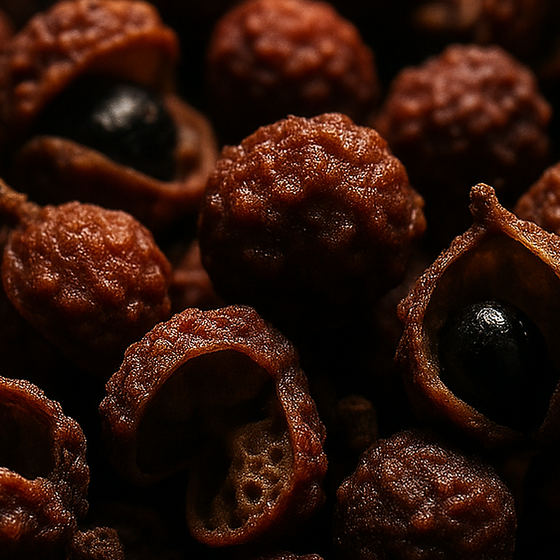
Sichuan pepper is not closely related to black pepper or chili pepper. Zanthoxylum plants are in the same family as citrus and rue. Zanthoxylum is a genus of about 250 species of deciduous and evergreen trees, shrubs and climbers in the family Rutaceae that are native to warm temperate and subtropical areas worldwide. Several species are cultivated for their use as spices, notably including Sichuan pepper. Sichuan pepper is commonly used in Sichuan cuisine of China and in the cuisines of the Himalayas.
The fruit of Zanthoxylum armatum and Zanthoxylum bungeanum is used to make Sichuan pepper by grinding the husks that surround the berries. Zanthoxylum bungeanum is native to North-Central, South-Central and Southeast China, the East Himalayas, Inner Mongolia, Manchuria, Nepal, Qinghai, Tibet and Xinjiang. Zanthoxylum armatum is found throughout the Himalayas, from Kashmir to Bhutan. Zanthoxylum armatum is green and less pungent, fragrant when fresh and more numbing when dried. Zanthoxylum piperitum is harvested in Japan and Korea to produce sanshō, which has numbing properties similar to those of Chinese Sichuan peppercorns.
Hydroxy-α-sanshool is a molecule found in plants from the genus Zanthoxylum. It is believed to be responsible for the numbing and tingling sensation caused by eating food cooked with Sichuan peppercorns. Its chemical structure resembles that of capsaicin, as both are fatty acid amides. Like capsaicin, it is an agonist at the pain integration channels TRPV1 and TRPA1. However, evidence suggests that the inhibition of tandem pore domain potassium channels KCNK3, KCNK9 and KCNK18 is primarily responsible for its effects. It also excites D-hair afferent nerve fibres, a distinct subset of the sensitive light touch receptors in the skin. Sanshool effects on other sensory channels may explain the accompanying feelings of cooling and numbing. Sichuan pepper has a citrus-like flavor and induces a tingling numbness in the mouth.
More than a hundred volatile compounds have been isolated from the genus. Limonene, linalool, hydroxy-α-sanshool and hydroxy-β-sanshool are the major flavor compounds of the supercritical CO₂ extract of Zanthoxylum bungeanum. Nineteen unsaturated alkylamides, including hydroxy-sanshools, dihydroxy-sanshools and bungeanool, were tentatively identified in that extract. The major components of a hydrodistilled oil from Zanthoxylum bungeanum pericarp are linalool (25.99%), limonene (19.34%), linalyl anthranilate (12.22%), 4-terpinenol (10.49%), eucalyptol (6.53%) and α-terpineol (5.02%). Those of a supercritical CO₂ oil from the same pericarp are nonanoic acid (21.43%), γ-terpinene (14.51%), eucalyptol (13.45%), α-terpineol (5.83%) and caryophyllene oxide (5.48%). Important compounds of Zanthoxylum armatum from Nepal include linalool (50%), limonene, methyl cinnamate and cineole. Important compounds of Zanthoxylum piperitum leaves from Japan include citronellal, citronellol and Z-3-hexenal.
Sichuan pepper is an important spice in Chinese, Nepali, Kashmiri, north east Indian, Tibetan, and Bhutanese cookery of the Himalayas. It is used in Sichuan dishes such as mapo doufu, Kung Pao chicken and Chongqing hot pot. In cooking it is often added to chili peppers to create a flavor known as málà, which means numb-spiciness. Essential oils of Zanthoxylum bungeanum can be used as a natural pest control agent against the drugstore beetle. As the food industry looks for natural flavoring ingredients, Sichuan pepper essential oils have drawn the interest of researchers and food companies.
—
Related: Bengal Pepper · Black Pepper Oil · Cubeb Or Tailed Pepper · Ghost Pepper · Guinea Pepper · Japanese Pepper · Pepper · Peppertree