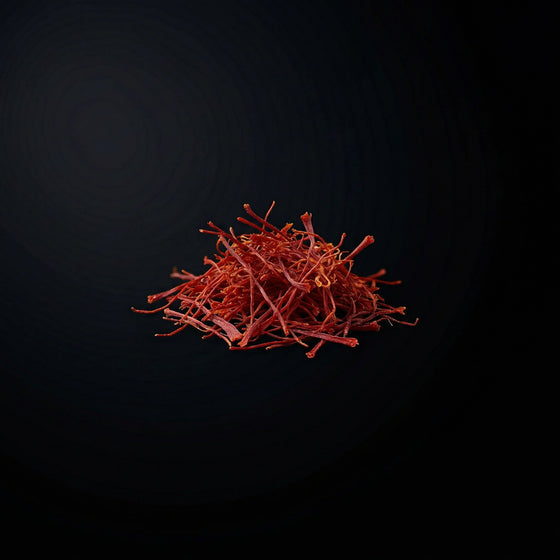
Saffron is an olfactive raw material used in fine perfumery — a structural pillar of PREMIEREPEAU's Insuline Safrine, where Greek saffron opens against bitter almond and Madagascar clove.
Crocus sativus is a species of flowering plant in the iris family Iridaceae. It is a cultivated perennial that is unknown in the wild. The plant is a triploid, which makes it sexually sterile, and it relies upon manual vegetative multiplication for its continued propagation. Its most probable ancestor is the wild species Crocus cartwrightianus. Each corm produces only one or two flowers. Each flower produces only three stigmas. Some 150,000 crocus flowers, picked by hand, are needed per kilogram of saffron. Forty hours of labour are needed to pick 150,000 flowers. All plants bloom within a window of one or two weeks. Saffron crocus is the only plant species that naturally produces crocins, safranal and picrocrocins in significant quantities.
Iran is the largest producer of saffron worldwide, accounting for over 90% of all saffron production. Iran produced 430 tons in 2019, and its main production areas lie in the Khorasan Province. Afghanistan comes second, with over 67 tons produced in 2023. Indian Administered Kashmir is the third largest producer. Most of Kashmir's saffron is grown in the Pampore area of the Kashmir valley. Kashmiri production declined by 65% over 22 years to 2018, from 16 to 5.6 metric tonnes. Greece is the fourth largest producer, followed by Morocco and Spain. Nearly all saffron is grown in a belt that runs from the Mediterranean in the west to mountainous Kashmir in the east. The European Union gives protected geographical status to saffron grown in La Mancha in Spain, in L'Aquila in Abruzzo, Italy, and around Kozani in Western Macedonia, Greece. The 2022 harvest in the La Mancha PDO zone came to 462.15 kilograms. Although market prices fluctuate, premium saffron regularly exceeds US$5,000 per kilogram.
Safranal (2,6,6-trimethylcyclohexa-1,3-diene-1-carbaldehyde, CAS 116-26-7) is the constituent primarily responsible for the aroma of saffron. Safranal is absent before drying. When saffron is dried after harvest, heat combined with enzymatic action splits picrocrocin into D-glucose and a free safranal molecule. Safranal is believed to be a degradation product of the carotenoid zeaxanthin, formed by way of picrocrocin. Safranal makes up 30-70% of the volatile compounds of saffron and 0.001-0.006% of its dry matter. Safranal has also been reported in other plants, such as Centaurea sibthorpii. The main aroma-active compounds of saffron are safranal, 4-ketoisophorone and dihydrooxophorone. Picrocrocin is the glycoside of safranal and may comprise up to 4% of dry saffron. Picrocrocin itself is colourless and odourless, and its structure was established in 1934. Crocin, a carotenoid pigment, gives dishes and textiles a rich golden-yellow hue, and it was first isolated in 1818. The pigment α-crocin may make up more than 10% of dry saffron's mass. Because α-crocin carries two esterified gentiobioses, it is water-soluble and suits the colouring of water-based, non-fatty foods such as rice dishes. Saffron quality is objectively measured under the ISO 3632 standard, which evaluates crocin (colour), picrocrocin (taste) and safranal (aroma). Dry saffron rapidly breaks down chemically in the presence of light and oxidising agents, so it must be stored in air-tight containers.
In Persian cuisine saffron is an essential ingredient, used in dishes such as chelow and tahdig and in stews such as khoresh-e fesenjan. Saffron is also used for health purposes, especially in traditional Asian medicine. It has also traditionally been used as a textile dye, cosmetic raw material, ornamental flower and aphrodisiac.
Saffron is a signature note in Insuline Safrine, where Greek saffron opens against bitter almond and Madagascar clove bud.
Where saffron's smell comes from
The bitter glucoside picrocrocin is responsible for saffron's pungent flavour. Safranal is less bitter than picrocrocin. Fresh stigmas produce only a minimal odour, which appears during drying and storage.
This note in PREMIEREPEAU. Insuline Safrine. Sample all seven extraits in the Discovery Set.