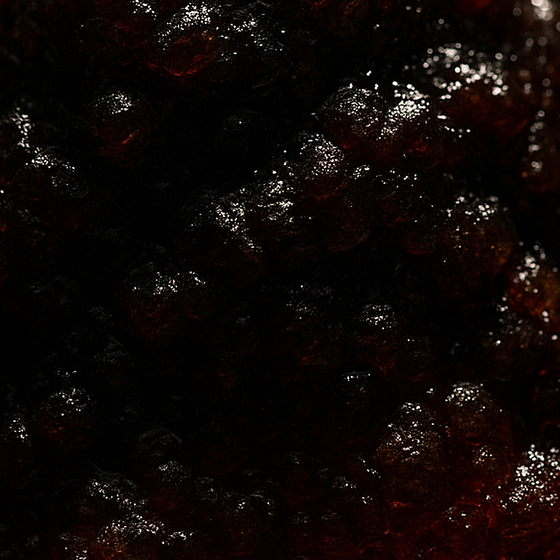
Абсолют лабдануму

НатуральнийСМОЛИ Й БАЛЬЗАМИамбровий · смолистий · солодкий
Базові нотиПіраміда
—Сила
—Стійкість
1Походження
Зразок
Абсолют лабдануму як парфумерна сировина
Базові ноти
Cistus ladanifer
Визначення

Labdanum absolute is the absolute of labdanum, a sticky brown resin obtained from the shrub Cistus ladanifer. Its odour is very rich, complex and tenacious.

АМБРОВИЙ СОЛОДКИЙ БАЛЬЗАМІЧНИЙ ТЕПЛИЙ
Ladanum, ladan, ladanon
Type
Складник
Olfactive family
Смолисті
Source
resin
Chemical class
complex mixture (labdane-type diterpenes, methylated flavonoids)
Інструменти
Піраміда
ВВерхні ноти
СНоти серця
ББазові ноти
Стійкість на блотері
Tenacious
Країни-виробники
Іспанія

Запах

Labdanum's odour is variously described as amber, sweet, woody, powdery, fruity, animalic, ambergris, dry musk, or leathery. It contributes a warm, ambery note carrying hints of sweet, dusty beeswax. The fragrance of the absolute is more refined than that of the raw resin.

Докладно

What it is

Labdanum absolute is obtained by solvent extraction of labdanum, a sticky brown resin from the shrub Cistus ladanifer. Cistus creticus, the pink rockrose of the eastern Mediterranean, is another source of labdanum. The shrub grows 1-2.5 m tall and wide. It is native to the western Mediterranean region. The whole plant is covered with a sticky exudate of fragrant resin, the source of labdanum. In Spanish the plant is called jara pringosa, which means "sticky shrub". Labdanum was historically used in herbal medicine and is still used in the preparation of some perfumes and vermouths. The raw gum is a black or sometimes dark brown, fragrant mass containing up to 20% or more of water. It is plastic but not pourable, and becomes brittle with age.

The plant and its range

Cistus ladanifer is an evergreen shrub of the rockrose family, Cistaceae. Its lanceolate leaves are 3-10 cm long, and its flowers, 5-8 cm across, have five papery white petals, usually with a red to maroon spot at the base. The plant stands both long summer droughts and cold weather, and it is extremely aggressive: it has taken over much former farmland and grassland in the mountain regions of central Spain and much of southern Portugal. In Portuguese it is called esteva.

Chemistry

Labdanum resin is a complex mixture of terpenoid and phenolic compounds, mainly labdane-type diterpenes and methylated flavonoids. Labdane-type diterpenoid acids and methylated flavonoid aglycones are among its identified compounds. Labdanolic acid is a major compound in labdanum resin. Labdanolic acid has the formula C₂₀H₃₆O₃ and a molecular weight of 324.5. Labdanolic acid does not absorb UV radiation. Eight peaks in the extracts were identified with standards as typical labdane-type diterpenoids or flavonoid aglycones. The absolute makes up about 70% of the resin, and its diterpenoid and flavonoid fractions make up about 75% and 15% of the absolute. Flavonoids account for 14 to 28% of the resin in plants harvested in summer and 6 to 16% in plants harvested in winter.

Cosmetic use

Labdanum resin is already used in the cosmetic industry, mainly by the fragrance and perfumery sector. The absolute has a spectrophotometric sun protection factor near 5, mainly due to its flavonoids. The flavonoid fraction alone has a sun protection factor of 13.

Explore all seven extraits in the Discovery Set.

—

Related: Amberwood · Andiroba · Bakhoor · Balsamic Notes · Benzoin Resinoid · Benzyl Benzoate · Benzyl Salicylate · Birch Tar

Цікавий факт

Percy Newberry, a specialist on ancient Egypt, speculated that the false beard worn by Osiris and pharaohs may have originally represented a labdanum-laden goat's beard. He also argued that the sceptre of Osiris, usually interpreted as a flail or a flabellum, was more likely an instrument for collecting labdanum, similar to one used in nineteenth-century Crete.

Отримання й хімія

Спосіб отримання

The raw resin is usually extracted by boiling the leaves and twigs. An absolute is also obtained by solvent extraction. An essential oil is produced by steam distillation. In the Andalusian process the resin is extracted from the plant material with warm alkaline water, then precipitated by lowering the pH with acid and separated with a skimmer or by decantation. In the Zamorean process the resin is removed from the plant surface with boiling water and the resin at the water surface is continuously separated with a skimmer. The Zamorean process gives a resin yield approximately 25 times lower than the Andalusian process. To make the absolute, the waxes are removed: the labdanum is dissolved in warm methanol, then cooled to negative temperatures so that the waxes precipitate and can be separated by centrifugation. The absolute may be separated into diterpenoid and flavonoid fractions by molecular sizing column chromatography. One of the most important producers of C. ladanifer extracts obtains around 300-350 tons of raw labdanum resin each year from 6000-7000 tons of manually harvested plants.

Формула
Complex natural mixture (key constituents: labdanolic acid C₂₀H₃₆O₃; methylated flavonoids)
CAS
8016-26-0
Ботанічна назва
Cistus ladanifer
Зовнішній вигляд
dark amber-green, very thick at room temperature
Стійкість
Tenacious
Синоніми
Ladanum, ladan, ladanon
Статус IFRA
Див. примітку

No IFRA Standard for the material itself (51st Amendment)

Фізичні властивості
Відносна густина
1.104 to 1.114 @ 25 °C
Показник заломлення
1.504 to 1.514 @ 20 °C

У парфумерії

Labdanum is produced today mainly for the perfume industry. It is the main ingredient used when making the scent of amber in perfumery, as well as chypre fragrances. In fine perfumery, cosmetics, personal care products, detergents, soaps and incense sticks, it is used in ambery, chypre and fougère accords as well as mystical notes. It also gives the composition substantivity. Its olfactive family in perfumery is ambery. Its resemblance to ambergris is a reason for its value in perfumery; ambergris has been banned from use in many countries because it originates from the sperm whale, an endangered species.

Роль у формулі
01фіксатор
02фірмова нота
03сполучний компонент
04тепло
Форми випуску
абсолют

Див. також

7 ноти