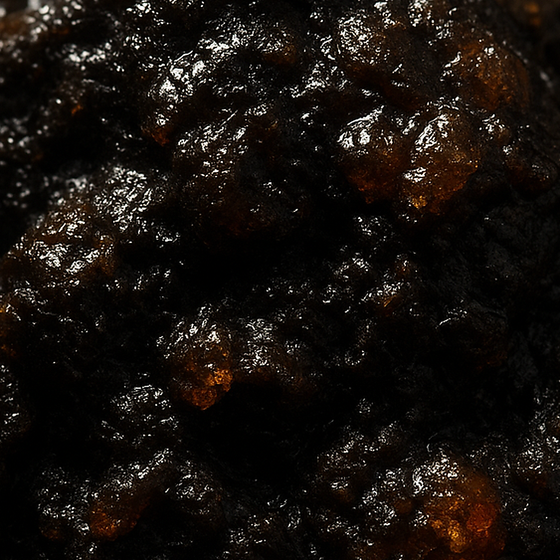
Резиноїд лабдануму

НатуральнийСМОЛИ Й БАЛЬЗАМИамбровий · теплий · смолистий
Базові нотиПіраміда
—Сила
100годСтійкість
1Походження
Зразок
Резиноїд лабдануму як парфумерна сировина
Базові ноти
Cistus ladanifer
Визначення

Labdanum resinoid is a perfume material prepared by extracting crude or cleaned labdanum with a hydrocarbon solvent. Its scent is described as balsamic, ambery, leathery and sweet.

АМБРОВИЙ СОЛОДКИЙ БАЛЬЗАМІЧНИЙ ТЕПЛИЙ
Cistus ladaniferus resinoid, Cistus ladaniferus L. resinoid
Type
Складник
Olfactive family
Смолисті
Source
resin/gum
Chemical class
resinoid (terpenoid resin: labdane-type diterpenes and methylated flavonoids)
Інструменти
Піраміда
ВВерхні ноти
СНоти серця
ББазові ноти
Стійкість на блотері
100годин · 4 днів
1 год6 год24 год3 дн.7 дн.400 год
за 20 %
Країни-виробники
Іспанія

Запах

Labdanum's odour is variously described as amber, sweet, woody, powdery, fruity, animalic, ambergris, dry musk or leathery. Its odor type is amber, with sweet, dry, old-wood, ambergris and balsam descriptors. The scent of one Spanish resinoid is warm and structured, leathery, woody and amber, with a light aromatic and artemisia note. That resinoid has more smoky and tobacco notes than labdanum absolute. Labdanum profiles are usually more intense and longer-lasting, with a leathery dry-down and animalic notes. The odor of labdanum is very rich, complex and tenacious.

Докладно

What it is

Resinoids are extracts of resinous plant exudates. Labdanum is a sticky brown resin obtained from rock rose shrubs, among them Cistus ladanifer in the western Mediterranean and Cistus creticus in the eastern Mediterranean.

The plant

Cistus ladanifer is a shrub growing 1-2.5 m tall and wide. It is native to the western Mediterranean region. The whole plant is covered with the sticky exudate of fragrant resin, the source of labdanum. Trichomes on the upper and lower sides of the leaf, primarily in young, developing leaves, secrete the labdanum of C. ladanifer. Exudate production is greatest in summer, since ultraviolet radiation and water stress trigger it.

Harvest

Cistus is harvested today mainly in southern Spain. Manual pruning of the branches begins in July, when they are full of resin. Only the shoots of the year are harvested. Once cut, the branches are gathered in bundles of 25 kg and taken to the processing plant. If it rains too much during the harvesting period, the plant's resin is 'washed away'.

Composition and raw gum

The raw gum comprises terpenoids, mainly labdane-type diterpenes, and methylated flavonoids. The raw gum is a black or sometimes dark brown, fragrant mass containing up to 20% or more of water. It is plastic but not pourable, and becomes brittle with age. The absolute is dark amber-green and very thick at room temperature.

Explore all seven extraits in the Discovery Set.

—

Related: Amberwood · Andiroba · Bakhoor · Balsamic Notes · Benzoin Resinoid · Benzyl Benzoate · Benzyl Salicylate · Birch Tar

Цікавий факт

Cistus ladanifer is an extremely aggressive plant that has taken over much of the former farmland and grasslands in the mountain regions of central Spain and much of southern Portugal. In Spanish it is called Jara pringosa, meaning 'sticky shrub'.

Отримання й хімія

Спосіб отримання

Raw gum is obtained from the leaves and stems of C. ladanifer with alkaline water to remove the surface waxes, followed by acid neutralization, a method used in Andalusia, Spain. The labdanum gum used is most often Spanish labdanum. Petroleum ether has been used more frequently in past years, since it yields a light amber resinoid that holds the most wanted odor principles in high concentration. One Spanish resinoid is made from the gum by ethanolic extraction. The collected twigs are soaked in an alkaline solution, rinsed and filtered to extract the resin. In one process the resin is separated from the water and dried, and solvent extraction then yields the absolute. The raw resin is usually extracted by boiling the leaves and twigs.

Формула
Complex natural mixture (key constituents: labdane-type diterpenes; methylated flavonoids)
CAS
8016-26-0
Ботанічна назва
Cistus ladanifer
Зовнішній вигляд
Red brown semi-solid
Стійкість
100 hour(s) at 20.00 %
Синоніми
Cistus ladaniferus resinoid, Cistus ladaniferus L. resinoid
Статус IFRA
Див. примітку

No IFRA Standard for the material itself (51st Amendment)

Фізичні властивості
Температура спалаху
> 200.00 °F. TCC (> 93.33 °C.)

У парфумерії

Labdanum is the main ingredient used when making the scent of amber in perfumery, as well as chypre fragrances. Resinoids are mainly used as perfume fixatives. Labdanum is much valued in perfumery because of its resemblance to ambergris, which has been banned from use in many countries because it originates from the sperm whale, an endangered species. Labdanum is used in ambery, chypre and fougère accords, and it gives the composition substantivity. The Spanish resinoid blends well with woody and ambery notes, and gives roundness and body to chypre and oriental accords. Usage levels of up to 10% in the fragrance concentrate are recommended. Labdanum blends well with oakmoss, clary sage, lavender, bergamot, vetiver, sandalwood and patchouli.

Роль у формулі
01фіксатор
02фірмова нота
03сполучний компонент
04тепло
Форми випуску
резиноїд

Див. також

6 ноти