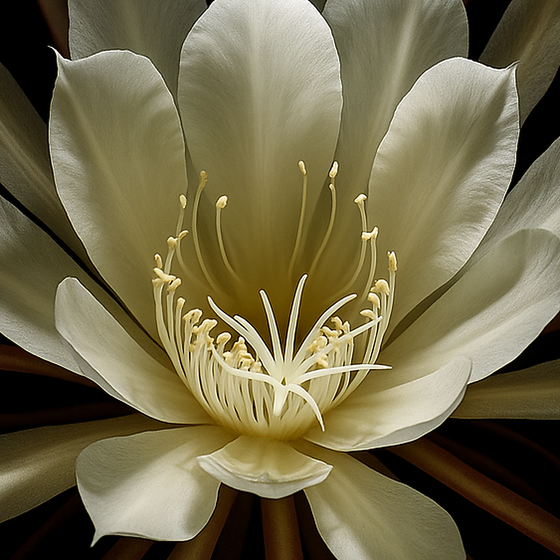
Цеструм нічний

НатуральнийКВІТИквітковий · солодкий · теплий
Ноти серцяПіраміда
—Сила
—Стійкість
3Походження
Зразок
Цеструм нічний як парфумерна сировина
Ноти серця
Cestrum nocturnum L.
Визначення

Lady of the Night (Cestrum nocturnum) is a species of plant in the potato family Solanaceae, an evergreen woody shrub. Its flowers are sweet-scented and heavily perfumed at night.

КВІТКОВИЙ ЗЕЛЕНИЙ ЗЕМЛИСТИЙ СОЛОДКИЙ ТЕПЛИЙ СВІЖИЙ
Lady of the night, night-blooming jasmine, night-blooming jessamine, night-blooming cestrum, night-scented jessamine, night-scented cestrum
Type
Складник
Olfactive family
Квіткові
Source
flower
Інструменти
Піраміда
ВВерхні ноти
СНоти серця
ББазові ноти
—Сила
Сильна вночі
Сильна вночі
Країни-виробники
Мексика Центральна Америка північ Південної Америки (природний ареал)

Запах

The flowers are fragrant and sweet-scented. They are heavily perfumed at night, and the aroma is strong during the night.

Докладно

Lady of the Night, Cestrum nocturnum, is a species of plant in the potato family Solanaceae. Despite its common name, it is not a true jasmine and does not belong to the genus Jasminum. It is native to Mexico, Central America and northern South America and is naturalized in South Asia.

Origin and Botany

It is an evergreen woody shrub with slender branches growing to 4 m tall. The leaves are simple, narrow lanceolate, 6-20 cm long and 2-4.5 cm broad, smooth and glossy. The flowers are fragrant and yellow or greenish-white, with a corolla tube 20-30 mm long. The fruit is a whitish globose berry, and the seeds are ovoid and black. The Latin epithet nocturnum means 'at night' and refers to the plant's habit of blooming at night. It can be found flowering and fruiting throughout the year. The genus Cestrum holds some 150 to 250 species, native to warm temperate to tropical regions of the Americas.

Cultivation and Spread

It is grown in subtropical regions as an ornamental plant for its flowers that are heavily perfumed at night. It was introduced in South-East Asia as an ornamental for its sweet-scented flowers, which bloom at night. In South-East Asia it is cultivated and locally naturalized from sea level up to 1600 m altitude, and it propagates easily from semi-hardwood cuttings. It has become widely naturalized in tropical and subtropical regions throughout the world, and it is classed as a weed in some countries.

Chemistry

The oil distilled from the flowers contains phenylethyl alcohol (27%), benzyl alcohol (12%), eicosane (5.6%) and eugenol (5.6%). Forty-seven compounds, representing 93.28% of the total oil, were identified in the essential oil by GC-MS. A total of 22 well-matched compounds were detected in the volatiles from the petals, including 12 species of phenylpropanoids. Benzaldehyde, phenyl acetaldehyde and benzyl acetate were identified as the main floral scent substances involved in the phenylpropanoid biosynthesis pathway. When the phenylpropanoid peak area was at its maximum at 24:00, benzaldehyde, phenylacetaldehyde and phenylmethyl acetate were the dominant components, at 32.40%, 26.91% and 23.07% respectively. The flower alcohol extract contains cytotoxic steroids.

Uses and Toxicity

In Central America and the Caribbean a leaf decoction is used as a lotion on skin eruptions. In former times a fruit extract was taken orally as a sedative in cases of epilepsy, chorea and hysteria. The essential oil and organic extracts showed antibacterial activity against several food-borne bacteria, including Staphylococcus aureus and Listeria monocytogenes. All parts of the plant are rich in saponins, yielding some 4-5%. All members of the family Solanaceae contain an alkaloid toxin called solanine. The most commonly reported problems associated with C. nocturnum are respiratory problems from the scent, and feverish symptoms following ingestion.

Explore all seven extraits in the Discovery Set.

Цікавий факт

Phenylacetylaldehyde is one of three principal volatile compounds emitted by the flowers, and it strongly attracts female cabbage looper moths. The total volatile peak area from the petals was greatest at 24:00 and smallest at 06:00, a 13.97-fold difference.

Отримання й хімія

Спосіб отримання

The flowers are distilled to give an oil. An absolute of the plant has also been prepared and analysed.

Формула
Complex natural mixture (key constituents: linalool; benzaldehyde C₇H₆O; benzyl alcohol C₇H₈O; benzyl acetate C₉H₁₀O₂)
Ботанічна назва
Cestrum nocturnum L.
Зовнішній вигляд
Tubular, greenish-white to yellow flowers; whitish globose berry
Сила запаху
Сильна вночі
Синоніми
Lady of the night, night-blooming jasmine, night-blooming jessamine, night-blooming cestrum, night-scented jessamine, night-scented cestrum
Статус IFRA
Див. примітку

No IFRA Standard for the material itself (51st Amendment)

У парфумерії

An absolute of Cestrum nocturnum has been analysed by GC and GC/MS, which detected more than 130 compounds, of which more than 100 were identified. The olfactorially valuable compounds found above 1% in it include linalool, benzaldehyde, benzyl alcohol, phenylacetaldehyde, cis-jasmone, benzyl acetate and methyl jasmonate. Linalool is the largest of them at 3.1%, ahead of benzaldehyde at 2.5% and benzyl alcohol at 2.4%. The other compounds above 1% are phenol (1.6%), 1,8-cineole (1.4%), borneol (1.3%), eugenol (1.3%), linalyl acetate (1.2%) and citronellyl propionate (1.1%). More than 70 other interesting volatiles, more than 10 higher hydrocarbons and more than 10 fatty acids and their esters were also identified in the absolute.

Роль у формулі
01модифікатор
02фірмова нота
03формувач об’єму
04свіжість
Форми випуску
ефірна олія абсолют

Див. також

8 ноти