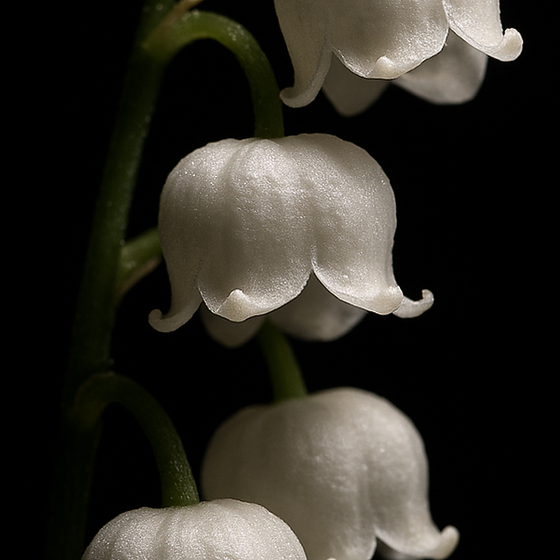
Конвалія

СинтетичнийКВІТИквітковий · свіжий · солодкий
Ноти серцяПіраміда
—Сила
—Стійкість
—Походження
Зразок
Конвалія як парфумерна сировина
Ноти серця
Convallaria majalis
Визначення

Lily-of-the-valley is the scent of Convallaria majalis, a Eurasian woodland plant with sweetly scented, bell-shaped white flowers. Perfumes have been based on its scent, although no aromatic extract can be produced from the plant itself.

КВІТКОВИЙ ЗЕЛЕНИЙ СОЛОДКИЙ ВОДЯНИСТИЙ ВОСКОВИЙ
Lily of the valley
Type
Складник
Olfactive family
Квіткові
Інструменти
Піраміда
ВВерхні ноти
СНоти серця
ББазові ноти

Запах

Hydroxycitronellal is described as sweet floral, lily, green, waxy and tropical, with slight melon and citrus undertones. Bourgeonal has a fragrance reminiscent of lily of the valley, otherwise described as floral, watery, green and aldehydic.

The (R)-enantiomer of Lilial has a strong floral odor, reminiscent of cyclamen or lily of the valley, whereas the (S)-enantiomer possesses no strong odor. The flowers of the plant itself are sweetly scented.

Докладно

The plant

Lily-of-the-valley (Convallaria majalis) is a Eurasian woodland plant. It grows to 15-35 cm (6-14 in) tall and produces racemes of pendulous, bell-shaped white flowers. Flowering is in late spring, typically May to June in Britain. The plant is used in floristry.

It is a herbaceous perennial that often forms extensive colonies by spreading underground stems called rhizomes. Each stem carries two, rarely three, leaves that are 5-20 cm (2-8 in) long and 3-7 cm (1-3 in) broad. The flowering stems bear a one-sided raceme of six to twelve pendulous flowers on the upper part of the stem. Each flower has six white tepals, rarely pink, fused at the base into a bell with reflexed tips, and measures 5-10 mm (0.2-0.4 in) across. The berry holds an average of 3.9 large whitish to brownish seeds, persists for an average of 47.5 days, and averages 85.8% water. In the APG III system the genus is placed in the family Asparagaceae, subfamily Convallarioideae, a group formerly treated as the family Ruscaceae.

Toxic constituents

The plant is highly poisonous if consumed, because of its concentration of potent cardiac glycosides (cardenolides). The fruit is a poisonous small orange-red berry approximately 5-7 mm (0.2-0.3 in) in diameter. Convallatoxin is a natural cardiac glycoside found in the plant. Convallatoxin has the formula C₂₉H₄₂O₁₀ and a molar mass of 550.645 g/mol. It inhibits the Na+,K+-ATPase, as other digitalis-like compounds do. Its therapeutic index is very small, so the margin between a therapeutic dose and an overdose is narrow.

Aroma chemicals of the muguet note

Hydroxycitronellal derives from citronellal and belongs to the class of organic compounds known as medium-chain aldehydes. Lilial is a trade name for lily aldehyde, also known as lysmeral or lilestralis. It was once produced synthetically on a multi-ton scale for use as a perfume in cosmetic preparations and laundry powders. Like most aldehydes, Lilial tends to oxidize on storage.

Bourgeonal is an aromatic aldehyde used in perfumery. It is a colorless liquid, although commercial samples can appear yellow. Hydroxymethylpentylcyclohexenecarboxaldehyde (HMPCC) is a synthetic fragrance known by the trade names Lyral, Kovanol, Mugonal and Landolal. It is found in some soaps, eau de toilettes, aftershaves and deodorants. Lyral is known to act as a skin allergen.

Chemical data of the main aroma chemicals

Hydroxycitronellal is 7-hydroxy-3,7-dimethyloctanal; its formula is C₁₀H₂₀O₂, its molar mass 172.26 g/mol and its density 0.922 g/cm³. Its condensation product with indole is called Indolene, and its Schiff base with methyl anthranilate is called Aurantiol.

Lilial is 3-(4-tert-butylphenyl)-2-methylpropanal, an aromatic aldehyde with the formula (CH₃)₃CC₆H₄CH₂CH(CH₃)CHO and a molar mass of 204.313 g/mol. It occurs naturally in crow-dipper and tomato plants. It is a clear viscous liquid with a density of 0.94 g/cm³, a melting point of -20 °C and a boiling point of 275 °C. It dissolves in water only to 0.045 g/L at 20 °C and has a log P of 4.36. It is also used as an intermediate in the synthesis of the agrochemicals fenpropimorph and fenpropidin.

Bourgeonal is 3-(4-tert-butylphenyl)propanal, with the formula (CH₃)₃CC₆H₄CH₂CH₂CHO, a molar mass of 190.286 g/mol, a density of 0.938 g/cm³ and a boiling point of 265.1 °C. As of 2010, bourgeonal is the only known odor substance to which males have a higher average sensitivity than females.

HMPCC has the preferred IUPAC name 4-(4-hydroxy-4-methylpentyl)cyclohex-3-ene-1-carbaldehyde, the formula C₁₃H₂₂O₂, a molar mass of 210.317 g/mol and a density of 0.995 g/mL at 20 °C. It is commonly tested for in patients undergoing patch testing.

Цікавий факт

Roughly 38 different cardiac glycosides, highly toxic if consumed by humans or animals, occur in lily-of-the-valley. In a 2003 study, bourgeonal acted in vitro as a chemo-attractant for human spermatozoa, leading them to swim twice as fast.

Отримання й хімія

Спосіб отримання

No essential oils can be obtained from the actual flowers. Lilial is produced by the mixed aldol coupling of 4-tert-butylbenzaldehyde and propionaldehyde, followed by hydrogenation. Industrial synthesis of bourgeonal involves a mixed aldol reaction of 4-tert-butylbenzaldehyde and acetaldehyde, followed by hydrogenation. Bourgeonal may alternatively be produced by the Heck reaction of 1-bromo-4-tert-butylbenzene with 2-hydroxymethylpropene, followed by isomerisation. Lyral is typically made from myrcene by a Diels-Alder reaction with acrolein, which produces the cyclohexenecarbaldehyde group. Acid-catalyzed hydration then completes the synthesis by forming the tertiary alcohol.

Формула
Synthetic accord; key molecules: hydroxycitronellal C₁₀H₂₀O₂ (MW 172.26), Bourgeonal C₁₃H₁₈O (MW 190.286), Lilial C₁₄H₂₀O (MW 204.313)
CAS
107-75-5 (hydroxycitronellal)
Ботанічна назва
Convallaria majalis
Зовнішній вигляд
Colorless to pale yellow clear oily liquid (hydroxycitronellal)
Синоніми
Lily of the valley
Статус IFRA
Див. примітку

No IFRA Standard for the material itself (51st Amendment)

Фізичні властивості
Нота
Convallaria majalis; no aromatic extract can be produced from the plant itself

У парфумерії

Lilial was used in many perfumes produced before 2022 as a synthetic substitute for the scent of lily of the valley. Because of the ban on Lilial, safe analogues are currently used in perfume production. Hydroxycitronellal is an odorant used in perfumery. No PREMIEREPEAU fragrance currently features a dominant muguet accord, though traces of hydroxycitronellal appear in many modern fine fragrance formulations as a background modifier.

Роль у формулі
01підсилювач дифузії
02модифікатор
03фірмова нота
04компонент піднесення
05сполучний компонент
06формувач об’єму
Форми випуску
стандартна форма

Див. також

5 ноти