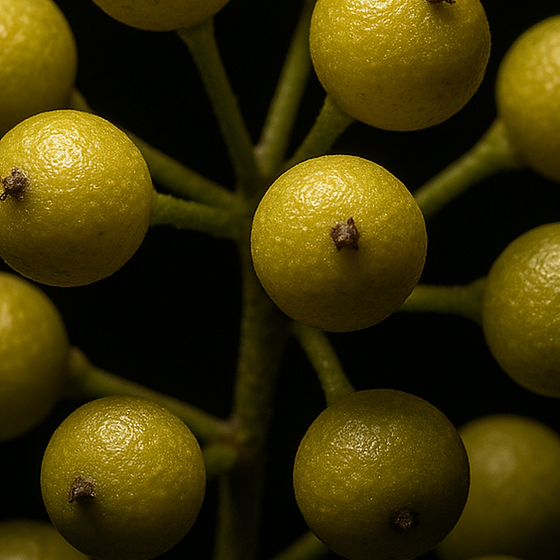
Літсея кубеба

НатуральнийЦИТРУСОВІ ЗАПАХИсвіжий · цитрусовий · фруктовий
Верхні нотиПіраміда
—Сила
—Стійкість
4Походження
Зразок
Літсея кубеба як парфумерна сировина
Верхні ноти
Litsea cubeba
Визначення

Litsea cubeba, also called may chang or mountain pepper, is an evergreen tree of the family Lauraceae whose fruit is processed for a lemony essential oil. The oil is a pale yellow liquid with an intensely lemonlike, spicy aroma.

КВІТКОВИЙ ЦИТРУСОВИЙ ТРАВ’ЯНИЙ СВІЖИЙ
May chang, mountain pepper, aromatic litsea, mujiangzi, douchijiang, maqaw
Type
Складник
Olfactive family
Цитрусові
Source
fruit
Chemical class
complex natural (essential oil)
Інструменти
Піраміда
ВВерхні ноти
СНоти серця
ББазові ноти
Країни-виробники
Китай Індонезія Тайвань В’єтнам

Запах

The oil has an intensely lemonlike, spicy aroma. It is also described as having an intense lemon-like, fresh, sweet aroma. Its main component, citral, has a strong lemon scent that presents as sharp, lemon, sweet, fresh, juicy, lemon peel, tart and green. Neral and geranial, which make up most of the oil, differ slightly: neral has a less sweet citrus, lemon, lemon peel note, whilst geranial is described as citrus, lemon.

Теруар і варіації

Докладно

Litsea cubeba is a species of evergreen tree in the family Lauraceae. It produces a fruit which is processed for its lemony essential oil. The plant is a shrub that grows up to 5-12 meters high. The genus Litsea has about 622 species, of which 74 grow in China. The oil's main component is citral, at 70-85% of the oil.

Terroir and Sourcing

The tree is native to Assam, Bangladesh, Borneo, Cambodia, Taiwan, Thailand and Vietnam, among other places. The oil is mainly produced in China from plantations. China is a major producer of the oil, with an annual output of 1500-2000 tonnes. Chinese customs reported that the total export volume of the oil from 2019 to 2023 reached 1682 tonnes. The highest yield of essential oil is from the fruit. The oil can also be extracted from the leaf, but this is considered to be lower in quality.

Composition

Citral is an acyclic monoterpene aldehyde made of two geometric isomers, geranial and neral. Analysis of fruit oils from eight regions of China identified 59 compounds, the dominant components being monoterpenes (94.4-98.4%). The 59 compounds comprised 41 monoterpenes, 15 sesquiterpenes and three non-terpene compounds. Neral and geranial together made up 78.7% to 87.4% of the oil. Neral and geranial are cis-trans isomers of citral, and neral always occurred in higher quantities than geranial. D-limonene was a lesser constituent, at 0.7-5.3% of the oil. The composition varied significantly between regions, and even oils from the same province differed. In Litsea cubeba, the alcohol dehydrogenases LcADH28 and LcADH29 are important for citral accumulation, and the transcription factor LcMYB44 is a negative regulator of citral biosynthesis. LcADH28 shows higher activity against geraniol and LcADH29 against nerol.

Uses and Trade

In China, the Ministry of Health has approved the oil for use as a food additive in accordance with standard GB 2760-2007. Litsea cubeba is used extensively as a spice by the aboriginal peoples of Taiwan. The fresh green fruit is also eaten in salads, chutneys and pickles. Extracts of the bark, leaf, root and fruits have been used in traditional Chinese medicine for various diseases. The timber is sometimes used for making furniture and crafts. The oils are mostly exported to European and American countries for further purification and synthesis in value-added functional products. After solvent-free microwave extraction the peel can be removed completely, leaving kernels that are pressed for an oil used as a medium-chain saturated fatty acid feedstock.

Beyond Fragrance

The chemical industry uses the oil as a raw material for the synthesis of vitamin A and violet-like fragrances. Citral is a precursor in the industrial production of vitamin A, vitamin E and vitamin K. Citral is also a precursor to lycopene, ionone and methylionone. Condensed with acetone in an alkaline medium, citral gives pseudoionone, which is cyclized to ionone under acidic conditions. Citral usually serves as a recognized standard to evaluate the economic value of the oil in international trade.

Цікавий факт

Litsea plants are a secondary source of food for muga silk worms, and the creamy, glossy silk from cocoons fed with Litsea is five times more expensive than silk from the primary food plant. Citral from Litsea cubeba has also been used in food packaging films, where coatings with 20% citral had bactericidal effects against Escherichia coli and Staphylococcus aureus.

Отримання й хімія

Спосіб отримання

The oil can be commercially extracted from the fruit, flowers, leaves, bark and even roots by conventional hydrodistillation or steam distillation. In hydrodistillation, the plant material is immersed in a water-filled container and heated to a boil, the water-oil vapor is condensed, and the oil and water phases are separated. Essential oil yields from the fruit are 3-5%. Fruits from eight regions of China gave oil contents of 3.04% to 4.56% by hydrodistillation. In one study the fruits were air-dried, and 100 g of the dried material was hydrodistilled in a Clevenger-type apparatus for 5 h, after which no more essential oil was obtained. Solvent-free microwave extraction raised the yield of oil from June to August harvests by nearly 47% compared with hydrodistillation. It obtained 1.80 ± 0.08% of oil within 24 min, against 1.16 ± 0.07% yielded by hydrodistillation in 60 min. Vacuum fractional distillation and molecular distillation are effective ways of changing the chemical composition of the oil. In a vacuum fractional distillation of the oil, three distillates were collected at boiling temperatures ranging from 38 to 44, 44 to 76 and 76 to 97 °C.

CAS
68855-99-2
Ботанічна назва
Litsea cubeba
Зовнішній вигляд
Pale yellow, flowing liquid
Синоніми
May chang, mountain pepper, aromatic litsea, mujiangzi, douchijiang, maqaw
Статус IFRA
Див. примітку

No IFRA Standard for the material itself (51st Amendment)

Фізичні властивості
Температура кипіння
229°C (citral)
Температура спалаху
91°C (citral)

У парфумерії

The oil is used as a fragrance, especially in bar soap, and for flavouring in its own right. It is extracted from the fresh fruits as an enhancer of aroma in cosmetic products and in foods. It is also a raw material in the production of perfumes. Its main component, citral, is used as an aroma compound in perfumery. Citral is used to fortify lemon oil. Citral is also used to enhance the flavour and fragrance of perfumes, soaps, food and beverages. Together with citronellal, citral is a key component responsible for the lemon note, and citral is the preferred one. No confirmed presence in the current PREMIEREPEAU collection.

Роль у формулі
01модифікатор
02фірмова нота
03компонент піднесення
04сполучний компонент
05свіжість
Форми випуску
ефірна олія

Див. також

8 ноти