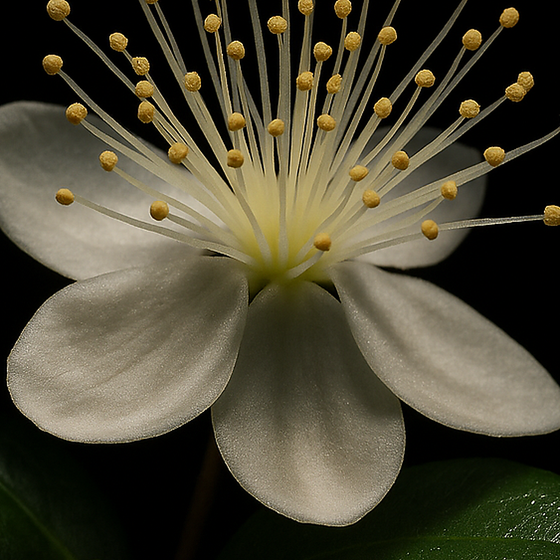
Мирт

НатуральнийЗЕЛЕНІ НОТИ, ТРАВИ Й ФУЖЕРНІ АКОРДИквітковий · свіжий · зелений
Верхні нотиПіраміда
3½/5Сила
—Стійкість
4Походження
Зразок
Мирт як парфумерна сировина
Верхні ноти
Myrtus communis
Визначення

Myrtle is the essential oil steam-distilled from the leaves and twigs of Myrtus communis, a Mediterranean evergreen shrub. Its aroma is fresh, menthol-like and terpenic.

Floral
93
Vert
81
Doux
37
Poudré
52
Fruité
29
Boisé
20
common myrtle, true myrtle
Type
Складник
Olfactive family
Ароматичні
Source
leaves and twigs
Chemical class
essential oil (natural extractive)
Інструменти
Піраміда
ВВерхні ноти
СНоти серця
ББазові ноти
3½/5Сила
Вище середньої
інтенсивність запаху
Країни-виробники
Туніс Туреччина Албанія Марокко

Запах

Myrtle oil emits a bright, diffusive freshness with menthol-like, terpenic and lemony aspects. Superior samples from Corsica and Tunisia show a slight floral softness and minimal harsh residue. Another description gives a fresh, herbal, fruity, penetrating aroma with clean rich camphor notes. A rectified Tunisian oil is described as an aromatic green bitter note with a sweet balsamic undertone and a slightly fir-tree woody background. One description, given for the oil at 100% concentration, lists fresh, fruity, spicy, allspice, camphoraceous, floral and herbal.

Теруар і переробка

Докладно

Myrtus communis, the common myrtle or true myrtle, is an evergreen shrub in the myrtle family, Myrtaceae. The plant is an evergreen shrub or small tree, growing to 5 metres tall. The leaves are 2-5 centimetres long and carry a fragrant essential oil. The flowers are white or tinged with pink, and the fruit is an edible berry that is blue-black when ripe. The species is native to southern Europe, North Africa, Western Asia, Macaronesia, and the Indian subcontinent. It grows wild in Algeria, Corsica, France, Italy, Morocco, Portugal, Sardinia, Spain, Tunisia, Turkey and Yugoslavia, among other places.

Myrtle oil's composition differs between origins and extraction techniques. Oil hydrodistilled from leaves of plants grown in Sardinia contained mostly α-pinene (generally 30.0%, in one case up to 59.5%), 1,8-cineole (15.9 to 41.7%, average 28.8%) and limonene (5.2 to 29.8%, average 17.5%). A hydrodistilled Spanish oil had a high content of myrtenyl acetate (35.9%) and 1,8-cineole (29.89%), and a low content of α-pinene (8.2%) and limonene (7.58%). A Greek oil extracted by steam distillation was rich in linalyl acetate (31.4%), limonene (21.8%), α-pinene (18%) and geranyl acetate (6.5%). For Iranian oil, the number and amount of compounds identified differed between hydrodistillation and supercritical carbon dioxide extraction.

The genus Myrtus was first described by Linnaeus in 1753 and has two accepted species, the common myrtle and the Saharan myrtle, Myrtus nivellei. Myrtle is described in Leviticus as part of the feast and observance of Sukkot.

In Jewish liturgy, the myrtle is one of the four species of Sukkot. Pausanias writes that the rose and the myrtle are sacred to Aphrodite. Myrtle in a wedding bouquet is a general European custom. In Sardinia and Corsica, Myrtus communis is macerated in alcohol to produce an aromatic liqueur called Mirto. Mirto comes in two varieties: mirto rosso, made from the berries, and mirto bianco, made from the less common yellow berries and sometimes the leaves. Many Mediterranean pork dishes include myrtle berries. The berries, whole or ground, have also been used as a pepper substitute.

Explore all seven extraits in the Discovery Set.

—

Related: Basil · Basil Oil · Clary Sage · Oregano · Rosemary · Rosemary Oil · Sage · Thyme

Отримання й хімія

Спосіб отримання

Myrtle oil is produced by steam distillation of the leaves and twigs of Myrtus communis. In some places the flowers, which are highly fragrant, are also included. In an industrial-scale study of steam distillation of the herbs, the optimum conditions were a boiler occupancy rate of 100%, a distillation duration of 75 min and a particle size of 20 mm. A higher boiler occupancy rate and a longer distillation seem to increase the oil volume, as does a smaller particle size of the leaves.

CAS
8008-46-6
Ботанічна назва
Myrtus communis
Зовнішній вигляд
pale amber clear liquid
Сила запаху
Medium-high
Синоніми
common myrtle, true myrtle
Статус IFRA
Див. примітку

No IFRA Standard for the material itself (51st Amendment)

Фізичні властивості
Відносна густина
0.94000 to 0.98000 @ 25.00 °C.
Показник заломлення
1.50110 to 1.51600 @ 20.00 °C.

У парфумерії

Myrtle oil functions as a top-note aromatic material. In cosmetics it serves as a perfuming agent. It lacks fixative properties. Because of its volatility and clean fade-out, it is often employed in complex top-note architectures that require energy without lingering intensity. In flavour, it is among the natural flavoring substances permitted for direct addition to food under United States food-additive rules, and its taste is described as spicy, terpenic, camphoraceous, citrus peel, eucalyptus and medicinal.

Роль у формулі
01модифікатор
02фірмова нота
03компонент піднесення
04сполучний компонент
05свіжість
Форми випуску
ефірна олія

Див. також

7 ноти