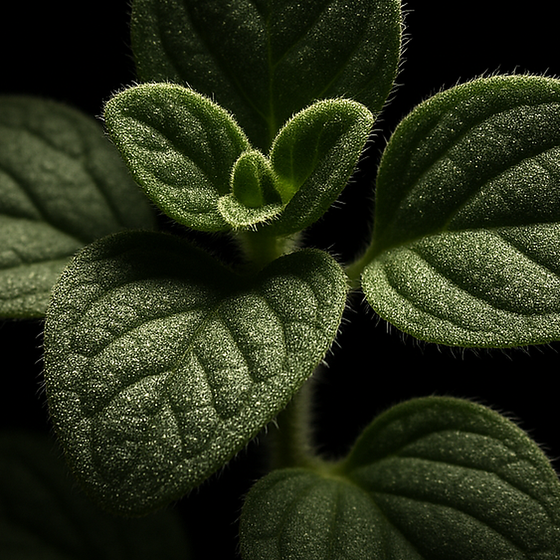
Орегано

НатуральнийЗЕЛЕНІ НОТИ, ТРАВИ Й ФУЖЕРНІ АКОРДИтеплий · зелений · свіжий
Ноти серцяПіраміда
—Сила
—Стійкість
—Походження
Зразок
Орегано як парфумерна сировина
Ноти серця
Origanum vulgare
Визначення

Oregano is Origanum vulgare, sometimes called wild marjoram, a species of flowering plant in the mint family, Lamiaceae. Its essential oil is composed primarily of monoterpenoids and monoterpenes.

ЗЕЛЕНИЙ ЗЕМЛИСТИЙ ПРЯНИЙ СОЛОДКИЙ ТРАВ’ЯНИЙ ТЕПЛИЙ СВІЖИЙ ПЕРЦЕВИЙ
wild marjoram
Type
Складник
Olfactive family
Ароматичні
Chemical class
complex natural (essential oil of monoterpenoids and monoterpenes)
Інструменти
Піраміда
ВВерхні ноти
СНоти серця
ББазові ноти

Докладно

The plant

Oregano is a woody perennial plant, growing up to 90 cm (35 in) tall. It is native to the Mediterranean region but widely naturalised elsewhere in the temperate Northern Hemisphere, particularly the United States and Mexico. Young stems are typically square and hairy and become woody with age. The flowers can be white, pink or light purple and are produced in clustered, erect spikes in summer. Oregano is used as a culinary herb, as is its close relative sweet marjoram (O. majorana). Many subspecies and strains of oregano have been developed by humans over centuries for their unique flavours or other characteristics. The common name oregano is given to more than 60 plant species of the Lamiaceae family and to members of other families, such as Verbenaceae. Lippia graveolens, called Mexican oregano, belongs to the verbena family.

Chemistry

The relative concentration of each compound in the oil varies widely across geographic origin and other factors. Over 60 different compounds have been identified in the oil, the primary ones being carvacrol and thymol, ranging to over 80%. Less abundant compounds include p-cymene, γ-terpinene, caryophyllene, spathulenol, germacrene D, β-fenchyl alcohol and δ-terpineol. Carvacrol is a monoterpenoid phenol. Thymol is a phenol derivative of p-cymene, isomeric with carvacrol. Greek oregano, the subspecies hirtum of Origanum vulgare, accumulates mainly the phenolic monoterpenes thymol and carvacrol, followed by their precursors p-cymene and γ-terpinene. In Origanum vulgare subsp. hirtum grown wild in Greece, carvacrol and thymol together account for 55-94% of the total oil content, as measured by direct GC-MS injection. In a study of 32 oils distilled from Greek oregano, carvacrol made up between 61.30% and 80.53% of the volatile fraction, averaging 71.67%. In the same oils thymol was present in a range of 0.98-2.33%, averaging 2.00%. In Origanum vulgare subsp. virens grown in Portugal, the putative chemotypes are carvacrol, thymol and linalool. In plants with a lower oil yield, the main constituents comprise acyclic compounds, mostly linalool, β-ocimene or β-myrcene. Marjoram from Turkey, a closely related plant, differs significantly in taste because phenolic compounds are missing from its essential oil.

History

Oregano appears in the earliest written traces of Greek medicine, the writings attributed to Hippocrates, with more than forty indications. According to mythology, the goddess Aphrodite created origanon on Mount Olympus as a symbol of well-being and joy. Crowning newlyweds with oregano is an ancient tradition, still occasionally alive nowadays.

Explore all seven extraits in the Discovery Set.

—

Related: Artemisia · Basil · Basil Oil · Bay Leaf · Chamomile · Clary Sage · Fig · Immortelle

Отримання й хімія

Спосіб отримання

In 32 distillations of Greek oregano, the yield of essential oil ranged from 0.3% to 2.7% w/w and averaged 1.44%. Distillation time strongly affected the oil yield and the carvacrol and thymol contents, while steam pressure and temperature had only a slight effect. Greek oregano is rich in essential oil, with more than 1.1% based on previous studies, while common oregano contains a lesser amount, not exceeding 0.8% of dry weight. In Portugal, yields of oil from O. vulgare subsp. virens ranged from below 0.05% to 3.3% for rooted cuttings. Younger plants give a lower oil yield than more developed ones, and full flowering attains the highest yield. Much higher concentrations of volatile compounds are achieved towards the end of the growing season. Drying of the plant material affects both the quantity and the distribution of volatile compounds, and methods using higher heat and longer drying times have a greater negative impact.

Формула
Complex natural mixture (key constituents: carvacrol C₁₀H₁₄O; thymol C₁₀H₁₄O; p-cymene; γ-terpinene)
CAS
8007-11-2
Ботанічна назва
Origanum vulgare
Зовнішній вигляд
Colourless to pale yellow liquid; some grades yellow-red to dark brown-red
Синоніми
wild marjoram
Статус IFRA
Див. примітку

No IFRA Standard for the material itself (51st Amendment)

Фізичні властивості
Температура кипіння
239 °C
Відносна густина
0.939 g/mL at 25 °C
Показник заломлення
1.508

У парфумерії

The predominance of phenolic monoterpenes in the oil gives the pungent characteristic oregano flavour, which is of higher commercial interest. Oregano is not featured in any current PREMIEREPEAU fragrance.

Роль у формулі
01модифікатор
02фірмова нота
03компонент піднесення
04сполучний компонент
05формувач об’єму
06свіжість
Форми випуску
ефірна олія

Див. також

8 ноти