Дубове листя

НатуральнийЗЕЛЕНІ НОТИ, ТРАВИ Й ФУЖЕРНІ АКОРДИземлистий · свіжий · зелений
Ноти серцяПіраміда
—Сила
—Стійкість
2Походження
Зразок
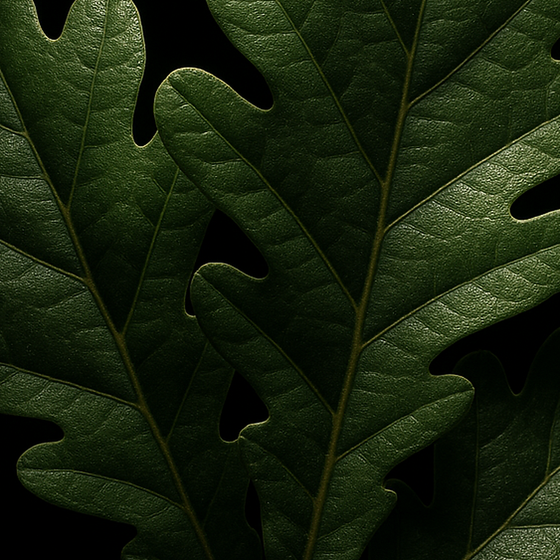
Дубове листя як парфумерна сировина
Ноти серця
Quercus spp.
Визначення

Oak leaves are the spirally arranged, often lobed leaves of oaks, hardwood trees or shrubs in the genus Quercus. They contain tannic acid.

КВІТКОВИЙ ЗЕЛЕНИЙ ЗЕМЛИСТИЙ СОЛОДКИЙ ТЕПЛИЙ СВІЖИЙ
Type
Складник
Olfactive family
Ароматичні
Source
Leaves of oaks (Quercus)
Chemical class
complex natural mixture (tannins)
Інструменти
Піраміда
ВВерхні ноти
СНоти серця
ББазові ноти
Країни-виробники
Європа Північна Америка

Докладно

Botany

Oaks have spirally arranged leaves, often with lobed edges, and bear a nut called an acorn. The genus Quercus is native to the Northern Hemisphere and includes deciduous and evergreen species. The leaves of pedunculate oak (Quercus robur) are dark green above and paler below. This species is native to Europe and western Asia. The leaves have a cordate base and 3-6 rounded lobes, divided no further than halfway to the midrib. By autumn they are often covered in small disks of spangle gall. In the Turkey oak section (Cerris) the leaves typically have sharp lobe tips with bristles, and in the Ilex oak section they are evergreen, with bristle-like extensions on the teeth. North America has the largest number of oak species, with approximately 160 in Mexico and about 90 in the United States, and China ranks second with approximately 100.

Tannins

The acorns and leaves of oaks contain tannic acid, which helps to guard against fungi and insects. Tannins are a class of astringent, polyphenolic biomolecules that bind to and precipitate proteins. Their astringency causes the dry and puckery feeling in the mouth that follows the consumption of unripened fruit, red wine or tea. Quercus tannins are a mixture of condensed and hydrolysable tannins. In Quercus rubra, the tannin composition is dominated by condensed tannins. Tannins are broadly classified into condensed tannins and hydrolysable tannins, and dicots can produce either type alone or as mixtures. In the oak family, Fagaceae, 73% of the species tested contain tannin. Tannins in senescent tissues also retain their ability to complex with proteins and inactivate soil enzymes. Climate changes the tannins of red oak leaves: under dry and ambient warm conditions the trees produced higher quantities of tannins that were less polymerized, while under wet conditions they produced lower quantities, with more polymerized condensed tannins. Gallic acid, ellagic acid and quercitrin are among the phenolic compounds found in Quercus robur.

Tanning

Vegetable tanning uses tannins, which occur naturally in the bark and leaves of many plants. Oak is one of the primary barks processed in bark mills and used in modern times. Tannins bind to the collagen proteins in the hide and coat them, which makes the hide less water-soluble and more resistant to bacterial attack.

—

Related: Acronychia Pedunculata · Adoxal · Agave · Algae · Aloe Vera · Aromatic Notes · Asparagus · Avocado

Отримання й хімія

Спосіб отримання

The supernatant of the five extractions is pooled into one extract.

Формула
Complex natural mixture (key constituents: condensed tannins; hydrolysable tannins)
Ботанічна назва
Quercus spp.
Статус IFRA
Див. примітку

No IFRA Standard for the material itself (51st Amendment)

Див. також

8 ноти