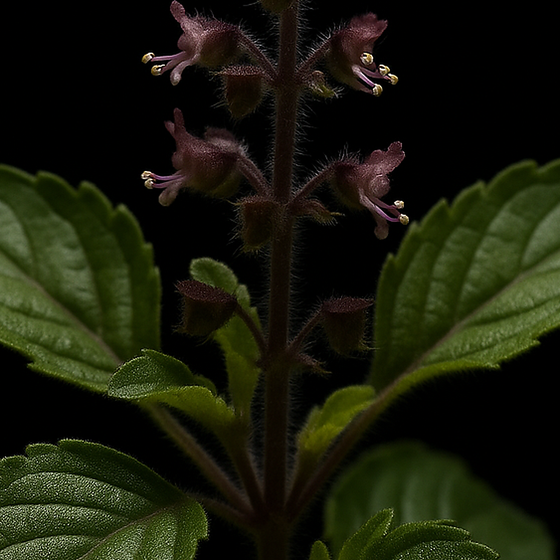
Tulsi (Ocimum tenuiflorum, syn. O. sanctum) is holy basil, an aromatic perennial plant of the family Lamiaceae. It is native to tropical and subtropical regions of Asia, Australia and the western Pacific. Holy basil is an erect, many-branched subshrub, 30-60 cm (12-24 in) tall with hairy stems. The leaves are green or purple and strongly scented. The purplish flowers are placed in close whorls on elongated racemes. The three main morphotypes cultivated in India and Nepal are Ram tulsi, the less common purplish green-leaved Krishna or Shyama tulsi, and the common wild vana tulsi.
The plant and its oil contain diverse phytochemicals, including tannins, flavonoids, eugenol, caryophyllenes, carvacrol, linalool, camphor and cinnamyl acetate, among others. Essential oil compositions and aroma levels vary among holy basil genotypes. The essential oil of Ocimum tenuiflorum is characterized by a high percentage of methyl eugenol and eugenol. Some studies report camphor (32%), eucalyptol (19%), ⍺-bisabolene (17%), eugenol (14%), germacrene (11%) and β-bisabolene (11%) as aroma compounds of the essential oil. Other studies state that tulsi essential oil consists mostly of eugenol (70%), β-elemene (11%), β-caryophyllene (8%) and germacrene (2%), with the balance made up of various trace compounds, mostly terpenes. More than 60 different aroma compounds were found in holy basil by gas chromatography-mass spectrometry analysis. By comparison, the essential oil from European basil contains high concentrations of linalool and methyl chavicol (estragole), in a ratio of about 3:1.
Tulasi is cultivated for religious and traditional medicine purposes, and also for its essential oil. It is cultivated throughout the Southeast Asian tropics. It is also used as an herbal tea, a use common in Ayurveda. For centuries, the dried leaves have been mixed with stored grains to repel insects. The essential oil may have nematicidal properties against Tylenchulus semipenetrans, Meloidogyne javanica, Anguina tritici and Heterodera cajani.
In Thai cuisine the leaves, known as kaphrao, go into certain stir-fries and curries, such as phat kaphrao, a stir-fry of Thai holy basil with meats, seafood or rice. Two types are used in Thailand: a red one that tends to be more pungent and a white one for seafood dishes. In Minangkabau cooking, holy basil, called ruku-ruku, is used in dishes, particularly fish gulai, where the leaves enhance flavour.
Tulasi has a place within the Vaishnava tradition of Hinduism, in which devotees perform worship involving the plant or its leaves. Vaishnavites are also known as "those who bear the tulsi around the neck". The ritual lighting of lamps each evening during Kartik includes the worship of the tulsi plant. Tulasi Vivaha is a ceremonial festival performed between Prabodhini Ekadashi (the 11th or 12th lunar day of the bright fortnight of the Hindu month of Kartika) and Kartik Purnima (the full moon of the month). Tulasi has been used in Ayurvedic and Siddha practices for its supposed medicinal properties.
—
Related: Acronychia Pedunculata · Adoxal · Agave · Algae · Aloe Vera · Aromatic Notes · Asparagus · Avocado