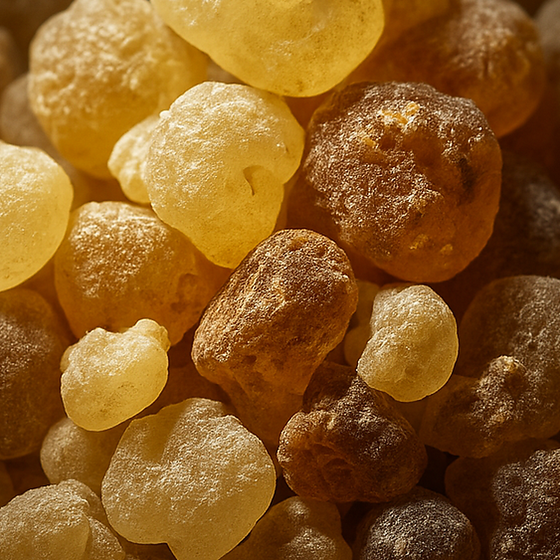
Boswellia trees belong to the family Burseraceae, and the oleo-gum resin of B. sacra is known as frankincense or olibanum. Several species of Boswellia produce frankincense, including B. sacra, B. frereana, B. serrata and B. papyrifera. B. carteri was long considered an independent species, but in the 1980s it was determined to be a synonym of B. sacra. B. sacra is native to Oman, Yemen, Somalia and Ethiopia. B. frereana is native to northern Somalia. Today 90 percent of the world's production of frankincense comes from the Horn of Africa.
The trees start producing resin at about eight to 10 years old. The resin is obtained by making a small, shallow incision in the trunk or branches of the tree, or by removing a portion of its crust. At every tapping of Boswellia papyrifera, a white emulsion exudes that dries and hardens into globular, pear or club shaped tears on exposure to air. Tapping is done two to three times per year, and the final taps give the best tears because of their higher aromatic terpene, sesquiterpene and diterpene content. Generally speaking, the more opaque resins are the best quality. Omani Boswellia sacra resin is sold as Houjri, Najdi and Sahli or Shaebi, names based on the places in Dhofar where the resin is harvested. Houjri, the first grade resin, has the lightest colour and a larger clump size, and is the most expensive.
Frankincense contains a gum similar to gum arabic, at 30-36%. Boswellia sacra frankincense contains 3-acetyl-beta-boswellic acid and alpha-boswellic acid. Incensole and its acetate ester, incensole acetate, are abundant components of frankincense. Incensole is a C20 diterpene alcohol. Incensole acetate is a macrocyclic diterpenoid and is considered a biomarker of Boswellia species. The chemistry of the essential oil is mainly monoterpenes and sesquiterpenes, such as alpha-pinene, limonene and beta-pinene. Steam distilled frankincense oils do not contain the insufficiently volatile boswellic acids, although they may be present in solvent extractions. In the oils of three Omani cultivars of Boswellia sacra, all three grades gave the highest value for alpha-pinene. In the Grade 1 oil of the Najdi cultivar, alpha-pinene made up 79.59%. The same species of plant behaves differently in the yield of active components of its essential oil under different environments.
References to incense from the land of Punt have been dated to the third millennium BCE. The Ebers Papyrus, from around 1500 BCE, provides some of the earliest evidence for frankincense used with intent as a possible therapy. The first recorded mention of frankincense was found on a tomb in Egypt dated to the 15th century B.C. Frankincense had made its impact on the ancient world, including Babylon, Egypt, Rome, Greece and China, by 1000 B.C. The Romans held frankincense to be the incense par excellence, and its high price reflected the enormous demand for it. In the 2nd century A.D., southern Arabia shipped more than 3000 tonnes of incense each year to Greece, Rome and the Mediterranean world. The Book of Exodus (30:34-38) prescribes frankincense, blended with equal amounts of three aromatic spices, to be ground and burnt on the sacred altar in the wilderness Tabernacle. Frankincense is mentioned in the New Testament as one of the three gifts, with gold and myrrh, that the magi presented to the Christ Child. Frankincense was introduced into church ceremonies at the beginning of Christianity. Its distinctive flavour is valued by chewing gum makers, and about 500 tonnes were imported into North African countries for chewing in 1987.
Recent studies indicate that frankincense tree populations are declining, partly from overexploitation. Heavily tapped trees produce seeds that germinate at only 16%, while seeds of trees that had not been tapped germinate at more than 80%. Burning, grazing, and attacks by the longhorn beetle have also reduced the tree population. Limited clinical studies have provided weak evidence for the use of frankincense resin in certain disease conditions, but the inconsistent, low quality of research remains inconclusive.
—
Related: Elemi Oil · Frankincense · Frankincense Oil · Olibanum Resinoid · Olibanum Sacra Resin Green