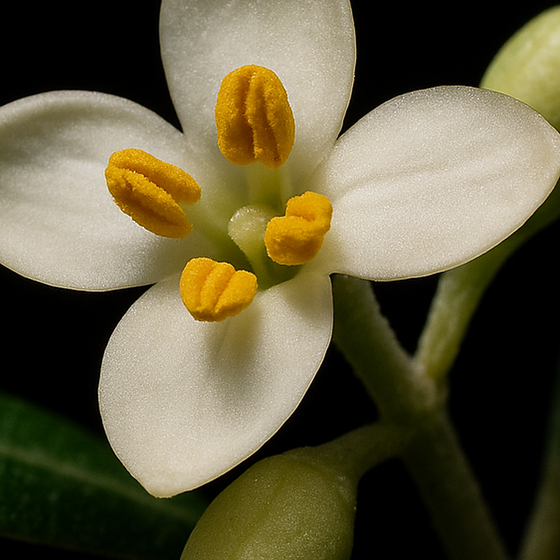
Small, white flowers are borne generally on the previous year's wood, in erect racemes springing from leaf axils. Each flower has four yellowish white petals fused at the bottom and joined to a base of four fused green sepals.
Botany
Olea europaea is the type species of the genus Olea, which lends its name to the Oleaceae plant family. The olive is andromonoecious: individual trees bear both hermaphrodite and staminate flowers. Staminate flowers result from pistil abortion. Hermaphrodite flowers have a small, greenish calyx, four white petals and two stamens with large anthers. A panicle carries a mean of 17 flowers, and the mean share of hermaphrodite flowers is 53.4%.
Flowering and pollination
The flower buds grow slowly for 4 to 6 weeks until they reach a length of about 2 cm and bloom. Blooming lasts 5-6 days in hot weather and 2 weeks in colder areas. Wind is the primary pollination vector, although bees occasionally collect olive pollen. Olive-tree pollen is extremely allergenic, with an OPALS allergy-scale rating of 10 out of 10.
Volatile compounds
Researchers at the Faculty of Science in Split have begun analysing the volatile compounds of the inflorescence of three olive varieties.
History
The olive has deep historical, economic, and cultural significance in the Mediterranean. It was first cultivated in the Mediterranean between 8,000 and 6,000 years ago. A comparison of plastid diversity in wild and cultivated olives indicates the cradle of first domestication in the northern Levant, followed by dispersal across the Mediterranean basin. Based on a combination of tree-ring and radiocarbon dating, olive trees have maximum ages between 300 and 500 years. Some research finds that most of the oldest trees had lived for up to 700 years.
Explore all seven extraits in the Discovery Set.
Related: Abelia · Almond Blossom · Alpha Terpineol · Alstroemeria · Alumroot · Amarillys · Amazon Moonflower · Amethyst Flower