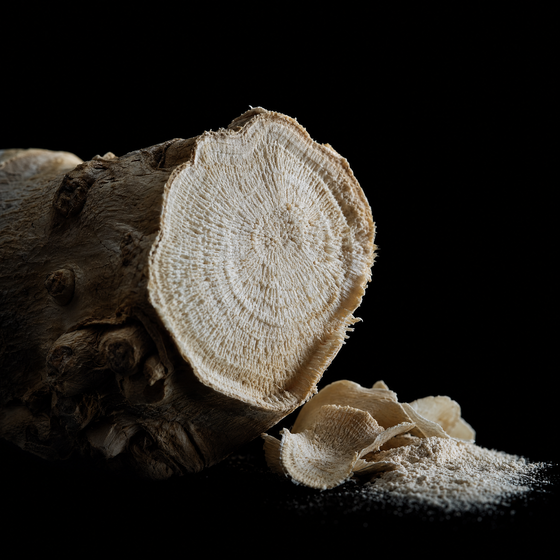
Orris root is the root of Iris germanica and Iris pallida. The rhizomes of the German iris and the sweet iris are traded as orris root and are used in perfume and medicine. Iris pallida, the Dalmatian iris or sweet iris, is native to the Dalmatian coast in Croatia. It is a bearded iris that grows from a rhizome. Iris × germanica is a natural hybrid involving a cross between Iris pallida and Iris variegata.
Constituents of orris root
The most valued component of orris root is oil of orris (0.1-0.2%), a yellow-white mass containing myristic acid. Oil of orris is sometimes sold as orris butter. Other components include fat, resin, starch, mucilage, bitter extractive, and a glucoside called iridin or irisin.
Irones
Irones are a group of methylionone odorants used in perfumery, derived from iris oil. Irone is a mixture of C14 monocyclic ketones obtained from the rhizomes of some Iris species, namely Iris florentina, Iris germanica and Iris pallida. The most commercially important irones are (-)-cis-γ-irone and (-)-cis-α-irone. Irones form through slow oxidation of triterpenoids in the dried rhizomes of Iris pallida. Irone is derived from triterpene precursors named iridals during the aging of peeled and/or sliced rhizomes. Alpha-irone has the formula C₁₄H₂₂O and a molecular weight of 206.32. The irone isomers present are indicative of the species. Essential oil from Iris germanica rhizomes from Morocco aged for two years had 62% cis-α-irone, 37% cis-γ-irone and 1% trans-α-irone, while Iris pallida essential oil had 61% cis-γ-irone, 34% cis-α-irone and 5% trans-α-irone.
Why orris takes years to make
After an initial drying period, which can take five years or more depending on the use, the root is ground. From planting to extraction, orris crops undergo at least a six-year cycle: three years until the rhizomes are harvested in the summer and approximately another three for aging the orris. To obtain black-type orris, harvested rhizomes are washed, sliced and dried. For white-type orris, they are peeled by hand and undergo slow drying for a few years. The drying of rhizomes begins by spreading the material in one layer in the sun before being placed in storage. This operation can also be performed artificially at 30-35 °C as an alternative to natural drying. In this time, the fats and oils inside the roots undergo degradation and oxidation, which produces many fragrant compounds that are valuable in perfumery.
Traditional aging of rhizomes is a slow desiccation process in which oxidative degradation of iridals leads to the slow accumulation of irones. The essential oil of Iris florentina rhizomes from Turkey aged for only 3 months had merely 4% α-irone and 8% γ-irone. Essential oil from Iris germanica rhizomes, also from Turkey, aged for around a year and a half to two years had 30-31% α-irone and 55-59% γ-irone. Patented methods can speed up the artificial aging of rhizomes to produce irones, among them chemical oxidation (for example with H₂O₂, KMnO₄ or nitrites), ionizing radiation, O₂/lipoxygenase, pressurized oxygen, thermal incubation at 50 °C, and bacteria and fungi, to name a few. However, there remains a preference for the naturally obtained product.
Where orris root comes from
Notable orris production comes from Morocco, with an estimated 120 tons of Iris germanica annually, China, with about 100 tons of Iris pallida, and France, with about 40 tons of Iris pallida. Italy was once the hallmark of orris production but is now limited to the areas of Chianti and Pratomagno in Tuscany, where less than 30 tons is produced annually. In Eastern Europe, several emerging countries have entered the orris market. Iris pallida is cultivated in the Chianti region of Italy for its fragrance and medicinal properties. Its successful cultivation is partly due to its ability to thrive in different environments, including different climates and nutrient-poor soils.
In Italy, irises were grown as an intercrop in vineyards and olive orchards and established on narrow and steep plots of land for which mechanization is unsuitable. In the summer of the third year, the plants are dug up entirely, and rhizomes are sold to the extraction companies as whole rhizomes, peeled or sliced. Industrial iris crops are established from rhizome segments of about 40 g with 2-3 shoots or buds. In September of the second or third year, plants can be harvested. The yield is about 10-20 tons of fresh rhizomes per hectare, and the yield for dry rhizomes is 2.5-3 tons per hectare.
Other uses of orris root
Orris root was once important in western herbal medicine. For hundreds of years, Iris pallida was used medicinally. Orris is also an ingredient in many brands of gin. For potpourri, the root powder is used without further processing. The dried rhizomes are also given whole to babies to help in teething. The rhizomes of Iris pallida are also used to make beads for children's teething necklaces as well as rosary beads.
Orris root is often included as one of the many ingredients of ras el hanout, a blend of herbs and spices used across the Middle East and North Africa, primarily associated with Moroccan cuisine. Orris root has been used in tinctures to flavour syrups, and its taste is said to be indistinguishable from raspberry. Orris root powder also had a use as the base in the making of nonpareils.
Orris root in perfumery
Doppel Dancers lists orris among its materials, with iris, pallida and florentina, next to pink pepper, ambrette, musk and sandalwood. The perfumer is Claire Liégent.
Find this note in PREMIEREPEAU: Doppel Dancers. Sample the extraits in the Discovery Set.