The compound
Pear ester is the common name of ethyl decadienoate, an organic chemical compound. Its IUPAC name is ethyl (2E,4Z)-deca-2,4-dienoate. Ethyl decadienoate is found in apples, Bartlett pears, Concord grapes, beer, pear brandy and quince.
The molecule has the formula C₁₂H₂₀O₂ and a molar mass of 196.29 g/mol. It is a colorless liquid that boils at 70-72 °C at 0.05 mmHg and has a flash point of 113 °C. It does not dissolve in water, but it dissolves in fat and in ethanol.
Pear ester and the volatiles of pears
Methyl and ethyl (E,Z)-2,4-decadienoate are two esters with a pear-like smell that are major volatile compounds in Bartlett and Beurre Bosc pears. In the Packham and longyuanyangli cultivars the same two esters were detected only at very low contents, under 0.53 ng/g.
In eight ripened pear varieties, esters comprise 60 to 98% of total volatiles. Hexyl acetate is the major ester in all of them except Bosc and Vicar of Winkfield, where butyl acetate is major, and Seckel, where ethyl 2,4 decadienoate is. Decadienoate esters were detected in all eight varieties, but they varied in amount and isomerization characteristics. Hexyl acetate has the formula C₈H₁₆O₂ and a molecular weight of 144.21.
A study of five pear cultivars identified 241 compounds, primarily esters, alcohols, aldehydes and alkenes. In it, acetates at high concentrations were the major ester constituents, including methyl, ethyl, n-propyl, butyl, pentyl, hexyl and heptyl acetate. Hexanal, (E)-2-hexenal and 1-hexanol are the dominant C6 compounds there, and C6 compounds are regarded as green leaf volatiles that contribute to the herbaceous odour in fruits. Esters are the major volatile components in P. ussuriensis and P. communis, while in P. pyrifolia aldehydes are the dominant volatile compounds.
In the same study, aldehyde concentrations were low except for acetaldehyde, hexanal and (E)-2-hexenal, and benzaldehyde was detected in all five cultivars. Sulfur-containing compounds such as ethyl 3-(methylsulfanyl)propanoate were also detected. Of the alkenes, α-farnesene is the only one found in all five cultivars, and it makes up the largest share.
The pear tree and its fruit
Pyrus communis, the common pear, is a species of pear native to central and eastern Europe and western Asia. It is the species from which most orchard pear cultivars grown in Europe, North America and Australia have been developed. 'Bartlett' (Williams) is the most common pear cultivar in the world, representing about 75% of US pear production. About 3,000 varieties of pears are grown worldwide, varying in both shape and taste.
The genus Pyrus was described by Carl Linnaeus in his Species Plantarum in 1753. The pear was cultivated by the Romans, who ate the fruits raw or cooked, just like apples. Pliny's Natural History noted three dozen varieties. In 2024, world production of pears was 27.6 million tonnes, led by China with 76% of the total. Pears are eaten fresh or cooked as a dessert, and fermented pear juice is called perry, which can be distilled to make a pear brandy. The wood of pear trees is a preferred material in the manufacture of high-quality woodwind instruments and furniture.
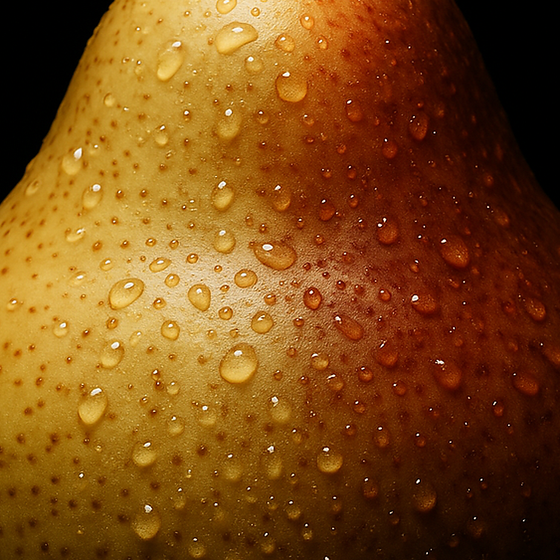
The word pear comes from Old English pere or peru, from Vulgar Latin pera, from Latin pirum. Most pear species are small or medium-sized trees, and a few are shrubs. The flowers are white, rarely tinted yellow or pink, and have five petals. The fruit is a pome, 1-4 cm across in most wild species but up to 18 cm long and 9 cm broad in some cultivated forms. The European pear has the classic pyriform shape, with an elongated base and a bulbous end.
Common pears are picked when mature but before they are ripe, and they store and ship well in that state if kept cold. Ethylene, a plant hormone, accelerates the ripening of pears. About 48% of the pears of the Southern Hemisphere come from the Patagonian valley of Río Negro in Argentina. Pear wood is close-grained and has also been used to make the blocks for woodcuts.
—
Related: Acai Berry · Acerola · Apple · Apricot · Banana · Blackberry · Blueberry · Cherry