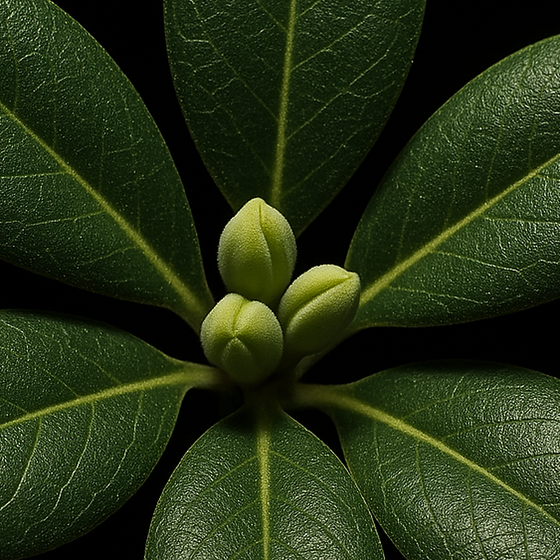
The plant
Pittosporum tobira is one of over 200 species of the genus Pittosporum, which also includes kōhūhū and tarata. The accepted name of the species is Pittosporum tobira (Murray) Aiton fil., in the family Pittosporaceae. It is an evergreen shrub that can reach 10 m tall by 3 m broad, and it can become treelike. It can also be trimmed into a hedge. It is native to Japan (south of Kanto), China, Taiwan, and Korea, but it is used throughout the world as an ornamental plant in landscaping and as cut foliage. Phylogenetic research suggests that P. japonicum, P. glabratum, P. illicioides and P. balfouri are its close relatives.
The genus
Plants of the genus are shrubs or trees, occasionally spiny, and the genus holds about 250 species. Other species include P. tenuifolium, called kōhūhū in New Zealand, and P. undulatum, called sweet pittosporum on the east coast of Australia. Across the genus the flowers sit singly or in cymes, and the white to yellow petals are fused at the base into a short tube. The fruit of the genus is a capsule with a single locule that opens to reveal angular seeds held in a sticky fluid.
Leaves, flowers and fruit
The leaves of P. tobira are oval with edges that curl under, reach up to 10 cm in length, and are leathery, hairless, darker and shinier on the upper surface. The inflorescence is a cluster of fragrant flowers at the ends of branches. The flowers are about 1 in. across, with creamy white petals that turn yellowish with age. The fruit is a hairy, woody capsule about 1 cm wide divided into three valves. Inside are black seeds in a bed of resinous pulp. The sticky substance around the seeds lets them stick to the beaks of birds and be carried over long distances. The fruits are not poisonous, but they are not edible.
Names and etymology
The genus name Pittosporum means 'pitch seed', from the Greek words for pitch and seed, and refers to the resinous substance around the seed. The species name tobira derives from the Japanese name for the plant. In Japan the plant is called tobera and in China hǎitóng huā. In German it is also called chinesischer Klebsame ('Chinese sticky seed') or Pechsame, and in Swedish glansbuske ('glossy shrubs').
Habitat and cultivation
Pittosporum tobira grows in forests, limestone areas, slopes, sandy seashores, and roadsides, usually to 1,800 m above sea level. In China it is found in Fujian province, and in Japan on Honshu, Kyushu, Shikoku and the Ryukyu Islands. It is also found in South Korea and northern Taiwan, and it has been introduced to parts of the United States, where it may be found in California, North Carolina, Georgia and Florida. In the gardens of the south of France, Italy and Dalmatia it is one of the commonest of evergreens, producing its flowers from April onwards. The blooms appear in late spring (April-May), starting out white and turning yellow upon pollination.
The shrub is not strictly hardy and needs wall protection at Kew, but in the south-western counties and at Castlewellan in Co. Down it grows well without protection. On the isle of Lokrum, near Dubrovnik, there are spreading bushes 20 to 25 ft high. It grows well in hardy zones 8-10, is easily transplanted, and tolerates drought, heat and salt spray. It withstands severe pruning, but the next season's blossoms appear on old growth. Cultivars include 'Compacta', 'Cream de Mint', 'Mojo', 'Variegata' and 'Wheeler's Dwarf'. The plant is vulnerable to the fungal pathogen Erythricium salmonicolor, which causes galls and the dieback disease known as pink limb blight, and it is frequently damaged by deer.
Garden use
The flowers form in clusters on a terminal umbel. Pittosporums are well suited for hedges and screens because of their rapid growth, dense foliage and resilience. They can be pruned into small, multi-stemmed trees by removing lower branches. Heavy, frequent pruning may mean sacrificing the fragrant flowers. Propagation is by semi-hardwood cuttings taken from mid-July to September.
Chemistry of the seeds
Seeds of P. tobira collected in southwestern Tunisia gave 0.84% essential oil by hydrodistillation. Nineteen components, making up 89.494% of the oil, were identified. The oil is mainly oxygenated sesquiterpenes (57.517%), followed by sesquiterpene hydrocarbons (11.794%) and oxygenated monoterpenes (6.659%). Headspace microextraction gave a similar pattern, with spathulenol, at 51.45%, the main sesquiterpene. Earlier work on the flowers of plants growing in Iran, using hydrodistillation, found α-pinene as the major component of their oil.
Range of the genus
Plants of the genus are native to parts of southern Africa, Madagascar, Saudi Arabia, Yemen, Pakistan, India, China, Korea, Japan, Southeast Asia, New Guinea, Australia, New Zealand and some Pacific Islands. The related P. undulatum is likely pollinated by moths and butterflies, since its flower produces a fragrant perfume at night. Its natural range ran from south-east Queensland to eastern Victoria.
—
Related: Abelia · Almond Blossom · Alpha Terpineol · Alstroemeria · Alumroot · Amarillys · Amazon Moonflower · Amethyst Flower