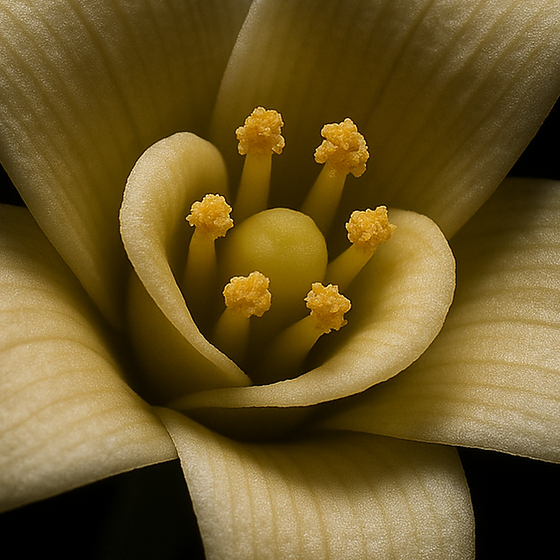
The tree and its flowers
Santalum album is an evergreen tree that grows between 4-9 metres. The tree starts to flower after seven years. The seeds are distributed by birds. Santalum album is commonly known as the white sandalwood or Indian sandalwood. The light green calyx gradually turns dark red.
The tree occurs from coastal dry forests up to 700 metres elevation and normally grows in sandy or well drained stony red soils. It rarely lives more than 100 years.
The plant parasitises the roots of other tree species, with a haustorium adaptation on its own roots, but without major detriment to its hosts. It is native to Indonesia (Java and the Lesser Sunda Islands), the Philippines and Western Australia.
The species is classed as vulnerable by the IUCN. Over-exploitation, habitat degradation, fire and spike disease are the main threats.
Heartwood and oil
The sapwood of the tree is unscented. The trunk of the tree starts to develop its fragrance after about 10 years of growth, but is not ready to harvest till after 20. The heartwood is yellow-brown, hard and oily in texture, while the sapwood is white or yellow.
In sandalwood oil from Santalum species, α-santalol is the larger fraction, at around 55%, and β-santalol the lesser, at around 20%. Alpha-santalol has the molecular formula C₁₅H₂₄O and a molecular weight of 220.35.
Sandalwood oil has a distinctive soft, warm, smooth, creamy, and milky precious-wood scent. Its quality and scent profile is greatly influenced by the age of the tree, location and the skill of the distiller.
Oil from the roots of the tree contains about fifty-three volatile compounds, mostly sesquiterpenols (78.5%). The seeds consist largely of ximenynic acid (79.0-82.8%), and the leaves contain flavonoids such as vitexin and isovitexin.
A variety of synthetic substitutes for sandalwood oil are commercially available, among them a number of campholenyl derivatives such as Brahmanol, Madrol, Sandranol, Ebanol, Sandalore, Firsantol, Polysantol and Javanol.
History
The use of S. album in India is noted in literature for over two thousand years. The species became naturalized in South India by at least 1300 BCE. It was introduced into the Dravidian regions of South Asia about 1500 BCE through the Austronesian maritime spice trade, together with areca nut and coconuts, and it appears in the archaeological record of the southern Deccan by 1300 BCE. The Indian government has banned the export of the timber.
Explore all seven extraits in the Discovery Set.