Валеріана

НатуральнийЗЕЛЕНІ НОТИ, ТРАВИ Й ФУЖЕРНІ АКОРДИземлистий · зелений · деревний
Базові нотиПіраміда
—Сила
—Стійкість
8Походження
Зразок
Валеріана як парфумерна сировина
Базові ноти
Valeriana officinalis
Визначення

Valerian (Valeriana officinalis) is an herbaceous perennial flowering plant in the family Caprifoliaceae, native to Europe and southwestern Asia. Its dried root holds a yellowish-green to brownish-yellow oil, and bornyl acetate is a major component of valerian oil.

ДЕРЕВНИЙ КВІТКОВИЙ ЗЕМЛИСТИЙ СОЛОДКИЙ ТРАВ’ЯНИЙ ТЕПЛИЙ СВІЖИЙ
Valerian root oil, valerian oil, Valeriana officinalis oil, valerian essential oil
Type
Складник
Olfactive family
Ароматичні
Source
roots
Chemical class
complex natural (essential oil)
Інструменти
Піраміда
ВВерхні ноти
СНоти серця
ББазові ноти
—Сила
надзвичайно сильна
надзвичайно сильна
Країни-виробники
Польща Бельгія Нідерланди Німеччина Чехія Україна Угорщина Сполучені Штати

Запах

Isovaleric acid, one of the main components of some valerian oils, has a strong pungent cheesy or sweaty smell. Bornyl acetate, a major component of valerian oil, is primarily responsible for the woody, pine, herbal, cedar, spicy, camphoraceous, mentholic odour of pine needle essential oil.

Теруар і переробка

Докладно

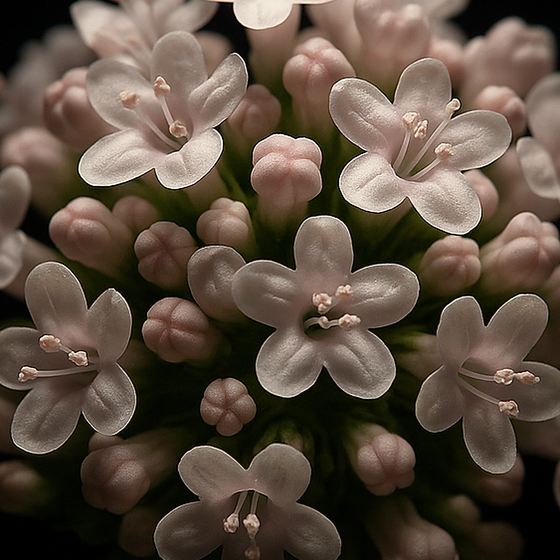
Valerian (Valeriana officinalis) is the type species of the genus Valeriana. The name of the herb comes from the personal name Valeria and the Latin verb valere (to be strong, healthy). The plant grows up to 1.5 m tall, rarely to 2 m. The flowers are produced from June to August and are sweetly scented, pale pink, occasionally white.

Valerian is native from Iceland south to Portugal, north to central Scandinavia, east to European Russia, and southeast to Iran. The plant is typically found in wet and dry meadows, wet woodlands, and marshes. The flowers attract many fly species, especially hoverflies of the genus Eristalis. The larvae of some butterfly and moth species, including the grey pug, feed on the plant. The young leaves can be cooked and the roots can be infused in hot beverages like hot chocolate. Valerian is considered potentially invasive by the US state of Connecticut, where it is officially banned.

Bornyl acetate is a major component of valerian oil. In total, 150 compounds were identified in the essential oils of 13 commercial samples of dried roots with rhizomes of V. officinalis from different countries. The principal compounds were bornyl acetate (1.6% to 27.1%), valeranone (0.5% to 17.9%), valerenal (0% to 14.7%), camphene (0% to 14.6%), α-fenchene (0% to 10.6%) and valerenic acid (0% to 8.5%). Isovaleric acid ranged from 0% to 44.6% in the same samples. In earlier studies of V. officinalis roots from Estonia and several other European countries, bornyl acetate reached up to 33.7%, α-fenchene 28.3% and valerianol 18.2%. Isovaleric acid was not detected in several samples, including those from Belgium, England, France, Hungary and the Netherlands. Three chemotypes were distinguished: bornyl acetate/valerenal, valeranone and isovaleric acid. Bornyl acetate, limonene and valeranone were consistently present in all 16 samples examined in one study and are proposed as marker compounds for the species. Monoterpenes are among the most prevalent constituents of the oil, notably borneol and its esters bornyl acetate and bornyl isovalerate. The European Pharmacopoeia sets a minimum essential oil concentration of 4 mL/kg and a minimum valerenic acid content of 0.17% (m/m), and only six of the 13 samples met the oil requirement.

Bornyl acetate (CAS 76-49-3), C₁₂H₂₀O₂, is the acetate ester of the terpenoid borneol. Valerenic acid (CAS 3569-10-6), C₁₅H₂₂O₂, is a sesquiterpenoid constituent of the essential oil of the valerian plant. Valeranone has the formula C₁₅H₂₆O and a molecular weight of 222.37. Sesquiterpenes contained in the volatile oil include valerenic acid, hydroxyvalerenic acid and acetoxyvalerenic acid. Alkaloids detected in valerian include actinidine, chatinine, shyanthine, valerianine and valerine. The plant also contains the flavanones hesperidin, 6-methyl apigenin and linarin, and iridoids including valepotriates.

Valerenic acid acts as a subtype-selective positive allosteric modulator of the GABA-A receptor. Valerenic acid may be at least partly responsible for valerian's sedative effects, together with hydroxyvalerenic acid and acetoxyvalerenic acid. Valerian supplements are often standardized to contain a particular amount of valerenic acid by weight, often 0.8%. Valerian is used as a herbal sedative which may be helpful in the treatment of insomnia. The plant contains the alkaloid actinidine.

—

Related: 4 Methylanisole · Almaciga · Arnica · Assam Tea · Calycanthus · Camphor · Canvas · Carvone

Цікавий факт

In medieval Sweden, valerian was sometimes placed in the wedding clothes of a bridegroom to ward off the "envy" of the elves. Valerian root is a cat attractant, containing attractant semiochemicals in a way similar to catnip. Its roots and leaves are one of three alternatives for the one-third of domesticated or medium-sized cats who do not feel the effects of catnip. The root has also been reported to be attractive to rats and has been used to attract members of the dog family to traps.

Отримання й хімія

Спосіб отримання

The dried root holds a yellowish-green to brownish-yellow oil, in amounts from 0.5 to 2.0%. A dry, stony soil yields a root richer in oil than moist, fertile soil. Isovaleric acid does not appear to be a natural constituent of Valeriana officinalis; it is a breakdown product created during the extraction process or by enzymatic hydrolysis during improper storage.

Формула
Complex natural mixture (key constituents: bornyl acetate C₁₂H₂₀O₂; valerenic acid C₁₅H₂₂O₂; valeranone C₁₅H₂₆O)
CAS
8008-88-6
Ботанічна назва
Valeriana officinalis
Зовнішній вигляд
yellowish-green to brownish-yellow oil
Сила запаху
надзвичайно сильна
Синоніми
Valerian root oil, valerian oil, Valeriana officinalis oil, valerian essential oil
Статус IFRA
Див. примітку

No IFRA Standard for the material itself (51st Amendment)

У парфумерії

The (-) enantiomer of bornyl acetate, a major component of valerian oil, is used as a food additive, flavouring agent and odour agent. Volatile esters of isovaleric acid, such as ethyl isovalerate, have pleasant odours and are used in perfumery.

Роль у формулі
01модифікатор
02фірмова нота
03сполучний компонент
04натуралізатор
05формувач об’єму
06свіжість
Форми випуску
ефірна олія

Див. також

7 ноти