


Sclareol
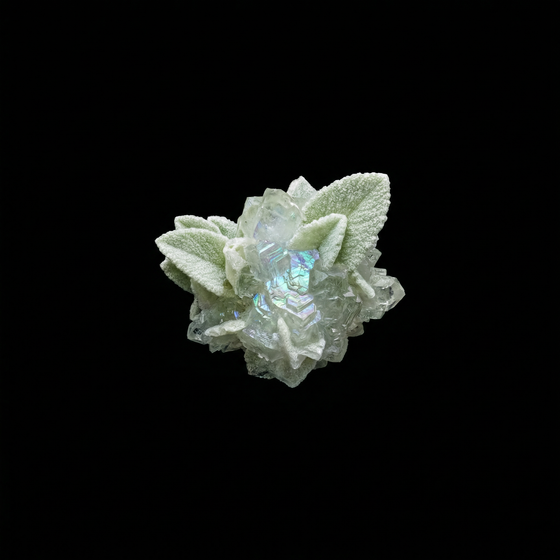
Sclareol ist ein labdanartiges Diterpen-Diol, das im Muskatellersalbei, Salvia sclarea, vorkommt. Als weißer kristalliner Feststoff mit bitter-krautigem, heuartigem Aromaprofil ist es ein etablierter Ausgangsstoff für Ambroxid und dessen Ambra-Charakter.
- Typ
- Zutat
- Duftfamilie
- Amber & Moschus
- Quelle
- Blütenstände des Muskatellersalbeis
- Chemische Klasse
- Labdan-Diterpen-Diol
Duft
Das Molekül — Hersteller & Varianten
Die ganze Geschichte
Wussten Sie schon?
Der Muskatellersalbei verbirgt den größten Teil seiner Sclareol-Produktion in winzigen Blütendrüsen. Eine Studie aus dem Jahr 2021, die eine nahezu haarlose Mutante mit chemischer Bildgebung kombinierte, ergab, dass große kopfige Drüsenhaare mehr als 90 % des in den Blütenkelchen produzierten Sclareols liefern.
Extraktion & Chemie
Extraktionsmethode
Kommerzielles pflanzliches Sclareol wird durch Lösungsmittelextraktion der Blütenstände oder des Strohs von Muskatellersalbei gewonnen, gefolgt von einer Reinigung. Die Wasserdampfdestillation gewinnt in erster Linie das ätherische Öl und ist für dieses schwerer flüchtige Diterpen ineffizient. In einem industriellen Vergleich aus dem Jahr 2012 lag die Ausbeute bei 0,01 Gewichtsprozent der trockenen Blütenstände durch Destillation, gegenüber 1,5 % durch direkte Fest-Flüssig-Extraktion von trockenem Stroh. Eine Studie aus dem Jahr 2023 fraktionierte ein wachsartiges n-Hexan-Konkret mit überkritischem CO₂: Bei 90 bar und 50 °C wurden zunächst leichtere aromatische Verbindungen gewonnen, anschließend bei 100 bar und 40 °C eine mit Sclareol und anderen Diterpenen angereicherte Fraktion. Die kumulative Extraktausbeute stieg von etwa 6,0 % auf 9,3 % der Konkret-Einwaage. Dabei handelt es sich um studiesspezifische Extraktausbeuten; die zweite Fraktion war ein Gemisch, wobei Sclareol 25,3 % der angegebenen GC-MS-Peakfläche ausmachte.
- Formel
- C₂₀H₃₆O₂
- CAS
- 515-03-7
- Botanische Bezeichnung
- Salvia sclarea L. (Muskatellersalbei)
- Aussehen
- Weißer kristalliner Feststoff
- Geruchsintensität
- Niedrig
- Beständigkeit
- 292 Stunden bei 100,00 %
- Synonyme
- (−)-Sclareol Labd-14-en-8,13-diol
Spezifikation — IFRA-Standard « Sclareol » (39. Änderung). Als Duftstoff verwendetes Sclareol muss eine Mindestreinheit von 98 % aufweisen.
- Siedepunkt
- 218,00 bis 220,00 °C bei 19,00 mm Hg
- Schmelzpunkt
- 105–107 °C (JECFA-Spezifikation)
- Flammpunkt
- 336,00 °F. TCC (169,10 °C) (geschätzt)
In der Parfümerie
Sclareol wird als Duftstoff und Aromastoff verwendet und ist ein etabliertes Ausgangsmaterial für Ambroxid. Sein Labdan-Grundgerüst lässt sich in den ambrigen, holzigen cyclischen Ether umwandeln, der für Ambra-Noten und zur Stützung der Basis eines Parfüms eingesetzt wird. Sclareol selbst wird auch als Fixativ in der Parfümerie beschrieben; seine Rolle als Vorstufe ist vom Geruch und der Leistung des fertigen Ambroxids zu unterscheiden.
Siehe auch
7 NotenQuellen
29- Efforts toward Ambergris BiosynthesisChem & Bio Engineering (2024)
- The bioactivities of sclareol: A mini reviewFrontiers in Pharmacology (2022)
- Study of the genetic and phenotypic variation among wild and cultivated clary sages provides interesting avenues for breeding programs of a perfume, medicinal and aromatic plantPLOS ONE (2021)
- SclareolPubChem
- Supercritical Fluid Extraction of Essential Oil and Sclareol from a Clary Sage ConcreteMolecules (2023)
- IFRA Standard: Sclareol — specification, Amendment 39 (2005)International Fragrance Association — minimum 98% purity
- SclareolWikipedia
- Salvia sclareaWikipedia
- AmbroxideWikipedia
- AmbergrisWikipedia
- Sclareol (CHEBI:9053): structure and chemical classificationEMBL-EBI — ChEBI
- (−)-Sclareol: JECFA No. 2029, specification for flavouringsFAO/WHO Joint Expert Committee on Food Additives, 73rd meeting (2010)
- Screening assessment: Sclareol, CAS 515-03-7 — identity, physical properties and usesEnvironment and Climate Change Canada / Health Canada (2017)
- Discovery and functional characterization of two diterpene synthases for sclareol biosynthesis in Salvia sclarea (L.) and their relevance for perfume manufactureCaniard et al., BMC Plant Biology 12, 119 (2012); doi:10.1186/1471-2229-12-119
- Extracellular Localization of the Diterpene Sclareol in Clary Sage (Salvia sclarea L., Lamiaceae)Caissard et al., PLOS ONE 7(10), e48253 (2012); doi:10.1371/journal.pone.0048253
- Sclareol and linalyl acetate are produced by glandular trichomes through the MEP pathwayChalvin et al., Horticulture Research 8, 206 (2021); doi:10.1038/s41438-021-00640-w
- Salvia sclarea L. — accepted name and native distributionRoyal Botanic Gardens, Kew — Plants of the World Online
- Salvia sclarea L. — general information and morphologyRoyal Botanic Gardens, Kew — Plants of the World Online, Flora of Iraq
- Terpenoids in the Essential Oil and Concentrated Aromatic Products Obtained from Nicotiana glutinosa L. LeavesPopova et al., Molecules 25(1), 30 (2020; online 2019); doi:10.3390/molecules25010030
- Terpenoid Compositions and Enantio-differentiation of Linalool and Sclareol in Salvia sclarea L. from Three Different Climatic Regions in IndiaYadav, Chanotiya and Singh, Journal of Essential Oil Research 22(6), 589–592 (2010); doi:10.1080/10412905.2010.9700406
- One-pot synthesis of (−)-AmbroxYang et al., Scientific Reports 6, 32650 (2016); doi:10.1038/srep32650
- Biocatalytic Process for (−)-Ambrox Production Using Squalene Hopene CyclaseEichhorn et al., Advanced Synthesis & Catalysis 360, 2339–2351 (2018); doi:10.1002/adsc.201800132
- Construction of an Artificial Microbial Consortium for Green Production of (−)-AmbroxideHe et al., ACS Sustainable Chemistry & Engineering 11(5), 1939–1948 (2023); doi:10.1021/acssuschemeng.2c06716
- Efficient Biotransformation of Sclareol to Sclareolide by Filobasidium magnum JD1025Fang et al., Applied Biochemistry and Biotechnology 195, 1184–1196 (2023); doi:10.1007/s12010-022-04225-8
- Process for producing diol and lactone and microorganisms capable of same — US4970163AFarbood, Morris and Downey, US patent published 13 November 1990; experimental Example II
- Odeur et Constitution III. Les substances bicyclohomofarnésiquesStoll and Hinder, Helvetica Chimica Acta 33, 1251–1260 (1950); doi:10.1002/hlca.19500330518
- Odeur et constitution IV. Sur les époxydes hydroaromatiques à odeur ambréeHinder and Stoll, Helvetica Chimica Acta 33, 1308–1312 (1950); doi:10.1002/hlca.19500330527
- A clary sage variety TatyanaShuvaeva, Gajtotina, Zelentsov and Moshnenko, Oil Crops 1(193), 109–115 (2023); Russian field-breeding study; doi:10.25230/2412-608X-2023-1-193-109-115
- Sage clary Russia essential oil, technical data sheet, product 00021730Producer's data sheet, issued 10 April 2023; source-plant and oil-origin corroboration, not a specification for isolated sclareol
