


Galbanum Oil
Keywords: green · bitter · resinous
Galbanum oil is the essential oil obtained by steam distillation of the dried resinous gum of Ferula gummosa. Its odour is green and slightly spicy.

- Olfactive family
- Aromatic · 510 entries of the glossary in this family Subfamily: Green notes · 93 entries in this subfamily Cluster: Green leafy notes · 420 entries in this cluster
- Material
- Natural Resin/gum
- Pyramid
- Top · Volatility: Top Note
- Strength
- High Step 4 of 5 · shared by 498 of 2,156 graded entries Graded entries at each step, from 1 to 5: 4, 119, 1,473, 498, 39. 23 more sit between two steps.
- Also called
- Ferula galbaniflua resin oil, Galbanum resin oil
Family, subfamily and cluster: PREMIEREPEAU house classification, version 2026‑11.
Galbanum Oil · Facets
Entries of the glossary that carry each facet, of 3,979:
- green 1,442
- earthy 660
- balsamic 343
- fresh 1,387
Galbanum Oil · Scent
The resin has an intense green scent accompanied by a turpentine odour. The initial notes are very bitter, acrid and peculiar, followed by a complex green, spicy, woody, balsam-like fragrance. When diluted, the scent has variously been described as reminiscent of pine, evergreen, green bamboo, parsley, green apples, musk, or simply intense green. The oil has a pine-like top note, which is less pronounced in the odour of the resinoid. The resinoid has a more woody, balsamic, conifer-resinous character. The oil is described as fresh, green, cortex, earthy, rooty, woody, balsam and metallic. Its odour is also described as balsamic and somewhat spicy.
Evolution over time
Galbanum Oil: scent over time.
- Immediately
Pine-like top note; very bitter, acrid and peculiar, with an intense green scent
Scent words: green · bitter - After a few hours
Complex green, spicy, woody and balsam-like
Scent words: green · balsamic · spicy · woody - After a few days
Dry green balsam with earthy, rooty and woody touches
Scent words: green · balsamic · woody · dry · earthy
- Tenacity
- 72 hrs. on smelling strip
Galbanum Oil · In Perfumery
Galbanum oil is used for creating green top notes in perfume compositions. The resinoid is used for the same purposes as the oil and has excellent fixative properties. Galbanum is occasionally used in the making of modern perfume. The debut of galbanum in fine modern perfumery is generally thought to be the origin of the “Green” family of scents.
Pyramid
Galbanum Oil: Top. Entries of the glossary stored at each place of the pyramid, of 4,006 (42 store no place):
- Top 718
- Top · Heart 497
- Heart 1,641
- Heart · Base 514
- Base 594
Role in the formula
Galbanum Oil: roles in the formula. Entries of the glossary that share each role, of 4,006:
- Top note lift 54
- Signature note 897
- Modifier 1,167
- Freshness 720
Galbanum Oil · Terroir & Origins
- Producing countries
- Iran
- Other countries of origin
- France
- Regions
- Middle East
Galbanum Oil · Extraction & Chemistry
The essential oil is obtained by steam distillation of the dried resinous gum. The gum is collected from a cut in the upper part of the uncovered roots. The resin contains approximately 15 to 26% essential oil. The soft Levant type is preferred because it contains far more essential oil, and the yield is generally in excess of 15%.
Available as
Galbanum Oil: available as.
- essential oil
- resinoid
- Appearance
- Colorless to yellowish brown clear liquid
Galbanum Oil · Did You Know?
Rashi (1040–1105) commented that galbanum is bitter and was included in the incense as a reminder of deliberate and unrepentant sinners. In the Talmud’s eleven-spice incense recipe, galbanum is one of four ingredients that each make up 19.02% of the total weight.
Galbanum Oil · In Depth
Plant and gum resin
Galbanum is an aromatic gum resin from certain umbelliferous Persian plant species of the genus Ferula, chiefly Ferula gummosa (synonym F. galbaniflua) and Ferula rubricaulis. Ferula gummosa is a perennial herb of the family Apiaceae, native to Iran and Turkmenistan. Plants that yield galbanum grow abundantly on the slopes of the mountain ranges of northern Iran. Ferula is a genus of about 220 species of flowering plants in the family Apiaceae, native to the Mediterranean region east to central Asia.
Production and types
Galbanum oil and galbanum resinoid are produced from the gum-like exudate of Ferula gummosa, which grows in northern Iran, and of Ferula rubricaulis, which grows in southern Iran. The annual yield of gum is about 50 t. Two types are distinguished commercially: soft Levant galbanum and hard Persian galbanum. The gum resin usually comes as hard or soft, irregular lumps, or occasionally as separate tears, in light-brown, yellowish or greenish-yellow shades.
Chemical composition
The gum resin contains about 8% terpenes, about 65% of a resin that contains sulfur and about 20% gum. The gum resin also contains a very small quantity of the colorless crystalline substance umbelliferone. Galbanum also contains α-pinene, β-pinene, limonene, cadinene, 3-carene and ocimene.
Galbanum oil contains 75% monoterpene hydrocarbons (α-pinene 5–21%, β-pinene 40–70%, 3-carene 2–16%) and about 10% sesquiterpene hydrocarbons. It also contains a fairly large number of terpene and sesquiterpene alcohols and their acetates. Minor components of entirely different structure, which have low odor threshold values, contribute strongly to the characteristic odor.
Resinoid and absolute
Galbanum resinoid is produced by extracting the gum with a nonpolar solvent. The solvent-free resinoid is a dark-amber viscous liquid whose odour is characteristic and balsamic. Galbanum absolute is a brown viscous liquid, obtained by solvent extraction from the gum oleo-resin, that easily resinifies over time even with minimal exposure to air. Galbanum is frequently adulterated with pine oil.
Explore all seven extraits in the Discovery Set.
Related: Green Pepper · Violet Leaf Absolute · Triplal · Cis-3-Hexenol (Leaf Alcohol)
Galbanum Oil · History
Biblical and ancient use
The ancient Egyptians highly treasured galbanum as a sacred substance. The Book of Exodus (30:34) mentions galbanum as used in making the Ketoret, the consecrated incense described in the Hebrew Bible and Talmud. The Book of Exodus lists galbanum among the components of that incense, together with stacte, onycha and pure frankincense. The rabbis of the Talmud expanded the description of the incense recipe from four ingredients in the Hebrew Bible to eleven.
Medical use and 1858 advice
Hippocrates employed galbanum in medicine, and Pliny ascribed extraordinary curative powers to it. In traditional Persian medicine, galbanum was used in preparations intended for respiratory complaints, digestive disorders, and topical applications. In 1858, Lola Montez recommended using a mixture of galbanum and pitch plaster attached to a leather strip for removing hair from body parts where it was unwanted.
Galbanum Oil · Technical Sheet
Identity
- Botanical
- Ferula gummosa Boiss. (syn. Ferula galbaniflua)
- Taxonomy
- Apiales order › Apiaceae family › Ferula genus · GBIF
- Botanical records
- Ferula gummosa: POWO, Ferula gummosa · IPNI, Ferula gummosa · GBIF, Ferula gummosa · Wikidata, Ferula gummosa · Wikipedia, Ferula gummosa
- IPNI
- Ferula gummosa Boiss., Diagn. Pl. Orient. ser. 2, 2: 92 (1856) — Pierre Edmond Boissier (1810–1885)
- Type
- Ingredient
- Category
- Greens, herbs and fougeres
In Nature
- Growth form
- Herb · POWO
- Native range
- Middle Asia · Western Asia · POWO
- Sample origins in GC-MS studies
- Iran (2 papers; one: Journal of essential oil research 2002, Iran)
- Wild or cultivated
- 1 native · 2 introduced · 9 cultivated among 167 records (the rest carry no such mark) · GBIF
- Recorded in
- 6 of 512 squares of the world grid; a brighter dot holds more records · GBIF
- Also from this genus
- Ferula: Galbanum · Asafoetida
- Also from this botanical family
- Apiaceae: Angelica · Angelica Root · Angelica Root Oil · Anise · Caraway · Carrot · 20 more entries
In Print
- Timeline
- first described 1856 · earliest aroma paper in Europe PMC, 2001
- In English books
- most mentioned in the 2010s · Google Books Ngram
Classification
- Chemical class
- Complex natural (essential oil)
Chemical data
- Most reported compounds
- Beta-Pinene (1 paper; one: Phytomedicine 2001, Beta-Pinene) · Alpha-Pinene (1 paper; one: Phytomedicine 2001, Alpha-Pinene) · Umbelliferone (1 paper; one: Chem Nat Compd 1991, Umbelliferone) · LOTUS
- Structure
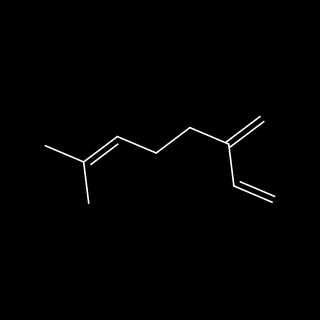
- Myrcene, Beta-Pinene:
Myrcene
PubChem, Myrcene
Beta-Pinene
PubChem, Beta-Pinene - CAS
- 8023-91-4
- INCI
- FERULA GALBANIFLUA RESIN OIL · ANTIMICROBIAL, TONIC, PERFUMING
- EC
- 296-925-4
- INCI names (CosIng)
- FERULA GALBANIFLUA GUM EXTRACT (ANTIMICROBIAL, TONIC, PERFUMING)FERULA GALBANIFLUA GUM (PERFUMING)
Labelling
- Forms in the EU cosmetic inventory
- Galbanum Oil: FERULA GALBANIFLUA RESIN OIL
- EU allergens reported
- Pinene
Physical properties
- Flash point
- 104.00 °F
- Specific gravity
- 0.86700 to 0.91600 at 25.00 °C
- Refractive index
- 1.47800 to 1.48700 at 20.00 °C
Performance and rules
- Strength
- High,recommend smelling in a 1.00 % solution or less
- Tenacity
- 400 Hour(s)
- IFRA status
- No IFRA Standard for the material itself (51st Amendment)
Galbanum Oil · See Also
Entries related to Galbanum Oil, by their place in the pyramid. “shared” marks a scent word Galbanum Oil has too.
Top notes

Shishito Pepper
green (shared) · spicy · vegetal Aromatic / Same cluster / Natural & Synthetic
Dynascone
green (shared) · fruity Green / Top · Heart / Same cluster / Synthetic
Green Sap
green (shared) · fresh (shared) · floral Green / Same cluster / Fantasy/Concept
Rosemary
aromatic · herbal · camphorous Aromatic / Top · Heart / Natural
Black Pepper
spicy · warm · aromatic Aromatic / Natural
Elemi Oil
resinous (shared) · citrus · fresh (shared) Resinous / Natural


Heart notes

Portulaca or Pigweed
green (shared) · earthy (shared) · fresh (shared) Aromatic / Same cluster / Natural
Buchu or Agathosma
fresh (shared) · green (shared) · fruity Aromatic / Same cluster / Natural
1,3,5-Undecatriene
green (shared) · herbal · gassy Green / Same cluster
Green Notes
green (shared) · fresh (shared) · fruity Green / Same cluster / Fantasy/Concept
Sage
aromatic · herbal · amber Aromatic / Natural


Galbanum Oil · Sources
- International Plant Names Index (IPNI) Ferula gummosa Boiss.
- IFRA Standards, 51st Amendment
- Wikipedia Galbanum
- Wikipedia Ketoret
- Wikipedia Ferula gummosa
- Wikipedia Ferula
Cite as PREMIEREPEAU Glossary, “Galbanum Oil”, https://premierepeau.com/
