


Cis-3-Hexenol (Leaf Alcohol)
Keywords: green · leafy · fresh
Cis-3-Hexenol (Leaf Alcohol): Cis-3-hexenol, also called leaf alcohol, is a colorless oily liquid with an intense grassy-green odor of freshly cut green grass and leaves.

- Olfactive family
- Green · 370 entries of the glossary in this family Subfamily: Green notes · 218 entries in this subfamily Cluster: Green leafy notes · 420 entries in this cluster
- Material
- Natural & Synthetic Occurs naturally in plants; sold in both natural and synthetic grades
- Pyramid
- Top · Volatility: Top Note
- Strength
- High Step 4 of 5 · shared by 498 of 2,156 graded entries Graded entries at each step, from 1 to 5: 4, 119, 1,473, 498, 39. 23 more sit between two steps.
- Also called
- Leaf alcohol, (Z)-3-hexen-1-ol, (Z)-hex-3-en-1-ol, green leaf alcohol, Hexenyl green
Family, subfamily and cluster: PREMIEREPEAU house classification, version 2026‑11.
Cis-3-Hexenol (Leaf Alcohol) · Facets
Entries of the glossary that carry each facet, of 3,979:
- green 1,442
- fresh 1,387
Cis-3-Hexenol (Leaf Alcohol) · Scent
The odor is green, grassy and melon rind-like, with a pungent freshness. At 10% in dipropylene glycol it is described as fresh, green, cut grass, foliage, vegetable, herbal and oily. Its strong odor resembles that of isoamyl alcohol and approaches the odor of green leaves when the material is highly dilute.
Evolution over time
Cis-3-Hexenol (Leaf Alcohol): scent over time.
- Immediately
Fresh, green and pungent
Scent words: fresh · green - After a few hours
Grassy cut-grass and foliage notes with a herbal side, and vegetable, oily and melon rind-like facets
Scent words: herbal
- Tenacity
- 4 hour(s) at 100.00 %
Cis-3-Hexenol (Leaf Alcohol) · In Perfumery
In fragrance formulation it is used to build green, fresh, outdoor-style scents, and in flavours to build fruit, vegetable and herbal profiles. Small amounts give fresh top notes in delicate floral fragrances such as muguet or lilac. In flavours it also adds sweet green notes to fruits, especially apple, pear, peach and tropical flavors.
Pyramid
Cis-3-Hexenol (Leaf Alcohol): Top. Entries of the glossary stored at each place of the pyramid, of 4,006 (42 store no place):
- Top 718
- Top · Heart 497
- Heart 1,641
- Heart · Base 514
- Base 594
Role in the formula
Cis-3-Hexenol (Leaf Alcohol): roles in the formula. Entries of the glossary that share each role, of 4,006:
- Top note lift 54
- Freshness 720
- Modifier 1,167
- Naturalness fewer than 40 entries
Cis-3-Hexenol (Leaf Alcohol) · Where It Is Made
- Producing countries
- China, Germany, Japan
Cis-3-Hexenol (Leaf Alcohol) · Extraction & Chemistry
Leaf alcohol can be isolated from the essential oils of various plants, but only in limited quantities, so the commercial material is mainly made by chemical synthesis. Other routes start from vinylacetylene or propargyl alcohol, and a second industrial process opens the ring of 6-methyl-3,6-dihydro-2H-pyran. Another natural grade is made by biotechnology, using sugar fermentation, bio-conversion and distillation.
Available as
Cis-3-Hexenol (Leaf Alcohol): available as.
- natural
- synthetic
- Appearance
- Colorless oily liquid
Cis-3-Hexenol (Leaf Alcohol) · Did You Know?
Cis-3-hexenol acts as an attractant to many predatory insects. Some synthetic green leaf volatiles, including (Z)-3-hexenol, induce gene expression in undamaged Arabidopsis thaliana plants.
Cis-3-Hexenol (Leaf Alcohol) · In Depth
Identity and occurrence
Cis-3-hexen-1-ol, also called leaf alcohol, has the molecular formula C₆H₁₂O and the IUPAC name (Z)-hex-3-en-1-ol. It is produced in small amounts by most plants.
Formation in plants
It belongs to the green leaf volatiles, which are organic compounds released by plants. On mechanical damage, plants form (Z)-3-hexenal, a C6 aldehyde, which is quickly reduced to the C6 alcohol (Z)-3-hexenol. The alcohol can be further converted to (Z)-3-hexenyl acetate by an acetyl transferase. Green leaf volatiles include the C6 aldehydes (Z)-3-hexenal and n-hexanal and their derivatives, among them (Z)-3-hexenol and (Z)-3-hexen-1-yl acetate.
Chemistry
Leaf alcohol is very slightly soluble in water and soluble in ethanol and ether. The related aldehyde cis-3-hexenal smells similar and even stronger, but it is relatively unstable and isomerizes into conjugated trans-2-hexenal.
Uses and perception
The global production volume is about 3000 tonnes. The esters of cis-3-hexen-1-ol are also important flavor and fragrance raw materials. A pair of single-nucleotide polymorphisms in the gene for the OR2J3 odor receptor strongly reduces human sensitivity to this odorant. The Joint FAO/WHO Expert Committee on Food Additives found no safety concern at current levels of intake when cis-3-hexen-1-ol is used as a flavouring agent.
Roles in plant defence
Some green leaf volatiles act as signalling compounds between plants of the same species, between plants of other species, and even between plants and insects. The green leaf volatiles also activate the expression of genes linked to the defence mechanisms of plants. They have antimicrobial properties that can prevent infection at the site of an injury.
Most healthy plant species do not release green leaf volatiles such as C6 aldehydes, alcohols or esters, but large amounts are emitted when plants are wounded. It is a common volatile compound emitted by most herbivore-damaged plants.
Explore all seven extraits in the Discovery Set.
Related: Melonal · Green Sap · Galbanum Oil · Galbanum · Chlorophyll · Forest Foliage · Cis-3-Hexenyl Salicylate · Cis-3-Hexenyl Butyrate
Cis-3-Hexenol (Leaf Alcohol) · History
The Joint FAO/WHO Expert Committee on Food Additives made its latest evaluation of cis-3-hexen-1-ol in 1998. In 2012, a study linked variation in the OR2J3 odor receptor gene to the ability to detect the grassy smell of cis-3-hexen-1-ol. Plant perception of volatiles from damaged neighbours was first reported in the early 1980s, in Sitka willow and poplar trees.
Cis-3-Hexenol (Leaf Alcohol) · Technical Sheet
Molecular weight
100.16084000 g/mol Heavier than 193 of the 536 other entries at the same place of the pyramid that store a weight.
2,515 entries store a molecular weight. By place in the pyramid: Top 537, Top · Heart 403, Heart 861, Heart · Base 452, Base 262.
Identity
- Botanical
- Mentha arvensis
- Taxonomy
- Lamiales order › Lamiaceae family › Mentha genus · GBIF
- Type
- Ingredient
- Category
- Greens, herbs and fougeres
Classification
- Chemical class
- Alkenol
Chemical data
- Formula
- C6H12O
- Structure
- Cis-3-Hexenol (Leaf Alcohol):
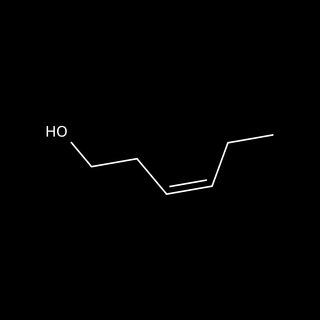 PubChem
- CAS
- 928-96-1
- Reported in plants
- Perilla frutescens (2 papers; one: J Agric Food Chem 2009, Perilla frutescens) · Artemisia annua (1 paper; one: J Nat Med 2007, Artemisia annua) · Camellia sinensis (1 paper; one: Phytochemistry 1973, Camellia sinensis) · Garcinia mangostana (1 paper; one: Phytochemistry 1982, Garcinia mangostana) · Olea europaea (1 paper; one: Phytochemistry 1998, Olea europaea) · LOTUS
- PubChem CID
- 5281167, compound record on PubChem
- InChIKey
- UFLHIIWVXFIJGU-ARJAWSKDSA-N
- Wikidata · Wikipedia
- Cis-3-Hexenol (Leaf Alcohol): Q300850, item on Wikidata · Wikipedia, English article
Physical properties
- Boiling point
- 156.50 °C. at 760.00 mm Hg
- Melting point
- −61 °C
- Flash point
- 142.00 °F. TCC (61.11 °C.)
- Specific gravity
- 0.84600 to 0.85000 at 25.00 °C.
- Refractive index
- 1.43600 to 1.45000 at 20.00 °C.
- Vapour pressure
- 1.039000 mm/Hg at 25.00 °C. (est)
- Log P
- 1.697 (est)
- Appearance
- Colorless clear liquid (est)
Performance and rules
- Strength
- High, recommend smelling in a 10.00 % solution or less
- IFRA status
- No IFRA Standard for the material itself (51st Amendment)
Cis-3-Hexenol (Leaf Alcohol) · See Also
Entries related to Cis-3-Hexenol (Leaf Alcohol), by their place in the pyramid. “shared” marks a scent word Cis-3-Hexenol (Leaf Alcohol) has too.
Top notes

Methyl 2-Octynoate (Violet Leaf)
green (shared) · violet · fresh (shared) Green / Top · Heart / Same cluster / Synthetic / 154.21 g/mol
Stems Greens
green (shared) · fresh (shared) · aromatic Green / Same cluster / Accord
trans-3-Hexen-1-ol
green (shared) · fatty · leafy (shared) Green / Same cluster / 100.16 g/mol
Shishito Pepper
green (shared) · spicy · vegetal Aromatic / Same cluster / Natural & Synthetic
Rose Leaf
green (shared) · leafy (shared) · fresh (shared) Aromatic / Top · Heart / Same cluster / Natural
Black Pepper
spicy · warm · aromatic Aromatic / Natural
Triplal
green (shared) · herbal · fresh (shared) Aromatic / Synthetic / 138.21 g/mol
cis-3-Hexenyl formate
green (shared) · waxy · apple Fruity / Top · Heart / 128.17 g/mol


Heart notes

Grape Leaves
fresh (shared) · green (shared) Green / Same cluster / Natural
Gyokuro Tea
green (shared) · fresh (shared) · rich Green / Same cluster / Natural
(E)-1-(1-Methoxypropoxy)
hex-3-ene
fresh (shared) · green (shared) · cortex Green / Same cluster / 172.26 g/mol
Violet Leaf
green (shared) · fresh (shared) · floral Green / Same cluster / Natural-
Violet Leaf Absolute
green (shared) · leafy (shared) · earthy Green / Heart · Base / Same cluster / Natural 
cis-3-Hexenyl propionate
green (shared) · apple · pear Green / Same cluster / 156.22 g/mol
(3Z)-Hexenyl tiglate
green (shared) · vegetable · fatty Green / Same cluster / 182.26 g/mol
Celery Seeds
fresh (shared) · green (shared) · aromatic Aromatic / Same cluster / Natural
Tea
green (shared) · aromatic · dry Aromatic / Heart · Base / Natural
Sage
aromatic · herbal · amber Aromatic / Natural
Trepanol
green (shared) · fresh (shared) Florals / Heart · Base / Synthetic / 156.26 g/mol
3-(cis-3-Hexenyloxy)
propanenitrile
green (shared) · fruity · tropical Fruity / Synthetic / 153.22 g/mol


Cis-3-Hexenol (Leaf Alcohol) · Sources
- International Plant Names Index (IPNI) Mentha arvensis L.
- Nature Communications (2023) Green leaf volatile sensory calcium transduction in Arabidopsis
- Scientific Reports (2012) Intermittent exposure to traces of green leaf volatiles triggers a plant response
- Plant Signaling & Behavior (2011) Roles of (Z)-3-hexenol in plant-insect interactions
- Proceedings of the National Academy of Sciences of the United States of America (2014) Intake and transformation to a glycoside of (Z)-3-hexenol from infested neighbors reveals a mode of plant odor reception and defense
- INCHEM JECFA Evaluations-cis-3-HEXEN-1-OL
- PubChem 3-Hexenol
- IFRA Standards, 51st Amendment
- The Good Scents Company (Z)-3-hexen-1-ol
- Wikipedia Cis-3-Hexen-1-ol
- Wikipedia Green leaf volatiles
Cite as PREMIEREPEAU Glossary, “Cis-3-Hexenol (Leaf Alcohol)”, https://premierepeau.com/
