


Transparent Flowers
Keywords: floral · fruity · fresh
Transparent Flowers: The use of Hedione, an aroma compound with an odor similar to that of jasmine, is considered the beginning of a new trend in perfumery towards transparency.
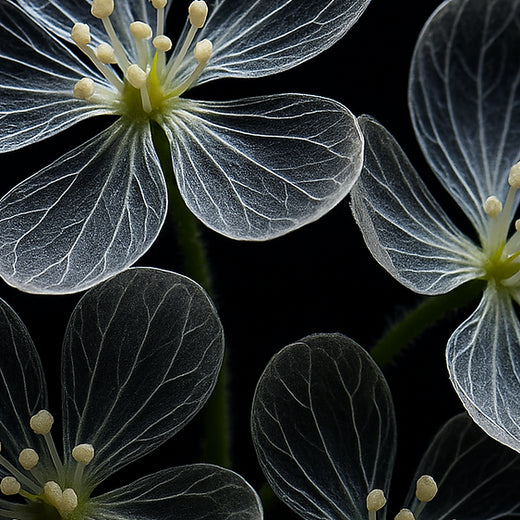
- Olfactive family
- Florals · 779 entries of the glossary in this family Subfamily: Fresh florals · 104 entries in this subfamily Cluster: Classic florals · 245 entries in this cluster
- Material
- Fantasy/Concept Synthetic (Hedione; muguet recreated synthetically)
- Pyramid
- Heart · Volatility: Heart Note
- Strength
- N/A — no measured strength for a fantasy accord Not on the graded scale
- Producing countries
- Asia, Europe
- Also called
- Fruity florals · Airy florals
Family, subfamily and cluster: PREMIEREPEAU house classification, version 2026‑11.
Transparent Flowers · Facets
Entries of the glossary that carry each facet, of 3,979:
- floral 1,546
- sweet 1,988
- fresh 1,387
Editorial note We own no rights to this material, its name or its trademark. This entry is independent editorial journalism, published under freedom of expression.
Transparent Flowers · Scent
In racemic mixtures the odor of Hedione is floral and citrus, while epimerized mixtures give a dense buttery-floral odor. The (R)-enantiomer of Lilial has a strong floral odor reminiscent of cyclamen or lily of the valley, while the (S)-enantiomer has no strong odor.
Aqueous Facets
Water lily reads as cool floral-water, lotus as creamy-aqueous-floral, cucumber as crisp-cool-vegetal-water and melon as juicy-water-fruity. Peony has soft, delicate floral notes with a slightly fruity hint. The delicate sweet odour of muguet is elegant and sophisticated but still lively and fresh.
Evolution over time
Transparent Flowers: scent over time.
- Immediately
N/A — no documented evolution for a fantasy accord
- After a few hours
N/A
Transparent Flowers · In Perfumery
Hedione is used in fine fragrances as well as cosmetics, toiletries and detergents. Hedione, Helional and cyclamen aldehyde are useful blending agents for muguet. Fixatives for muguet include indol, which gives depth without undue sweetness. Macro and polycyclic musks are useful in muguet. Aquatic notes generally contain Calone or synthetics such as Floralozone and Helional. They are also used to accent floral, oriental and woody fragrances.
Pyramid
Transparent Flowers: Heart. Entries of the glossary stored at each place of the pyramid, of 4,006 (42 store no place):
- Top 718
- Top · Heart 497
- Heart 1,641
- Heart · Base 514
- Base 594
Role in the formula
Transparent Flowers: roles in the formula. Entries of the glossary that share each role, of 4,006:
- N/A — no documented formula role 361
Transparent Flowers · Extraction & Chemistry
Modern synthesis condenses cyclopentanone and pentanal, isomerises the C=C bond to give the 2-pentylcyclopentenone derivative, then runs a Michael reaction with dimethyl malonate followed by decarboxylation.
Available as
Transparent Flowers: available as.
- synthetic accord
- fantasy note
Transparent Flowers · Did You Know?
Odor perception of Hedione in humans is very different from that of the vast majority of other odors, since it acts as a ligand for the vomeronasal type-1 receptor 1 (VN1R1) rather than an olfactory receptor.
Transparent Flowers · In Depth
Hedione is considered one of the compounds responsible for the projection of the scent in living flowers. In the 2010 version of the fragrance wheel, the Fresh family includes a Water subfamily of marine and aquatic notes, and the Floral family includes a Floral subfamily with fresh-cut flowers as its example.
Origin and Production
Lily of the valley, Convallaria majalis, is a herbaceous perennial native to Europe, Western Asia and Northern Asia, with white bell-shaped flowers that are sweetly scented. No natural aromatic extract can be produced from lily of the valley, so its scent must be recreated synthetically.
Chemistry
Methyl dihydrojasmonate, often referred to by its trade name Hedione, is an aroma compound with an odor similar to that of jasmine. It is a synthetic relative of methyl jasmonate, a naturally occurring compound in floral scents such as jasmine, tuberose and magnolia. Hedione has the formula C₁₃H₂₂O₃ and is a clear to pale yellow oily liquid.
Floralozone smells fresh, slightly ozonic and transparent, with a cool floral-water character that distinguishes it from the saltier Calone. Helional contributes a soft marine-floral-aqueous facet, lighter and more diffusive than Calone. At lower concentrations Calone delivers a cleaner, more aqueous-floral character.
Muguet odorants and substitutes
The main components of muguet are the rose alcohols citronellol, geraniol and nerol and their esters, phenyl ethyl alcohol and linalool, indol, and traces of cis-3-hexenol and its esters. Muguet flowers display a natural greenness, which is frequently replicated using cis-3-hexenol and cis-3-hexenyl benzoate. Hydroxycitronellal is traditionally the most representative of the muguet odorants, and in compounds up to 40% of it can frequently be found.
Lilial was used as a synthetic substitute for the scent of lily of the valley in perfumes produced before 2022. It was banned from use in cosmetics in the EU as of March 2022. Lilial is an aromatic aldehyde with the formula C₁₄H₂₀O, and it has been largely banned after being found to be harmful to fertility. Like most aldehydes, it tends to oxidize on storage.
Transparent Flowers · History
The first commercially successful fragrance to use Hedione was launched in 1966. Adding Hedione to a classically hesperidic fragrance construction created a dewy lemony magnolia-jasmine dimension without being directly floral. This is considered to be the beginning of a new trend in perfumery towards transparency and projection. Since 1945, new categories of scents have emerged thanks to great advances in compound design and synthesis. The aquatic category was the newest, first appearing in 1988.
Transparent Flowers · Technical Sheet
Identity
- Botanical
- N/A — abstract floral perfumery accord
- Type
- Accord
- Category
- Flowers
- Note
- Abstract floral perfumery concept. Sheer, diaphanous floral notes created with muguet, freesia-type molecules (Hedione, Lilial replacements)
Chemical data
- Formula
- N/A — abstract floral accord
Performance and rules
- IFRA status
- No IFRA Standard for the material itself (51st Amendment)
Transparent Flowers · See Also
Entries related to Transparent Flowers, by their place in the pyramid. “shared” marks a scent word Transparent Flowers has too.
Heart notes

Carambola Blossom
floral (shared) · fruity (shared) · fresh (shared) Florals / Same cluster / Fantasy/Concept
Fuchsia
floral (shared) Florals / Same cluster / Fantasy/Concept
Orchard Blossom
floral (shared) · fruity (shared) · fresh (shared) Florals / Same cluster / Fantasy/Concept
Mahonial
green · floral (shared) · muguet Florals / Same cluster / Synthetic
Orange Blossom
floral (shared) · honeyed · citrus Florals / Natural
Violet
floral (shared) · violet Florals / Natural & Synthetic
Rose
floral (shared) · honeyed · waxy Florals / Natural
Lily
floral (shared) · green · waxy Florals / Synthetic
Water Flowers
floral (shared) · fresh (shared) · aquatic Florals / Fantasy/Concept


Other entries · Place in the pyramid not stored

Carnation
floral (shared) · spicy · clove Florals / Same cluster / Natural

Transparent Flowers · Sources
- IFRA Standards, 51st Amendment
- Wikipedia Methyl dihydrojasmonate
- Wikipedia Lilial
- Wikipedia Perfume
- Wikipedia Lily of the valley
- Wikipedia Fragrance wheel
Cite as PREMIEREPEAU Glossary, “Transparent Flowers”, https://premierepeau.com/
