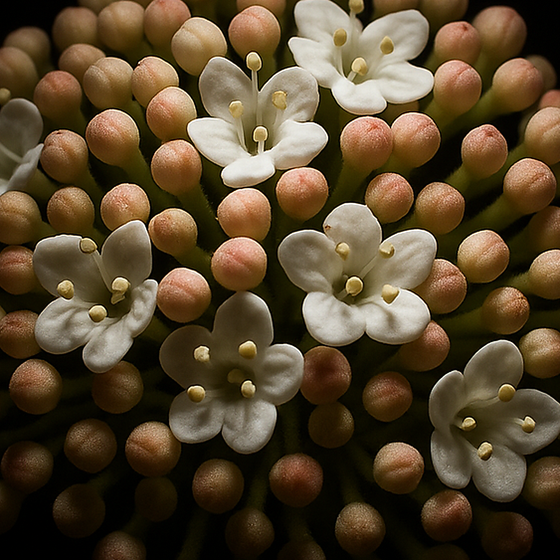
Viburnum is a genus of well over 100 species of shrubs or small trees, deciduous or evergreen, found mainly in the temperate regions of the northern hemisphere and extending into Malaysia and South America. Its family, Viburnaceae, is also called Adoxaceae. The genus was previously included in the family Caprifoliaceae. Each flower is white, cream or pink, small, and has five petals.
The fruit is a drupe that is red, purple, blue or black and contains a single seed. Some fruits are edible, but many others are mildly poisonous. The fruit of some species, such as V. lentago, can be eaten raw or made into jam. Other species, such as V. opulus, are mildly toxic and can cause vomiting if eaten in quantity. The bark of some species is used in herbal medicine, as an antispasmodic and to treat asthma.
Viburnum carlesii, the Korean spice viburnum, is native to Korea and Japan. Its round clusters of red buds open to strongly scented, pale pink flowers in late spring. Viburnum tinus is native to the Mediterranean area of Europe and North Africa. Viburnum opulus, the guelder rose, is a Eurasian and North American species.
Many species are popular as garden or landscape plants because of their showy flowers and berries, fragrance, and good autumn colour of some forms. The hybrid Viburnum × bodnantense is particularly popular for its strongly scented pink flowers on the leafless deciduous shoots in mid- to late winter.
Several species bear two kinds of flower in one inflorescence: a showy sterile flower made of a corolla without stamens or pistil, and a much smaller fertile one. The large sterile flowers attract insects to the inflorescence. In Viburnum opulus, V. macrocephalum and V. plicatum, mutations exist in which the whole inflorescence is made of sterile flowers. Viburnum tinus flowers in winter and bears dark blue-black drupes 5-7 mm long. Their metallic blue comes from microscopic globules of fat, a structural colour that is unusual in plants. The family Viburnaceae holds three genera, Adoxa, Sambucus and Viburnum, with 150-200 species in all.
Explore all seven extraits in the Discovery Set.
—
Related: Abelia · Almond Blossom · Alpha Terpineol · Alstroemeria · Alumroot · Amarillys · Amazon Moonflower · Amethyst Flower