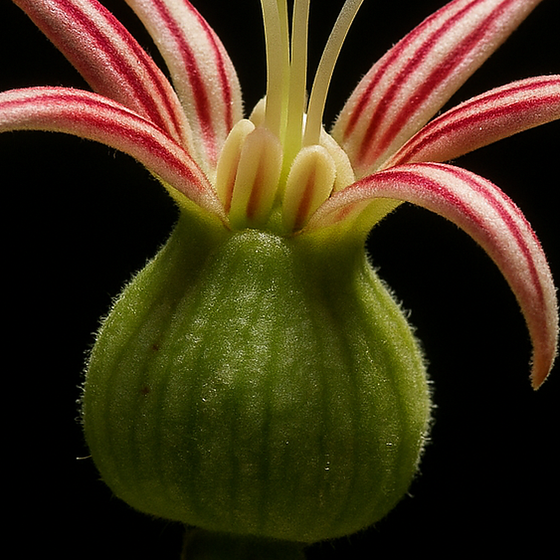
Cashew flowers (Anacardium occidentale) are small and are borne in a panicle or corymb that reaches 26 cm in length. Each flower is pale green at first, then turns reddish, and has five slender, acute petals 7-15 millimeters long. Cashew flowers produce nectar.
The presence of osmophores has been confirmed in the flowers of Anacardium and Mangifera. Cashew trees bear male and hermaphrodite flowers, and the sugar content is significantly higher in hermaphrodite flowers than in male flowers. Bee foraging is more intense during the hermaphrodite flowering phases than during the male phase.
In a study in three Ivoirian regions, the honeybee Apis mellifera and the stingless bees Meliponula bocandei and Meliponula togoensis were the most abundant flower visitors of cashew plants. The density of flowers, the quantities of pollen and nectar, and their contents in amino acids and sugars correlated positively with the fruiting rate.
The cashew tree is native to tropical South America. Portuguese explorers encountered it in the 16th century and spread it to India and other tropical regions of the world. The tree can grow as tall as 14 meters. The cashew apple, an oval or pear-shaped structure, develops from the pedicel and the receptacle of the cashew flower. It ripens into a yellow or red structure about 5-11 cm long. The true fruit is a drupe that grows at the end of the cashew apple.
The English name derives from the Portuguese name for the fruit of the cashew tree, caju, which comes from the Tupi word acajú. The pulp and juice of the cashew apple can be processed into a sweet, astringent fruit drink or fermented and distilled into liquor.
Anacardic acids are phenolic lipids found in the shell of the cashew nut. They form a mixture of closely related compounds, each a salicylic acid carrying an alkyl chain of 15 or 17 carbon atoms. Anacardic acid is the main component of cashew nutshell liquid, which the chemical industry uses to produce cardanol for resins, coatings and frictional materials.
—
Related: Accord Eudora · African Marigold · Alpha Amylcinnamaldehyde · Alyssum · Angels Trumpet · Aquaflora · Ashoka Flower · Aurantiol