


Листя туї
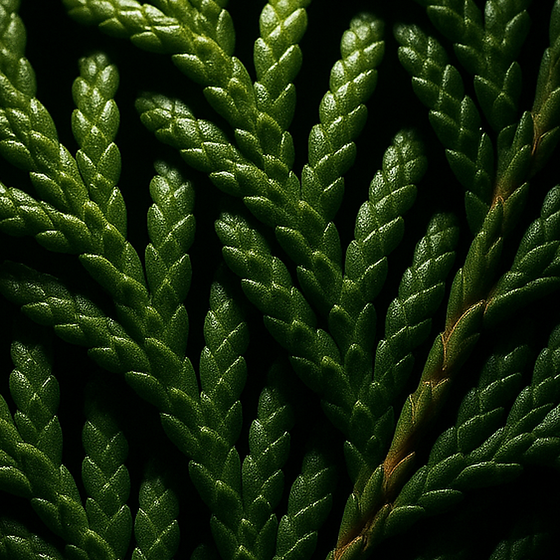
Sharp, camphoraceous green — the smell of crushing arborvitae foliage between damp fingers. Not cedar heartwood at all: brighter, more terpenic, with an almost medicinal bite from thujone.
- Type
- Складник
- Olfactive family
- Ароматичні
- Source
- foliage
- Chemical class
- complex natural (essential oil)
Запах
Теруар і переробка
Докладно
Отримання й хімія
Спосіб отримання
Steam distillation of fresh foliage and young twigs of Thuja occidentalis (eastern white cedar). Trees must be at least 15 years old. Leafy branches are cut, dried briefly, then loaded into a distillation tank. Extraction proceeds under high-pressure steam; vapors are condensed in an indirect-contact heat exchanger, then separated in a Florentine vase. Yield: 0.6–1.0% by weight. The crude oil contains 60–70% total ketones (alpha-thujone + fenchone). Some commercial grades undergo redistillation to reduce thujone content for IFRA compliance, which modifies the olfactory character. Major production: Quebec, Canada, with approximately 80% exported to the United States.
- Формула
- Complex — key component: alpha-Thujone (C₁₀H₁₆O, up to 65%), Fenchone (C₁₀H₁₆O)
- CAS
- 8007-20-3 (Thuja occidentalis leaf oil)
- Ботанічна назва
- Thuja occidentalis L.
- Зовнішній вигляд
- Pale yellow to amber liquid
- Сила запаху
- Середня
- Синоніми
- Cedar needles, Cedar foliage
Restricted — thujone content subject to IFRA Amendment 49 (Standard 102). Maximum thujone levels per product category apply. Used in small quantities due to neurotoxicity.
- Температура спалаху
- ~50°C
- Відносна густина
- 0.910–0.930 @ 25°C
- Показник заломлення
- 1.456–1.460 @ 20°C
У парфумерії
Top-to-heart modifier providing green-coniferous specificity. The high thujone and fenchone content gives cedar leaf a character distinct from any cedarwood material — sharper, greener, more volatile. Functions primarily as a lifting agent and naturalizer in aromatic and fougere compositions, where it bridges lavender and coumarin with woody hearts. At low dosages (0.1–0.5%), it adds textural realism to forest and outdo or accords without drawing attention to itself. At higher levels, the medicinal-camphoraceous quality dominates. Cedar leaf partners well with juniper berry, lavender, geranium, pine needle, and clary sage. In woody-aromatic masculine structures, it sharpens cedarwood or vetiver bases. IFRA restricts thujone-containing materials — cedar leaf oil must be dosed with attention to total thujone exposure across the formula.
Див. також
8 ноти