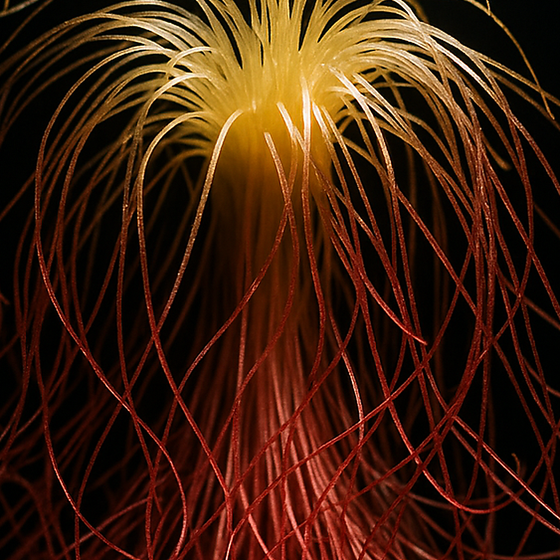
Кукурудзяні рильця

АкордФРУКТИ, ОВОЧІ Й ГОРІХИсолодкий · зелений · вершковий
Ноти серцяПіраміда
3/5Сила
—Стійкість
5Походження
Зразок
Кукурудзяні рильця як парфумерна сировина
Ноти серця
Zea mays
Фантазійний/концептуальний
Визначення

Pale, starchy sweetness — raw corn husk, warm hay, a faint vegetal milkiness. Not the butter-and-salt of cooked corn. This is the raw silk itself: blond, dry, and faintly green, like holding sun-warmed plant fibers to your nose.

КВІТКОВИЙ ЗЕЛЕНИЙ СОЛОДКИЙ ТЕПЛИЙ СВІЖИЙ ВЕРШКОВИЙ
MAIZE SILK ZEA MAYS SILK
Type
Акорд
Olfactive family
Фруктові
Source
stigmas (silk)
Chemical class
fantasy note (accord)
Інструменти
Піраміда
ВВерхні ноти
СНоти серця
ББазові ноти
3/5Сила
Середня
інтенсивність запаху
Країни-виробники
Сполучені Штати Китай Бразилія Аргентина Мексика

Запах

Pale starchy sweetness with a dry, hay-like warmth. Not buttery, not cooked — this is the raw vegetal fiber, closer to dried grass than to popcorn. A faint milky-green quality sits underneath, softer and less sharp than cis-3-hexenol, warmer and less crystalline than heliotropin alone. The overall impression is blond and textile: sun-dried linen, corn husk, warm straw. Compared to oat or rice notes (which tend toward creamier, more lactonic profiles), corn silk reads drier and slightly more vegetal. No floral character. No fruit.

Докладно

Corn silk — the stigma and style of Zea mays — is a fantasy note in perfumery. No commercial essential oil or absolute exists. The material is not distilled, extracted, or traded as a fragrance raw material. When a perfumer lists 'corn silk,' they are building an accord from scratch: a reconstruction of what fresh corn silk smells like, assembled from available molecules.

Explore all seven extraits in the Discovery Set.

The chemistry of actual corn silk volatiles has been studied. El-Ghorab et al. (Journal of Agricultural and Food Chemistry, 2007) identified 36 compounds by GC-MS in Egyptian corn silk, dominated by cis-alpha-terpineol (24.2%), 6,11-oxidoacor-4-ene (18.1%), citronellol (16.2%), trans-pinocamphone (5.9%), and eugenol (4.4%). Earlier, Flath et al. (1978) catalogued corn silk volatiles as attractants for Heliothis zea (corn earworm moth). These studies describe a terpene-rich, faintly rosy-herbaceous profile — quite different from the buttery sweetness most people associate with corn, which comes from dimethyl sulfide formed during cooking.

A perfumer reconstructing a corn silk accord would likely work with materials that suggest starchy sweetness, dry vegetal warmth, and blond-hay tonality: ethyl maltol for grain sweetness, coumarin for the hay quality, a trace of heliotropin for powdery softness, perhaps cis-3-hexenyl acetate for green freshness, and a clean musk base for the silky-textile impression. The result is a quiet, transparent accord — not a statement note but a textural modifier that carries warmth and softness without identifiable florality or fruitiness.

Corn silk also has a long history outside perfumery. Known as stigma maydis in pharmacology, it has been used as a diuretic in Native American, Chinese, and Turkish traditional medicine for centuries. Modern pharmacological research (Hasanudin et al., 2012) confirms its flavonoid and phenolic acid content — compounds with documented antioxidant activity, though irrelevant to its olfactory use.

—

Related: Acerola · Akebia Fruit · Allyl Amyl Glycolate · Arctic Bramble · Argan · Berries · Black Sapote · Buriti

Цікавий факт

In 1978, USDA chemists R.A. Flath and colleagues identified the volatile compounds of corn silk as chemical attractants for the corn earworm moth (Heliothis zea). The moth navigates to its host plant by following the scent trail of the silk's terpene emissions — the same molecules (linalool, geraniol, myrcene) that perfumers use in floral accords. The silk that feeds insect navigation also fed, indirectly, the perfumer's imagination.

Отримання й хімія

Спосіб отримання

No commercial extraction exists for perfumery use. Corn silk is a fantasy note — its scent is reconstructed as a synthetic accord. GC-MS analysis of raw corn silk volatiles (El-Ghorab et al., J. Agric. Food Chem., 2007) identified 36 compounds in the dichloromethane extract, dominated by cis-alpha-terpineol (24.2%), citronellol (16.2%), and eugenol (4.4%). However, these analytical data describe the plant tissue's volatile profile, not a commercially available extract. No steam distillation, solvent extraction, or CO2 extraction of corn silk is practiced at industrial scale.

Формула
N/A — complex mixture of flavonoids, saponins, volatile compounds
CAS
N/A — natural material, complex mixture
Ботанічна назва
Zea mays
Сила запаху
Середня
Синоніми
MAIZE SILK ZEA MAYS SILK
Статус IFRA
Без обмежень

No known restrictions

Фізичні властивості
Нота
Zea mays stigma (corn silk) contains volatile compounds including geraniol, limonene, and carvacrol. Used primarily in traditional medicine and as a perfumery fantasy note.

У парфумерії

Fantasy note — no natural extract exists. Corn silk functions as a textural modifier in gourmand, grain-inspired, and soft-floral compositions. It provides starchy warmth and a dry, hay-adjacent sweetness without the density of vanilla or the sharpness of green notes. In practice, the accord is built from materials like ethyl maltol (grain sweetness), coumarin (hay, dried grass), heliotropin (powdery softness), and clean musks (textile warmth). The note occupies the heart-to-base register, lending quiet volume and a sense of sun-warmed softness. It works with lactonic peach notes, oat milk accords, linen musks, and tonka bean. No PREMIEREPEAU fragrance currently features a corn silk accord.

Роль у формулі
01модифікатор
02фірмова нота
03сполучний компонент
04формувач об’єму
05свіжість
Форми випуску
синтетичний акорд фантазійна нота

Див. також

7 ноти