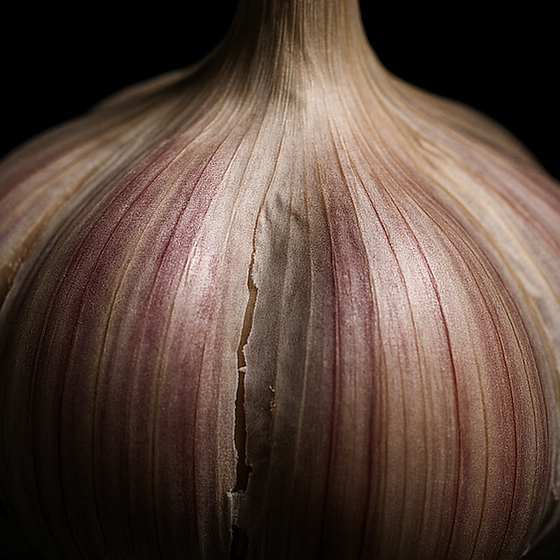
Часник

НатуральнийЗЕЛЕНІ НОТИ, ТРАВИ Й ФУЖЕРНІ АКОРДИpungent · sulfurous · alliaceous
Ноти серця·Базові нотиПіраміда
4/5Сила
—Стійкість
5Походження
Зразок
Часник як парфумерна сировина
Від нот серця до базових нот
Allium sativum
Визначення

Garlic is Allium sativum, a species of bulbous flowering plants in the genus Allium. Sulfur compounds give garlic its pungent odor and flavor.

PUNGENT SULFUROUS ALLIACEOUS
Type
Складник
Olfactive family
Ароматичні
Source
bulbs
Chemical class
complex natural (volatile oil) — volatile sulfur compounds
Інструменти
Піраміда
ВВерхні ноти
СНоти серця
ББазові ноти
4/5Сила
Висока
інтенсивність запаху
Країни-виробники
Китай Індія Єгипет Бангладеш Іспанія

Запах

The pungent odor of fresh garlic comes mainly from thiosulfinates and their degradation products. Garlic oil has an intense garlic odor of the alliaceous type. Steam-distilled garlic oil typically has a pungent and disagreeable odor. Diallyl disulfide, a principal component of the oil, has a strong garlic smell. The scent of garlic is known to linger upon the human body.

Докладно

The bulb of garlic has a strong odor and is typically made up of 10 to 20 cloves. Its close relatives include the onion, shallot, leek and chives. Garlic is native to Central Asia and northeastern Iran. Among alliums, garlic has by far the highest concentrations of initial reaction products, making garlic much more potent than onion, shallot, or leeks. In 2024 world production of garlic was 30 million tonnes, and China accounted for 73% of the total.

The biosynthesis of allicin begins with the conversion of cysteine into S-allyl-L-cysteine, and oxidation of this thioether gives the sulfoxide alliin. Allicin is not present in garlic unless tissue damage occurs. When fresh garlic is chopped or crushed, the enzyme alliinase converts alliin into allicin, which is responsible for the aroma of fresh garlic. Alliin is a sulfoxide that is a natural constituent of fresh garlic. Allicin is unstable and quickly changes into a series of other sulfur-containing compounds such as diallyl disulfide. Allicin, along with its decomposition products diallyl disulfide and diallyl trisulfide, are major contributors to the characteristic odor of garlic. The conversion of allicin to diallyl disulfide and trisulfide takes place particularly rapidly above 37 °C. The sulfur compounds are believed to have evolved as a defensive mechanism, deterring animals such as birds, insects and worms from eating the plant.

The process of cooking garlic removes allicin, thus mellowing its spiciness. During the heating process of garlic, thiosulfinates are mainly decomposed, and nitrogen-containing volatile compounds, such as pyridines and pyrazines, are generated. Cooked garlic also yields Maillard reaction products, which are not sulfur-containing compounds. Studies have reported 85 sulfur-containing and 40 non-sulfur-containing volatile compounds in raw and heated garlic cloves.

Garlic oil is the volatile oil derived from garlic. Garlic oil contains volatile sulfur compounds such as diallyl disulfide, a 60% constituent of the oil. Along with diallyl trisulfide and diallyl tetrasulfide, diallyl disulfide is one of the principal components of the distilled oil of garlic. It is produced during the decomposition of allicin, which is released upon crushing garlic.

—

Related: Acronychia Pedunculata · Adoxal · Agave · Algae · Aloe Vera · Aromatic Notes · Asparagus · Avocado

Цікавий факт

Allicin is surprisingly unstable in vegetable oil, with a chemical half-life of 3.1 hours.

Отримання й хімія

Спосіб отримання

Garlic oil is typically prepared by steam distillation, in which crushed garlic is steamed and the resulting condensation contains the oil. The diallyl disulfide yield is highest from steam distillation of garlic bulbs, which contain about 2 wt.% of diallyl disulfide-rich oil. Garlic leaves can also be used, but their oil content is significantly lower, at 0.06 wt.%. To produce around 1 gram of pure steam-distilled garlic oil, around 500 grams of garlic is required. Ether can also be used to extract garlic oil. Soaking diced or crushed garlic in vegetable oil does not give pure garlic oil, only a garlic-infused oil. Separating diallyl disulfide from higher sulfides such as diallyl trisulfide is the major problem in extraction from plants, because their physical properties are very similar.

CAS
8000-78-0
Ботанічна назва
Allium sativum
Зовнішній вигляд
Pale yellow to reddish orange clear liquid
Сила запаху
Сильна
Статус IFRA
Див. примітку

No IFRA Standard for the material itself (51st Amendment)

Фізичні властивості
Температура спалаху
130.00 °F. TCC
Відносна густина
1.04000 to 1.09000 @ 25.00 °C
Показник заломлення
1.55900 to 1.57900 @ 20.00 °C

У парфумерії

Highly diluted, diallyl disulfide is used as a flavoring in food. Garlic oil is used in cooking and as a seasoning. A stabilized garlic flavor blend combines dehydrated garlic powder with garlic oil, which strengthens the flavor of the powder. Undiluted garlic oil has 900 times the strength of fresh garlic, and 200 times the strength of dehydrated garlic. Some commercial preparations are produced with various levels of dilution, such as a preparation that contains 10% garlic oil.

Роль у формулі
01модифікатор
02фірмова нота
03сполучний компонент
04формувач об’єму
Форми випуску
ефірна олія (харчова ароматизація)

Див. також

8 ноти