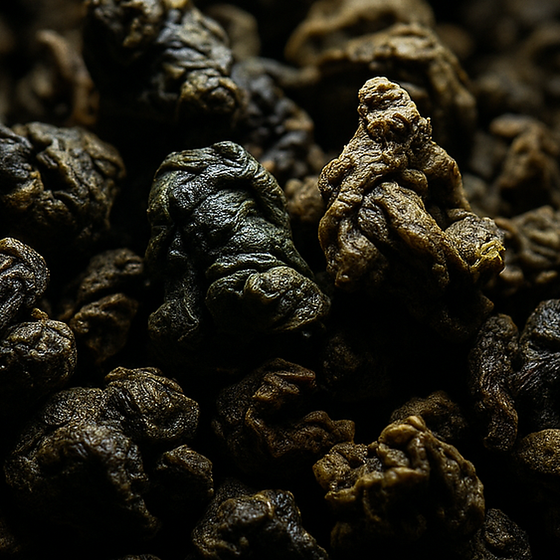
Улун

НатуральнийНАПОЇзелений · фруктовий · свіжий
Ноти серцяПіраміда
—Сила
—Стійкість
2Походження
Зразок
Улун як парфумерна сировина
Ноти серця
Camellia sinensis
Визначення

Oolong is a traditional semi-oxidized Chinese tea (Camellia sinensis). It has a fruity and floral flavor, falling between unfermented green tea and fully fermented black tea.

Herbacé
94
Vert
49
Frais
59
Aromatique
44
Boisé
34
Terreux
37
Wulong, Black Dragon, Qingcha
Type
Складник
Olfactive family
Квіткові
Source
leaves
Chemical class
Complex natural mixture (alcohols, aldehydes, ketones, esters, heterocyclic compounds)
Інструменти
Піраміда
ВВерхні ноти
СНоти серця
ББазові ноти
Країни-виробники
Китай Тайвань

Запах

Styles of oolong vary widely in flavor: they can be sweet and fruity with honey aromas, woody and thick with roasted aromas, or green and fresh with complex aromas. Unroasted teas have more pronounced fresh and green flavors, while roasted teas score higher in pungent and caramel flavors.

Tieguanyin, a light and unroasted oolong, imparts floral and creamy notes. Dongding tea has a creamy, sweet, toasted nutty flavor. Wuyi rock tea has a unique fragrance of floral fruity flavors. Among the aroma compounds of oolong, linalool is described as citrus, floral and sweet, and geraniol as sweet, floral and fruity.

Теруар і післязбиральна обробка

Докладно

Oolong is one of the six traditional Chinese tea categories. Its degree of oxidation is controlled by the time between picking and final drying and ranges from 8% to 85%, depending on the variety and production style. Oolong shares some characteristics with both green and black teas: its flavour notes are light, but it is often more complex than green tea and not as strong as black tea. Most oolong teas, especially those of fine quality, involve unique tea plant cultivars that are used exclusively for particular varieties. Oolong is especially popular in southeastern China and among ethnic Chinese in Southeast Asia.

Varieties and regions

Tea production in Fujian is concentrated in the Wuyi Mountains and Anxi County, both major historical centers of oolong production in China. Da Hong Pao is a Wuyi rock tea grown in the Wuyi Mountains of Fujian Province. Tieguanyin is a variety of oolong that originated in the 19th century in Anxi in Fujian province. Dancong tea refers to a family of strip-style oolong teas from Guangdong Province.

Taiwan is a large producer of oolong. Baozhong is the least oxidized of the oolong teas from Taiwan. The leaves are usually formed into one of two styles: long curly leaves or small beads, each with a tail.

Aroma chemistry

In tea generally, volatile compounds make up only 0.01% of the dry weight, yet they largely determine its sensory character and economic value. The essential aroma components of oolong are linalool and its oxides, benzyl alcohol, 2-phenylethanol, jasmine lactone and indole. A total of 128 volatile compounds have been identified in four typical types of oolong tea. The main alcohols in oolong samples are linalool and its oxides, geraniol, hotrienol, phenylethyl alcohol and (E)-nerolidol, which have typical floral and fruity aromas.

Roasting largely increases the variety of volatile compounds in oolong tea. Heterocyclic compounds are significantly more numerous and more abundant in roasted oolong than in unroasted oolong. In Dongding tea, most of the characteristic roasted-scent compounds are pyrroles, pyrazines and pyridines, which derive from the Maillard reaction during roasting. Three pyrazines contribute significantly to the caramel aroma of Dongding tea.

Explore all seven extraits in the Discovery Set.

—

Related: Alpha Pinene · Angelica · Angelica Root · Angelica Root Oil · Artemisia · Barrenwort · Beachheather · Behini Tree

Цікавий факт

Only six mother Da Hong Pao tea trees remain, on a cliff of Jiulongyu in the Wuyi Mountains.

Отримання й хімія

Спосіб отримання

Oolong is made by withering the leaves under strong sun and allowing some oxidation to occur before curling and twisting. Withering, rolling, shaping and firing resemble the process for black tea, but timing and temperature need much more attention. Manufacture involves repeating stages to achieve the desired amount of bruising and browning of the leaves. The processing typically takes two to three days from withering to drying, with a relatively short oxidation period of several hours. Wuyi rock tea and Dongding tea undergo robust roasting after oxidation, while High Mountain tea and Tieguanyin are lightly oxidized without roasting.

Формула
Complex natural mixture (key constituents: linalool; geraniol; jasmine lactone; indole)
Ботанічна назва
Camellia sinensis
Синоніми
Wulong, Black Dragon, Qingcha
Статус IFRA
Обмежено

Restricted — IFRA Standard « Tea leaf absolute » (Amendment 49)

У парфумерії

A related trade material is tea leaf absolute (CAS 84650-60-2), also named Camellia sinensis L. leaf absolute, and also sold under the name Thea sinensis L. leaf absolute. Tea leaf absolute is supplied as an amber viscous liquid with a dry herbal sweet woody odor. An IFRA Standard of the restriction type covers tea leaf absolute. That Standard was published in January 2020, in Amendment 49.

Роль у формулі
01tea note
02floral-fruity accent
03roasted-caramel accent
Форми випуску
dried tea leaves infusion

Див. також

8 ноти