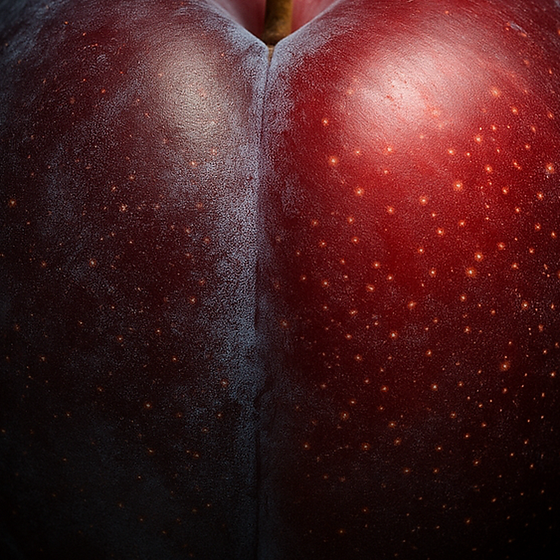
The fruit
Dried plums are usually called prunes. The fruit is a drupe, with a firm and juicy flesh. Plum fruits are usually of medium size, between 2-7 centimetres in diameter, and globose to oval. The smooth peel has a waxy natural surface bonded to the flesh. Plum trees reach 5-6 metres in height when pruned.
Prunus domestica is a species of flowering plant in the family Rosaceae. The greengages and damsons also belong to subspecies of P. domestica. The pulp of P. domestica is usually sweet, although some varieties are sour. Its subspecies cross easily, and the fruit colours range from bluish-purple to red, orange, yellow or light green.
Kinds of plum
Japanese or Chinese plums are cultivars of Prunus salicina or its hybrids. They are large and juicy with a long shelf life, and they dominate the fresh fruit market. The European plum cultivars include damson, prune plum, greengage, mirabelle, Victoria and yellowgage. The myrobalan or cherry plum, Prunus cerasifera, is widely cultivated in West Asia.
Origin
Plums are likely to have been one of the first fruits domesticated by humans. Prunus domestica has been traced to East European and Caucasian mountains, while Prunus salicina and Prunus simonii originated in China. Plum remains have been found in Neolithic age archaeological sites along with olives, grapes and figs.
Aroma chemistry
The aroma of alpha-damascone is described as sweet, floral, metallic, fruity, apple, spicy, plum, minty, woody, green and berry. Beta-damascone is described as fruity, floral, black currant, plum, rose, honey and tobacco. Gamma-damascone is described as fruity, floral, rose, green, cooked apple, plum, thujonic and tobacco. Methyl formate has an odour described as fruity, plum and estery. Guaiyl butyrate has an odour described as rose, plum, animal, balsamic and woody. Hexyl formate has an odour described as apple, unripe plum, banana and sweet. Heliotropyl isobutyrate has an odour described as fruity, berry, jam, plum, tropical, heliotrope and powdery.
As with many other members of the rose family, plum kernels contain cyanogenic glycosides, including amygdalin. Amygdalin is present in plum kernels at 4-17.5 g/kg depending on variety. Benzaldehyde released from amygdalin provides a bitter flavor. Benzaldehyde is a colorless liquid with a characteristic odor similar to that of bitter almonds and cherry.
Uses and production
Plums can be eaten fresh, dried to make prunes, used in jams, or fermented into wine and distilled into brandy. Dried, salted plums are used as a snack, sometimes known as saladito or salao. In the Balkans, plum is converted into an alcoholic drink named slivovitz. In Romania, 80% of the plum production is used to create a similar brandy, called țuică. In Hungary, Damson plums are used to make lekvar, a plum paste jam, and palinka, a traditional fruit brandy.
In 2023, China produced 55% of the world total of plums. Romania and Chile were the next largest producers after China.
—
Related: Acai Berry · Acerola · Aldehyde C 14 Peach · Apple · Apricot · Banana · Black Cherry · Blackberry