Botany
Pancratium maritimum grows on beaches and coastal sand dunes. Mediterranean coasts are harsh habitats, with direct exposure to sea breeze and continuous salt spray, and the sea daffodil is well adapted to these conditions. It is a perennial clonal geophyte of fixed and mobile sand dunes and beaches, and much of its leaves and scapes are often buried in the sand. The plant belongs to the Amaryllidaceae family, and it is not a true lily.
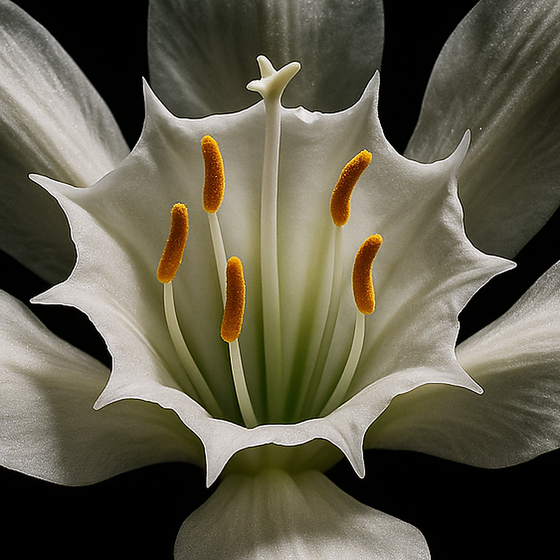
It is a bulbous perennial with a long neck, and the scape reaches up to 40 centimetres. The flowers are white, up to 15 cm long, and borne in an umbel of 3 to 15. The corona is two-thirds as long as the tepals, and flowering runs from August to October. The leaves are glaucous and broadly linear, and they often die back during hot summers. Each flower produces about 10 to 20 seeds, which are black and extremely light, about 4 to 8 mg, and are suited to dispersal by both wind and water.
Distribution
The species is native to both sides of the Mediterranean region and the Black Sea, from the Canary Islands, Portugal, Morocco and Cyprus east to Turkey, Syria, Israel and the Caucasus. Its range on the Black Sea coasts includes southern Bulgaria, northern Turkey and Georgia, and the species is naturalized in Southern California. In Cyprus it grows on several beaches, among them the Akamas, the Akrotiri peninsula, Ayia Napa and Protaras, Ayios Amvrosios in Kyrenia and the Karpasia peninsula. A distribution model predicts that the species can occupy the coastline of the entire Mediterranean basin, including the southern and north-western coasts of the Black Sea, with suitable areas also along the Atlantic coast from northern Africa to France. The genus Pancratium comprises about 15 species and subspecies found across Mediterranean Europe, North Africa and tropical regions of Asia.
Pollination
Pancratium maritimum is pollinated by a hawk-moth named Agrius convolvuli. The plant is not receptive to its own pollen and must be cross-pollinated.
Chemistry and cosmetic use
4'-Hydroxy-5,7-dimethoxy-8-methylflavan is a flavan found in Pancratium maritimum. In cosmetics, Pancratium maritimum extract has a bleaching function: it lightens the shade of hair or skin.
Conservation
The IUCN Red List classes the species as Least Concern. In Cyprus, the sea daffodil is considered near-threatened because its habitat and population are under great pressure from intense human activity in coastal areas. In Cyprus, large concentrations of the plant grow within protected areas that belong to the Natura network. A genetic study of 48 populations and 867 specimens found good genetic diversity, with lower values in the marginal populations on the Atlantic coast.
Cultivation
The sea daffodil is easily grown but needs a very sunny position and a very well drained, sandy soil. It needs hot summers to flower and is often a shy bloomer in cooler climates. It is hardy to USDA zone 8 and tolerates temperatures down to about -5 °C. Propagation is by seeds or by division after flowering, and seedlings may flower in their third or fourth year.
Name
The genus name Pancratium comes from the Greek words pan and krataios, which mean strong, and alludes to the plant's resilience as it flowers in dry, sandy land. The epithet maritimum means "of the sea".
Explore all seven extraits in the Discovery Set.
—
Related: Abelia · Almond Blossom · Alpha Terpineol · Alstroemeria · Alumroot · Amarillys · Amazon Moonflower · Amethyst Flower