Звіробій

НатуральнийЗЕЛЕНІ НОТИ, ТРАВИ Й ФУЖЕРНІ АКОРДИароматичний · смолистий
Ноти серцяПіраміда
2/5Сила
—Стійкість
—Походження
Зразок
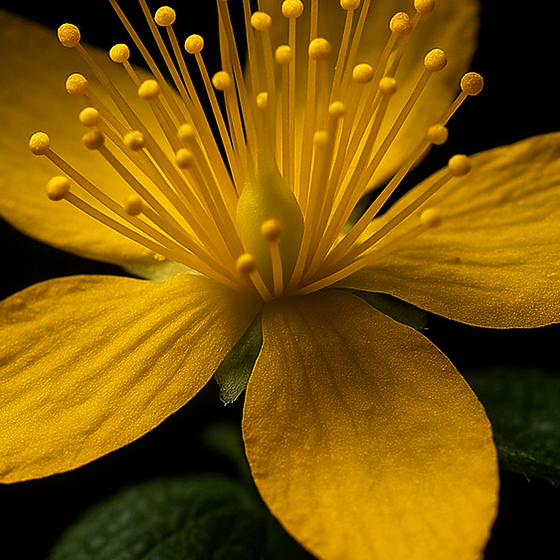
Звіробій як парфумерна сировина
Ноти серця
Hypericum perforatum
Визначення

St. John's Wort is the herb Hypericum perforatum, a hairless perennial plant of the family Hypericaceae. Its odor is faint but aromatic, resembling that of resins like balsam.

Herbacé
95
Floral
80
Vert
70
Chaud
60
Terreux
45
Doux
35
Hypericum, Klamath weed, goatweed, common St. John's wort, perforate St. John's wort
Type
Складник
Olfactive family
Трав’яні
Chemical class
essential oil (monoterpenes and sesquiterpenes)
Інструменти
Піраміда
ВВерхні ноти
СНоти серця
ББазові ноти
2/5Сила
Низька
інтенсивність запаху

Запах

The plant's odor is faint but aromatic and resembles that of resins such as balsam.

Теруар і переробка

Докладно

St. John's Wort (Hypericum perforatum) is a flowering plant in the family Hypericaceae. The plant is a hairless, perennial herb with woody roots, yellow flowers marked by black glands, and leaves that appear perforated due to translucent glands. The species is probably a hybrid of the closely related H. attenuatum and H. maculatum that originated in Siberia, and it has spread worldwide. As a medicinal plant it has both historical and contemporary use, particularly for mild to moderate depression.

In healthy H. perforatum plants the essential oil content is highest at full bloom, at 0.35%, against 0.12% before bloom and 0.18% at fruiting. Typical essential oil constituents of the species include the monoterpenes α- and β-pinene, limonene and myrcene, and the sesquiterpenes β-caryophyllene and caryophyllene oxide. The most common active chemicals in the plant are hypericin and pseudohypericin, which are naphthodianthrones, and hyperforin, a phloroglucinol derivative. Hypericin is a red-colored, photosensitive compound. Hyperforin accumulates in oil glands, pistils and fruits, probably as a plant defensive compound. Hyperforin is unstable in the presence of light and oxygen.

The common name St John's wort comes from the fact that its flowers and buds were commonly harvested at the time of the Midsummer festival, later Christianized as St John's Feast Day on 24 June. The herb was used in classical antiquity and was a standard component of the ancient concoctions called theriacs. H. perforatum generally produces a variety of yellows suitable for dyeing.

The taste of the plant is bitter and acrid. The genus name Hypericum possibly comes from the Greek words hyper, above, and eikon, picture, after the tradition of hanging the plant over religious icons in the home. Because the plant was thought to ward off spirits, it was also called fuga daemonum, loosely "demon-flight".

Explore all seven extraits in the Discovery Set.

—

Related: Abelia · Almond Blossom · Alpha Terpineol · Alstroemeria · Alumroot · Amarillys · Amazon Moonflower · Amethyst Flower

Отримання й хімія

Спосіб отримання

St John's oil is a red, oily liquid extracted from H. perforatum. Essential oil extraction with liquid or supercritical CO₂ gives a yield of 1.00% (w/w), higher than the 0.06% from steam distillation. Hyperforin and its derivatives can be extracted with liquid or supercritical CO₂, but not with steam distillation.

Формула
Complex natural mixture (key constituents: α-pinene; β-pinene; limonene; myrcene; β-caryophyllene; caryophyllene oxide)
CAS
84082-80-4
Ботанічна назва
Hypericum perforatum
Зовнішній вигляд
Light to medium amber liquid (flower extract, 20% in water and glycerin); powdered extract: brown-grey powder
Сила запаху
Ледь відчутна
Синоніми
Hypericum, Klamath weed, goatweed, common St. John's wort, perforate St. John's wort
Статус IFRA
Див. примітку

No IFRA Standard for the material itself (51st Amendment)

У парфумерії

Hypericum species are generally classed as essential oil-poor plants, with an oil yield generally below 1% (w/w).

Роль у формулі
01модифікатор
02сполучний компонент
Форми випуску
ефірна олія абсолют

Див. також

7 ноти