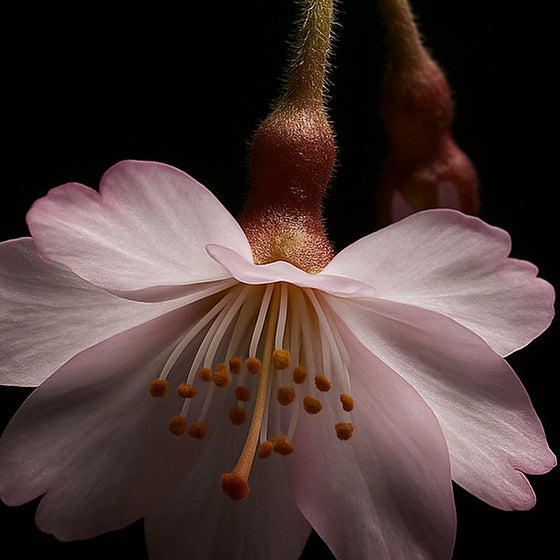
The weeping cherry
Weeping cherry, or shidare-zakura, is a cultivar derived from Edo higan. Edo higan is Prunus itosakura, a wild species of cherry trees native to Japan. The weeping cherry was born as a mutation in Edo higan and inherits the longevity characteristics of Edo higan. Many cultivars of weeping cherry inherit the characteristic of Edo higan that flowers bloom before the leaves unfold. The Miharu Takizakura, which is 1,000 years old, is a famous long-standing weeping cherry. A weeping form of Prunus × subhirtella, called 'Pendula', has small, abundant, faded pink flowers. Cultivars are clones propagated by grafting or cutting, so each tree of the same cultivar planted in the same area will come into full bloom all at once.
Names and botany
Itosakura means thread cherry. Prunus pendula Desf. and Prunus pendula Siebold ex Maxim. are synonyms of Prunus itosakura. Other plants called Prunus pendula are synonyms of Prunus campanulata (Prunus pendula Anon.) and of Prunus cerasus (Prunus pendula K.Koch). Since 2018, the United States Department of Agriculture has classified the species as Prunus itosakura, not Prunus subhirtella. Prunus × subhirtella is the scientific name for the hybrid between Prunus itosakura and Prunus incisa. The wild Edo higan can grow taller than 30 meters and has five petals, with many small white or pale pink flowers. The Yoshino cherry, the cultivar 'Somei-yoshino' of the hybrid Prunus × yedoensis, has Edo higan as its mother plant and Oshima cherry as its father plant.
Cherry blossom and related materials
The cherry blossom, or sakura, is the flower of trees in Prunus subgenus Cerasus. Coumarin is found in many cherry blossom tree varieties of the genus Prunus. Coumarin belongs to the benzopyrone chemical class and is considered a lactone. Benzaldehyde is an organic compound consisting of a benzene ring with a formyl substituent. Cherry seed contains significant amounts of amygdalin, a glycoside that breaks up under enzyme catalysis into benzaldehyde, hydrogen cyanide and two equivalents of glucose. In sweet cherry flowers, benzaldehyde is among the main volatiles of the aroma, together with ethanol, linalool, dimethyl sulfide, acetaldehyde and (E)-2-hexenal. In flowers, benzaldehyde is produced by the enzymatic breakdown of amygdalin.
Cultural meaning
Hanami is the Japanese traditional custom of enjoying the transient beauty of flowers, which almost always means those of cherry trees or, less frequently, plum trees. The blossoms last only a week or two. Mono no aware is a Japanese idiom for the aesthetic appreciation of impermanence. To be affected by and appreciate the beauty of cherry blossoms was an example of knowing mono no aware given by Norinaga.
History
Itosakura appeared in historical documents from the Heian period in Japan. 1,000 years ago, during the Heian period, the Japanese created the cultivar 'Shidare-zakura' based on Edo higan, the oldest among the confirmed cherry cultivars. A 2014 DNA study by the Forestry and Forest Products Research Institute proved that many cultivars with pendulous branches, such as 'Shidare-zakura', were derived from Edo higan. By the Heian period (794-1185), cherry blossoms came to attract more attention than the plum blossom, and hanami was synonymous with sakura. The historical text Nihon Kōki documented the first observation of the sakura bloom in the year 812. The custom of hanami was originally limited to the elite of the Imperial Court, but soon spread to Samurai society and, by the Edo period, to the common people as well. Coumarin was first synthesized in 1868 by the English chemist William Henry Perkin.
Explore all seven extraits in the Discovery Set.
—
Related: Acerola Blossom · Albizia · Anisaldehyde · Apple Blossom · Babys Breath · Campion Flower · Cannonball Flower · Cotton Flower