


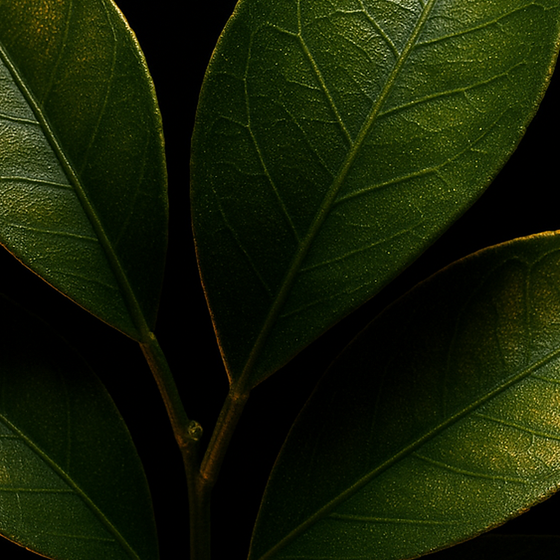
マンダリンの葉と小枝から水蒸気蒸留で得られるタンジェリンリーフオイルは、プチグレン・マンダリンとも呼ばれます。その香りは、甘く、豊かで、深みのある果実香、ブドウを思わせる香り、そしてフローラルな香りと表現されます。
- 種別
- 成分
- 香りの系統
- アロマティック
- 原料
- 葉と枝
- 化学分類
- 天然複合物(エッセンシャルオイル)
香り
テロワールと加工
詳しい解説
豆知識
スイートオレンジはマンダリンとブンタンの両方の系統を受け継いでおり、2025年のゲノム研究は、その起源がサワーオレンジとマンダリンの交配にあることを裏付けました。マンダリンオレンジという果実の名前は、スウェーデン語の「mandarin apelsin」を経由して英語に入り、英語での使用例は1771年に記録されています。スウェーデン語の「apelsin」は、リンゴと中国を意味する語を組み合わせたものです。
抽出と化学
抽出方法
Citrus reticulataの葉を水蒸気蒸留すると精油が得られます。新鮮なCitrus reticulataの葉500グラムから得られる精油の収率は、重量比で0.078から0.232パーセントの範囲でした。プチグレン・マンダリンは、マンダリン果実を実らせる木の葉と枝から蒸留されます。ビターオレンジのプチグレンも同様に、葉と緑の小枝から水蒸気蒸留されます。
- 分子式
- 複雑な天然混合物(主要成分:メチルN-メチルアントラニレート C₉H₁₁NO₂、γ-テルピネン、リモネン)
- CAS
- 8014-17-3(プチグレン・マンダリン油)、84929-38-4(マンダリン抽出物)
- 植物学名
- Citrus reticulata
- 外観
- 液体。2022年に調査されたエジプトの6品種では淡黄色、PCWの市販規格ではアンバーから淡い赤褐色。
- 香りの強さ
- ミディアム
- 別名
- プチグレイン・マンダリン、マンダリンリーフ
原料そのものにIFRA基準はありません(第51次改正)。その構成成分であるメチル N-メチルアントラニラートは、IFRA基準「Methyl N-methylanthranilate」(第51次改正)の対象であり、カテゴリー4の最終製品では全由来を合算して0.10%に制限されています。葉油の使用量はその組成と他の成分によって決まります。ニトロソ化系でニトロソアミンを生成する可能性があるため、下流での通知が必要であり、使用者は適切な保護措置を検討できます。
- 引火点
- 58°C(密閉式引火点、PCW PGM-2仕様)
- 比重
- 0.920~1.040(20°C/4°C、PCW PGM-2仕様)
- 屈折率
- 1.494~1.544(nD20、PCW PGM-2仕様)
- 注記
- PCW PGM-2 プチグレンマンダリン油の物理的仕様(2026年2月10日)。値は油によって異なる場合があります。1997年に研究されたイタリア産油の主要成分であるN-メチルアントラニル酸メチルのモル質量は165.19 g/molです。
調香での役割
プチグレイン系のオイルは、香水やアロマセラピーで、フレッシュな香りの精油として用いられます。
関連項目
7 ノート出典
31- Italian Citrus petitgrain oils. II. Composition of mandarin petitgrain oilMondello, Basile, Previti and Dugo (1997), Journal of Essential Oil Research 9(3), 255–266; DOI 10.1080/10412905.1997.10554241. FAO AGRIS record of the original Italian industrial leaf-oil study.
- Methyl N-methylanthranilatePubChem
- IFRA Standards, 51st AmendmentIFRA
- petitgrain mandarin oilThe Good Scents Company
- PetitgrainWikipedia
- Mandarin orangeWikipedia
- IFRA Standard: Methyl N-methylanthranilateIFRA
- Guidance for the use of IFRA Standards — 51st AmendmentIFRA; natural complex substances and contributions from other sources, including §§7.11–7.12.
- Italian Citrus Petitgrain Oils. Part I. Composition of Bitter Orange Petitgrain OilMondello, Dugo, Dugo and Bartle (1996), Journal of Essential Oil Research 8(6), 597–609; DOI 10.1080/10412905.1996.9701026. Primary compositional study.
- Citrus reticulata Leaves Essential Oil as an Antiaging Agent: A Comparative Study between Different Cultivars and Correlation with Their Chemical CompositionsFahmy et al. (2022), Plants 11(23), 3335; DOI 10.3390/plants11233335. Original six-cultivar Egyptian leaf-oil experiment; cited for extraction, appearance and composition, not clinical efficacy.
- Petitgrain Mandarinier Essence — PGM-2 Technical Data Sheet, 10 February 2026Parfum Cosmetic World (PCW); current primary supplier specification for Italian Citrus reticulata leaf oil. Product-specific identity, colour, physical properties and origin.
- Characterization of Italian Citrus Petitgrain OilsDugo et al. (1996), Perfumer & Flavorist 21 (May/June), 17–28; original analytical research on industrial leaf oils, with geographic and extraction context. Publisher-hosted original PDF.
- Natural Isolates from Seville Bitter Orange TreeBoelens and Oporto (1991), Perfumer & Flavorist 16 (November/December); primary industrial research distinguishing flower, leaf and peel products. Publisher-hosted original PDF.
- Chemical variability of peel and leaf essential oils of mandarins from Citrus reticulata BlancoLota, de Rocca Serra, Tomi and Casanova (2000), Biochemical Systematics and Ecology 28(1), 61–78; DOI 10.1016/S0305-1978(99)00036-8. Original GC, GC/MS and 13C-NMR study of 41 cultivars under common cultivation conditions.
- Citrus reticulata — Ecocrop record 718FAO Ecocrop; institutional description of mandarin morphology, cultivation and frost sensitivity. Cultivar-dependent agronomic ranges, not oil-production statistics.
- Citrus reticulata (PROSEA)Sumeru Ashari, Plant Resources of South-East Asia, Fruits and nuts account, reproduced by Pl@ntUse/Pl@ntNet. Historical cultivation and trade data, including Indonesia in 1986; not a current leaf-oil market survey.
- Genomics of the origin and evolution of CitrusWu et al. (2018), Nature 554, 311–316; DOI 10.1038/nature25447. Original genomic analysis of ancestral citrus lineages, admixture and domestication.
- Origin and de novo domestication of sweet orangeLiu et al. (2025), Nature Genetics 57, 754–762; DOI 10.1038/s41588-025-02122-4. Original phased-genome and hybridization study supporting a sour-orange × mandarin parental model.
- Chinese loanwords in the OEDIsabel de la Cruz-Cabanillas (2008), Studia Anglica Posnaniensia 44; p.264 discusses mandarin, Swedish transmission and the 1771 English citation. Institutional repository of Adam Mickiewicz University.
- Heter det en eller ett apelsin?Swedish Institute for Language and Folklore (ISOF), Frågelådan; institutional explanation of apelsin as appel (apple) plus Sina (China).
- Petitgrain Mandarinier Égypte / Petitgrain Mandarin EgyptA. Fakhry & Co.; primary producer record naming Citrus reticulata Blanco, Egyptian product origin and the oil’s sweet, deep-fruity, grape-like, floral character.
- Aceite Esencial de Petitgrain Mandarina — Ficha Técnica, 30 November 2022Essentiales Mart S.L.; primary supplier specification naming Citrus reticulata leaf oil, Spain, and steam distillation of branches, leaves and flowers. Country evidence is product-specific.
- Pharmacographia — Other Products of the genus CitrusF. A. Flückiger and D. Hanbury, second edition (1879), p.128; contemporaneous scholarly account of petitgrain from immature oranges and from orange leaves/shoots. Project Gutenberg transcription.
- Petit-grain — Vocabolario on lineIstituto della Enciclopedia Italiana Treccani; literal French meaning and distinction between bitter-orange petitgrain and leaf/twig oils from other citrus trees.
- Petitgrain Mandarin oil — Citrus reticulataPurity Egypt; primary supplier record of leaf distillation, identity and perfumery/aromatherapy applications. An application listing, not evidence of therapeutic efficacy.
- Petitgrain Mandarin Oil (Citrus reticulata Blanco var. mandarin), FEMA 2854Flavor and Extract Manufacturers Association; institutional identity record, CAS 8014-17-3. Flavoring identity is not unrestricted fragrance-use approval.
- Compendium of food additive specifications, Addendum 13 — methyl N-methylanthranilate, No.1545FAO/WHO JECFA, 65th meeting (2005), Section C; institutional compound identity, formula and molecular-weight specification. Cited for the constituent, not the whole essential oil.
- Origin and de novo domestication of sweet orange — full textLiu et al. (2025), Nature Genetics 57, 754–762; DOI 10.1038/s41588-025-02122-4. NIH PMC access to the same original phased-genome and hybridization study cited at its publisher URL; not a second independent experiment.
- Pharmacographia, second edition (1879), p.128 — Other Products of the genus CitrusFriedrich A. Flückiger and Daniel Hanbury. Project Gutenberg transcription of the historical scholarly account; alternate access to the same edition as the existing cache URL. Distinguishes immature-orange distillation from leaves and shoots.
- Petitgrain Mandarin Oil — Product Specification Sheet, version 03, 24 June 2020Pure Essential Oils & Herbs Co. (Purity Egypt), product PSD04400. Primary Egyptian leaf/twig oil specification, identity, steam distillation and sensory description. Product-specific figures differ from PCW; no cross-product physical range is inferred.
- Citrus reticulata BlancoInternational Plant Names Index (IPNI)
