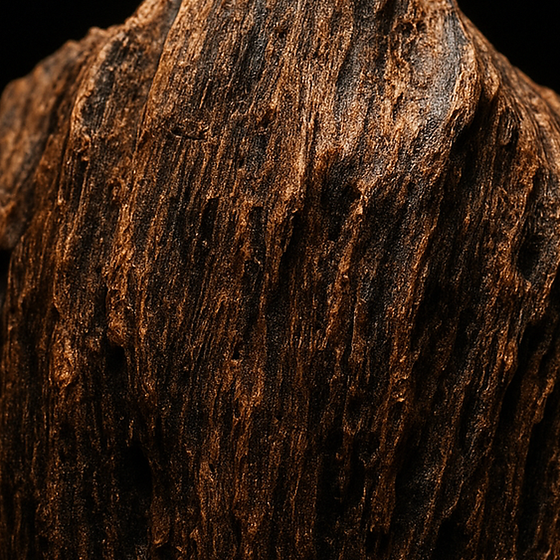
Australijski oud

PrirodnaDRVA I MAHOVINEdrvenast · bogat · balzamski
Bazne notePiramida
—Jačina
—Trajnost
1Poreklo
Uzorak
Australijski oud kao sirovina za parfeme
Bazne note
Aquilaria spp. (cultivated in Australia)
Definicija

Australian oud is agarwood (oud) from Aquilaria trees cultivated in Australia. Agarwood oil smells woody, with sweet, balsam and sandalwood tones.

CVETNI DIMNI SLADAK BALZAMSKI VOĆNI KOŽNI TOPAO SVEŽ
Agarwood, Oud
Type
Sirovina
Olfactive family
Drvenasti
Source
wood
Chemical class
complex natural (essential oil)
Instrumenti
Piramida
GGornje note
SSrednje note
BBazne note
Zemlje proizvođači
Australija

Miris

The odour is woody, described as sweet, woody, balsam and sandalwood. The odour of agarwood is also complex and pleasing, with few or no similar natural analogues.

Detaljno

What it is

Agarwood is a resinous heartwood used for perfume and incense. The resin forms in the tree in response to infection.

Origin

Aquilaria is a genus of trees that includes 21 species native to southeast Asia. Aquilaria crassna, a species native to Southeast Asia, has been cultivated in tropical Australia. Significant transplant stress during establishment has been a feature of contemporary plantings in Australia.

Formation

Healthy Aquilaria trees do not form agarwood. A tree that is infected by a mould produces a self-defence material to conceal damage or infection. A common method in planted forestry is to inoculate trees with the fungus. The formation of agarwood is lengthy and could take up to 10 years.

The aromatic qualities of agarwood are influenced by the species, geographic location, length of time since infection, and methods of harvesting and processing.

Chemistry

The composition of agarwood oil is exceedingly complex, with more than 150 chemical compounds identified. At least 70 of them are terpenoids, in the form of sesquiterpenes and chromones, and no monoterpenes have been detected at all. The exact balance varies with the age and species of the tree and the details of the oil extraction process.

Regulation

In 2004 all Aquilaria species were listed in CITES Appendix II, although a number of countries have outstanding reservations about that listing. The planting of Aquilaria trees is tightly regulated by the representatives of CITES in each member country.

—

Related: Agarwood Oil · Agarwood Oud · Cambodian Oud · Chinese Oud · Indian Oud · Indonesian Oud · Laotian Oud · Malaysian Oud

Dobijanje i hemija

Način dobijanja

Agarwood oil is distilled from the wood with steam. The total yield of oil from 70 kg of wood does not exceed 20 ml. Steam distillation uses only steam, whereas hydro-distillation uses water, steam, or both. Conventional extraction techniques are reported to be highly time-consuming, with the process extending up to 16 hours.

Formula
Complex natural mixture (key constituents: sesquiterpenes; chromones)
CAS
94350-09-1 (agarwood oil)
Botanički naziv
Aquilaria spp. (cultivated in Australia)
Izgled
Orange to green-brown viscous liquid
Sinonimi
Agarwood, Oud
Status prema standardima IFRA
Pogledajte napomenu

No IFRA Standard for the material itself (51st Amendment)

Fizička svojstva
Tačka paljenja
141.00 °F

U parfemima

Oud is generally used as a base note and is traditionally paired with rose. Few perfume houses use real oud in their creations, because oud is very expensive and potent. Most brands have a creation based on or dedicated to oud, or on an accord of oud created through certain chemical scent components.

Uloga u formuli
01fiksativ
02modifikator
03okosnica
04nota potpisa
05sirovina za stapanje
06graditelj volumena
Oblici na tržištu
eterično ulje

Pogledajte i

7 nota