


Ulje agarovog drveta
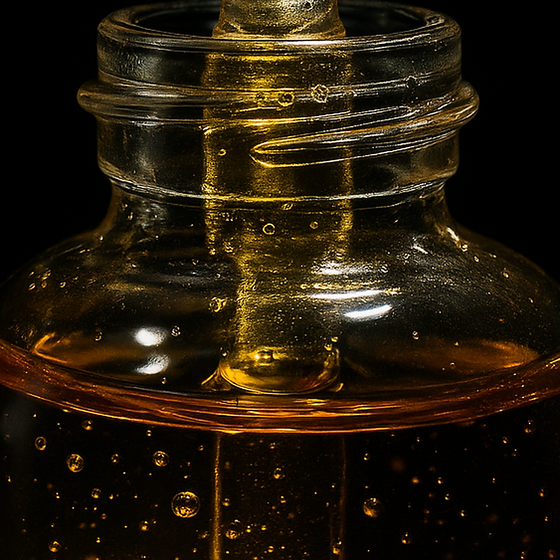
Agarwood oil is an essential oil distilled from agarwood, the resinous heartwood of Aquilaria trees. Its odour is very rich, deep and complex, with an enveloping woody note and warm, animalic accents.
- Type
- Sirovina
- Olfactive family
- Drvenasti
- Source
- heartwood
- Chemical class
- complex natural (essential oil)
Miris
Teroar i zrelost
Detaljno
Dobijanje i hemija
Način dobijanja
Oud oil can be distilled from agar wood using steam. Traditionally, harvested agarwood chips have been soaked in water before hydrodistillation, which aims to increase oil yield. Woodchips of Aquilaria subintegra were hydrodistilled in a Clevenger-type apparatus for 48 h. Incubating woodchips with lactic acid bacteria supernatants gave an oil yield of 0.45% w/w, against 0.22% w/w for water. Oil yields are generally very low, and the extraction process is reported to be very tedious and time-consuming. Treating Aquilaria crassna with an enzyme mixture before supercritical fluid extraction significantly increased the extraction yield. A common method in planted forestry is to inoculate trees with the fungus. In artificial induction, nail or axe wounds are made in the wood, which is then exposed to infection by fungi such as Phialophora parasitica. When a tree is ready to be harvested, it is felled, the bark is removed, and the wood is carved to remove the parts not stained with agarwood.
- Formula
- Complex natural mixture (key constituents: agarospirol C₁₅H₂₆O; β-agarofuran; α-eudesmol; karanone)
- CAS
- 94350-09-1
- Botanički naziv
- Aquilaria malaccensis / Aquilaria crassna
- Izgled
- Orange to green-brown viscous liquid
- Sinonimi
- oud oil, agar wood oil, aloe wood oil
No IFRA Standard for the material itself (51st Amendment)
- Tačka paljenja
- 61.00 °C (141.00 °F, TCC)
U parfemima
Agarwood oil is used in many oriental fragrances, where it sits at the heart of woody and leathery accords. In the Middle and Far East, agarwood is traditionally burned as incense or used to make attars and perfume oils. Agarwood is used in the perfume industry, especially by Arabic brands. Oud is valued for its distinctive fragrance in Middle Eastern and South Asian cultures, and is used in colognes, incense and perfumes. Synthetic agarwood compounds are used to make poor-quality fragrances and incense sticks, and there are currently no synthetic substitutes for high-grade incense or oil.
Pogledajte i
6 nota