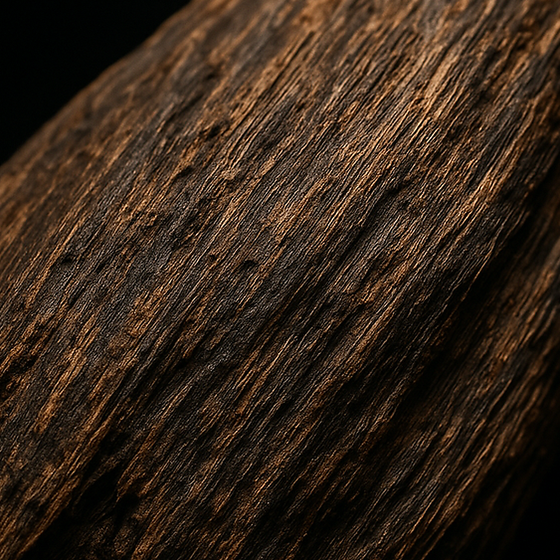
Laoski oud

PrirodnaDRVA I MAHOVINEdrvenast · balzamski · začinski
Bazne notePiramida
—Jačina
—Trajnost
1Poreklo
Uzorak
Laoski oud kao sirovina za parfeme
Bazne note
Aquilaria crassna
Definicija

Laotian oud is agarwood essential oil, obtained by distilling the wood of Aquilaria crassna, a tree cultivated in Laos.

DRVENAST CVETNI DIMNI SLADAK KOŽNI TOPAO
Agarwood, Oud
Type
Sirovina
Olfactive family
Drvenasti
Source
wood
Chemical class
essential oil; sesquiterpenes and chromones
Instrumenti
Piramida
GGornje note
SSrednje note
BBazne note
Zemlje proizvođači
Laos

Miris

The odour of agarwood is complex and pleasing, with few or no similar natural analogues.

Teroar i zrelost

Detaljno

Aquilaria crassna is a species of the Thymelaeaceae family, native to Southeast Asia. The tree reacts to damage by insects or fungi by producing an intensely fragrant, dense and dark-coloured resinous wood. The tree produces the resin in response to infection by a parasitic mold, Phaeoacremonium parasitica. The resin raises the mass and density of the affected wood and changes its colour from a pale beige to yellow, orange, red, dark brown or black. The genus Aquilaria has seventeen species, of which nine are known to produce agarwood; A. crassna and A. sinensis are, besides A. malaccensis, the species commonly harvested.

The composition of agarwood oil is exceedingly complex, with more than 150 chemical compounds identified. At least 70 of these are terpenoids in the form of sesquiterpenes and chromones, and no monoterpenes have been detected at all. Among the chromones of agarwood, 2-(2-phenylethyl)chromones are currently the most commonly isolated type. Chromones are characteristic components of agarwood. Diepoxy-tetrahydro-2-(2-phenylethyl)chromones have been obtained from A. crassna. Four new bi-2-(2-phenylethyl)chromone derivatives, crassins A–D, and six previously undescribed ester-bonded dimeric compounds, aquilacrassnins A–F, come from the EtOAc extract of agarwood originating from A. crassna. Other common classes of compounds include agarofurans, cadinanes, eudesmanes, valencanes and eremophilanes, guaianes, prezizanes and vetispiranes. The exact balance of these materials varies with the age and species of the tree as well as the details of the oil extraction process. The aromatic qualities of agarwood are influenced by the species, geographic location, the branch, trunk or root origin, the time since infection, and the methods of harvesting and processing.

More than 99% of traded Aquilaria crassna comes from plantations, because of the significant decline of wild populations of this critically endangered species. In 2004, all Aquilaria species were listed in CITES Appendix II, although a number of countries have outstanding reservations about the listing. Laos is among the top exporters of agarwood chips and powder, which make up over 80% of the global agarwood trade. Vietnam, Thailand and Malaysia export large volumes of A. malaccensis and A. crassna, and import agarwood from Laos and Cambodia for re-export to markets in the Middle East and East Asia.

Agarwood has thousands of years of known use and is valued across Hindu, Buddhist, Muslim and Chinese cultures.

Explore all seven extraits in the Discovery Set.

—

Related: Agarwood Oil · Agarwood Oud · Australian Oud · Cambodian Oud · Chinese Oud · Indian Oud · Indonesian Oud · Malaysian Oud

Dobijanje i hemija

Način dobijanja

Agarwood essential oil is obtained by distilling the wood of Aquilaria crassna. After harvesting, the wood is selected according to its colour and quality; part of it is burned for fumigation, and the remainder is distilled. Oud oil can be distilled from agarwood using steam. A CO2 extract is also made from a selection of Laotian agarwood pieces. The natural infection of the trees takes two years, and the dark wood pieces from infected trees are selected according to their colour. 2-(2-Phenylethyl)chromone derivatives can only be extracted in solvents or supercritical CO2, and are never found in hydrodistillates.

Formula
Complex natural mixture (key constituents: sesquiterpenes; 2-(2-phenylethyl)chromones)
CAS
958663-49-5
Botanički naziv
Aquilaria crassna
Sinonimi
Agarwood, Oud
Status prema standardima IFRA
Pogledajte napomenu

No IFRA Standard for the material itself (51st Amendment)

U parfemima

Oud is generally used as a base note and is traditionally paired with rose. Few perfume houses use real oud in their creations, because oud is very expensive and potent. Most brands have a creation based on or dedicated to oud, or to an oud accord created through the use of certain chemical scent components. A CO2 extract of Laotian agarwood pieces suits an ambery signature and niche perfumery. The extract blends harmoniously with vanilla absolute, cocoa absolute and jasmine grandiflorum.

Uloga u formuli
01fiksativ
02modifikator
03okosnica
04nota potpisa
05sirovina za stapanje
06graditelj volumena
Oblici na tržištu
eterično ulje CO2 ekstrakt

Pogledajte i

7 nota