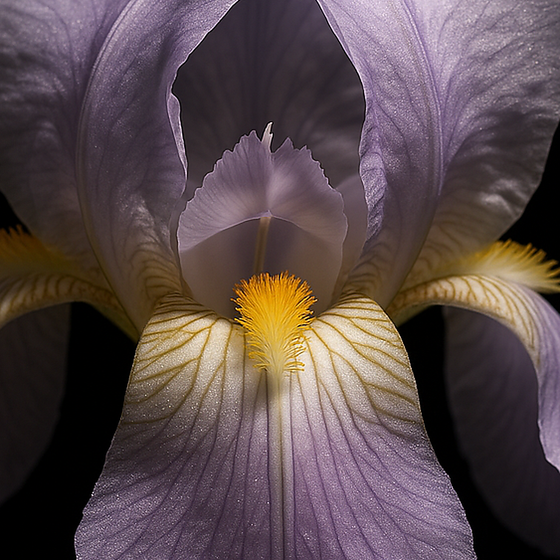
Iris pallida

PrirodnaKORENJE I MAHOVINEcvetni · puderast · kremast
Bazne notePiramida
—Jačina
—Trajnost
3Poreklo
Uzorak
Iris pallida kao sirovina za parfeme
Bazne note
Iris pallida
Definicija

Iris pallida, the Dalmatian iris or sweet iris, is a bearded iris that grows from a rhizome. Orris butter distilled from its rhizomes smells powdery and floral, reminiscent of violets.

Floral
96
Vert
85
Doux
34
Poudré
47
Fruité
42
Boisé
20
Dalmatian iris, sweet iris
Type
Sirovina
Olfactive family
Cvetni
Source
rhizome (orris root)
Chemical class
complex natural (essential oil)
Instrumenti
Piramida
GGornje note
SSrednje note
BBazne note
—Jačina
Snažan
Snažan
Zemlje proizvođači
Kina Francuska Italija

Miris

The aroma of orris butter is delicate, sweet, warm and powdery-floral, reminiscent of violet flowers with mellow woody undertones. The scent of orris root oil is generally expressed as a rich and powerful floral note with a powdery character, reminiscent of the scent of violet. Its fragrance has been described as tenaciously flowery, heavy and woody. Orris extracts provide rich natural effects such as powdery, earthy and metallic notes in fine perfumery. One orris extract delivers very clean notes evoking black soap, with a leathery impact in the base note. Among the irones, cis-γ-irone is described as floral, sweet and green, with a strong powdery scent.

Propisi i izmene formule

Detaljno

Iris pallida, the Dalmatian iris or sweet iris, is a hardy flowering perennial plant of the genus Iris, family Iridaceae. It is native to the Dalmatian coast in Croatia but widely naturalised elsewhere. It prefers rocky places in the Mediterranean and Submediterranean zone. It grows to a stem height of 50-80 cm. The fan-shaped inflorescence, produced in May or June, contains two or three flowers, which are usually pale purplish to whitish. Iris pallida flowers last longer than those of other Iris species, but take longer to develop, especially in colder climates. Some authors recognise three subspecies of Iris pallida in the broad sense as species: cengialti, from Slovenia and adjacent Italy, illyrica, from the North Dalmatian coast, and pseudopallida, from the South Dalmatian coast. The variegated cultivar 'Variegata' has gained the Royal Horticultural Society's Award of Garden Merit.

Orris root is the root of Iris germanica and Iris pallida. Iris pallida is cultivated in the Chianti region of Italy for its fragrance and medicinal properties. It is grown as a garden plant and commercially for the extraction of essential oils from its rhizome. The rhizomes of the orris species I. florentina, I. germanica and I. pallida produce one new rhizome section, called a struma, per year of growth on average. In Italy, irises were grown as an intercrop in vineyards and olive orchards, on narrow and steep plots of land for which mechanization is unsuitable. In these conditions, all work is usually performed by hand. Italy, once the hallmark of orris production, is now limited to the areas of Chianti and Pratomagno in Tuscany, where less than 30 tons is produced annually. Notable orris production also comes from Morocco, with an estimated 120 tons of I. germanica annually, from China, with about 100 tons of I. pallida, and from France, with about 40 tons of I. pallida. Orris essential oil costs several thousands of euros per kg, given the long process required to obtain it.

Irones are a group of methylionone odorants used in perfumery, derived from iris oil. Traditional aging of the rhizomes is a slow desiccation in which oxidative degradation of iridals leads to the slow accumulation of irones. Five geometrical irone isomers have been fully identified in Iris: cis-α-irone, trans-α-irone, cis-γ-irone, trans-γ-irone and β-irone. The α-, β- and γ-irones differ in the position of the double bond on the cyclohexane ring. Dextrorotatory irones are found in I. pallida, whereas levorotatory irones are found in I. germanica. In one comparison, I. pallida essential oil had 61% cis-γ-irone, 34% cis-α-irone and 5% trans-α-irone, while I. germanica essential oil had 62% cis-α-irone, 37% cis-γ-irone and 1% trans-α-irone. The main components of orris absolute are cis-γ-irone, typically 30-40%, and cis-α-irone, typically 20-30%. These two irones are considered responsible for the typical orris odor. The α-irone and γ-irone contents are accepted as the most significant criteria of the commercial quality of iris essential oil. In a study of I. pallida from Ukraine, the rhizome oil held myristic acid (56%), capric acid (14.50%), lauric acid (15.42%) and α-irone (2.85%) as dominant compounds.

The rhizomes are also used to make beads for children's teething necklaces as well as rosary beads.

Explore all seven extraits in the Discovery Set.

—

Related: Alpha Ionone · Alpha Isomethyl Ionone · Beta Ionone · Boisiris · Iris · Iris Butter · Orris Absolute

Zanimljivosti

One ton of iris root produces two kilos of essential oil, also referred to as orris root butter or butter of iris. It is the most expensive substance used in the fragrance industry.

Dobijanje i hemija

Način dobijanja

Orris rhizomes take three years to grow in the field, and prior to distillation the rhizomes are stored for an additional three years. In the summer of the third year, the plants are dug up entirely, and the rhizomes are sold to the extraction companies as whole rhizomes, peeled or sliced. To obtain black-type orris, harvested rhizomes are washed, sliced and dried, and for white-type orris, they are peeled by hand and undergo slow drying for a few years. The drying of rhizomes begins by spreading the material in one layer in the sun before it is placed in storage. The ground rhizomes of some iris, including Iris pallida, are steam distilled to provide an orris root oil. The steam distillate is a light yellow to brown-yellow solid mass, called orris butter or orris concrete, because it contains high concentrations of myristic and other fatty acids. By industry specification, dry ground rhizome is steam-distilled to obtain orris essential oil, also called orris butter or orris concrete, with a yield of 0.2-0.3% and an irone content of 13-17%. Orris absolute is obtained from orris butter after the removal of the fatty acids with alkali. The orris resinoid is obtained by benzene extraction or using petroleum ether from comminuted dried rhizomes.

Formula
Complex natural mixture (key constituents: cis-γ-irone; cis-α-irone; myristic acid)
CAS
90045-90-2
Botanički naziv
Iris pallida
Izgled
Cream to light yellow, semi-solid, wax-like, opaque mass
Jačina mirisa
Snažan
Sinonimi
Dalmatian iris, sweet iris
Status prema standardima IFRA
Pogledajte napomenu

No IFRA Standard for the material itself (51st Amendment)

Fizička svojstva
Tačka topljenja
40-50 °C

U parfemima

Orris root is now used mainly as a fixative and base note in perfumery, and for potpourri it is the most common fixative. A small amount of orris root oil is used in high-end perfumes to add a powdery and violet-like scent. Typical iris perfumes are those in which orris prevails over the other components. A commercially available synthetic irone with a higher trans isomer ratio than natural orris root oil seems to smell quite different from it. Orris is also an ingredient in many brands of gin. Orris root is often included in ras el hanout, a blend of herbs and spices used across the Middle East and North Africa. Orris root has been used in tinctures to flavour syrups, and its taste is said to be indistinguishable from raspberry. Orris extract destined for use as a flavor in the food industry in the United States has been assigned GRAS numbers 2829 and 2830.

Uloga u formuli
01pojačivač difuzije
02modifikator
03okosnica
04nota potpisa
05sirovina za stapanje
06graditelj volumena
Oblici na tržištu
eterično ulje

Pogledajte i

6 nota