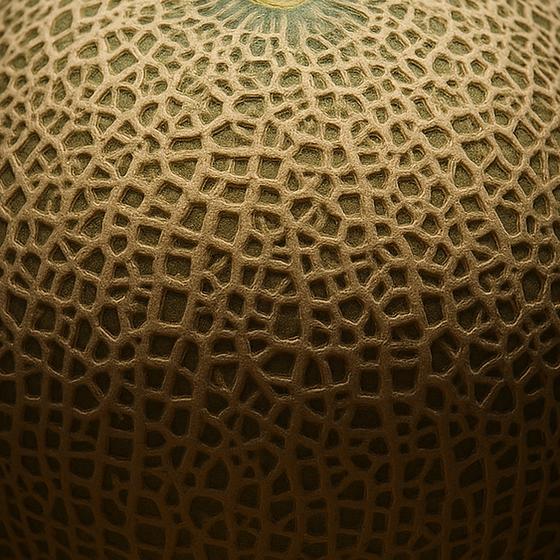
The true or European cantaloupe has a rind that is not netted or only slightly netted, and orange flesh. The muskmelon, which has a strongly netted rind, is called cantaloupe in North America. Cantaloupes range in mass from 0.5 to 5 kilograms. The cantaloupe was named after the commune Cantalupo in Sabina, in the Sabine Hills near Tivoli, Italy, a summer residence of the Pope. It was originally cultivated about the year 1700 from seeds brought from Armenia. The name was first used in English in 1739. The cantaloupe may have originated in a region from South Asia to Africa, although its exact origin is unknown. The Charentais is the most widely enjoyed variety of European cantaloupe and is cultivated almost exclusively in France. Columbus introduced cantaloupes to North America on his second voyage in 1494. In 2024, world production of cantaloupes and other melons was 28 million tonnes, led by China with 47% of the total. Cantaloupe is normally eaten as a fresh fruit, as a salad, or as a dessert with ice cream or custard. Raw cantaloupe is 90% water, 8% carbohydrates and 1% protein, with negligible fat.
Explore all seven extraits in the Discovery Set.
The key contributors to the total volatile compounds of melon are esters, aldehydes and ketones, along with smaller quantities of alcohols, sesquiterpenes and sulfur-containing compounds. Research on melon volatiles has identified around 291 compounds. In Charentais melons, esters were the most important contributors to the desirable sweet and fruity aroma of the fruit. Methyl 2-methylbutanoate and ethyl 2-methylbutanoate were the most intense odorants in the ester fraction of muskmelon. Both esters also contribute to a fruity, sweet and cantaloupe-like aroma. In Jiashi muskmelons, esters made up 86% of the volatiles by concentration but only 10% of the contribution to the aroma profile, while aldehydes and alcohols, at 11% and 4% of the ester content, contributed 56% and 34%. Ethyl 2-methylbutanoate has the formula C₇H₁₄O₂ and a molecular weight of 130.18. Its CAS number is 7452-79-1. Tuscan melons have a noticeably different flavour, potentially due to higher production of ester compounds in these varieties. The cis-isomer of 6-nonenal is often listed as the principal component in the aromas of muskmelon fruits. In the ripe, unmodified muskmelon cis-6-nonenal is present in only low concentration, and its concentration increases steeply when the cells are lysed and exposed to air. 6-Nonenal is thought to be biosynthesized from γ-linolenic acid by a lipoxygenase. The odour of muskmelons requires exposure to air. Of the eight sulphur compounds identified in the headspace of the melons, four were detected by the assessors. 2,6-Dimethyl-5-heptenal is among the volatile compounds recovered from 28 melon breeding lines. Sucrose accumulates as the major sugar of melons during ripening, at about 50%, with lower levels of fructose and glucose.
Melonal is 2,6-dimethyl-5-heptenal, CAS number 106-72-9. Its odour is described as a fruity, green melon odour with citrus undertones. Calone, also called methylbenzodioxepinone, is a white solid derived from 4-methylcatechol. Calone has the formula C₁₀H₁₀O₃ and the CAS number 28940-11-6. In the fragrance industry Calone is also known as watermelon ketone. Calone was discovered in 1966. It has been used as a scent component since the 1980s, and as a more dominant note in several perfumes of the marine trend beginning in the 1990s.
No PREMIEREPEAU fragrance currently features a cantaloupe note. The material's olfactory register — sweet, fruity, aquatic — occupies a different territory from the house's preferred vocabulary of resinous, floral, and mineral compositions.
—
Related: Acerola · Akebia Fruit · Allyl Amyl Glycolate · Arctic Bramble · Argan · Berries · Black Sapote · Buriti