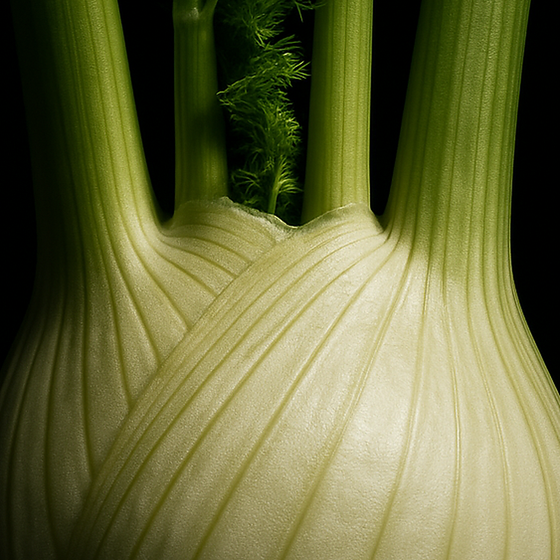
Фенхель

НатуральнийПРЯНОЩІсолодкий · теплий · ароматичний
Ноти серцяПіраміда
—Сила
—Стійкість
5Походження
Зразок
Фенхель як парфумерна сировина
Ноти серця
Foeniculum vulgare
Визначення

Fennel oil is an essential oil of Foeniculum vulgare, a plant of the family Apiaceae. The aroma of fennel fruits includes licorice-like notes from trans-anethole and estragole, and mint and camphor notes from fenchone.

Épicé
91
Chaleureux
78
Doux
54
Boisé
40
Terreux
30
Aromatique
38
Fennel oil, fennel fruit oil, fennel seed extract
Type
Складник
Olfactive family
Пряні
Source
Fruits ("seeds") of Foeniculum vulgare
Chemical class
complex natural (essential oil)
Інструменти
Піраміда
ВВерхні ноти
СНоти серця
ББазові ноти
Країни-виробники
Єгипет Франція Індія Італія Туреччина

Запах

The aromatic character of fennel fruits derives from volatile oils with mixed aromas: trans-anethole and estragole resemble licorice, fenchone suggests mint and camphor, and 1-octen-3-ol suggests mushroom. The (E)-anethole of sweet-fennel oil is responsible for its anise fragrance. Fenchone has an odor similar to that of camphor. Sweet-fennel fruits smell strongly of anise, whereas those of bitter or common fennel have a pungent odour and taste like camphor. A lower fenchone and higher trans-anethole ratio makes the aroma of fennel fruits sweeter and more delicate.

Теруар і хемотипи

Докладно

What it is

Fennel most probably originated from southern Europe and the Mediterranean. Fennel has been used for centuries in the Mediterranean area as an aromatic herb and also in folk medicine. Florence fennel, or finocchio, is a selection with a swollen, bulb-like stem base that is used as a vegetable. In mature fennel about 95% of the oil is located in the fruit.

Sweet and bitter fennel

The major compound of sweet-fennel oil is (E)-anethole, at up to 70-80%, which is responsible for the anise fragrance and sweet taste. The (E)-anethole content of bitter-fennel oil is only half that of sweet fennel, whereas the fenchone content is higher. Fenchone is considered a character-impact constituent of bitter-fennel oil. The oil obtained from sweet fennel possesses a finer odour and flavour than that from bitter fennel. A sweet-fennel oil from Italy contained 87.1% (E)-anethole, 4.7% limonene, 3.5% (Z)-anethole and 2.1% fenchone. A bitter-fennel oil from Italy contained 81.9% (E)-anethole, 10.2% fenchone and 4.9% limonene.

Variation between cultivars

In three Egyptian cultivars, trans-anethole accounted for 61% of the oil of azoricum, 46% of dulce and only 5% of vulgare. Estragole was the major compound in the oil of the vulgare cultivar at 58%, against 12% and 6% in azoricum and dulce. Pinene, limonene and fenchone were found in all three oils. Under four different cultivation conditions, the fruit oil of sweet fennel differed in its constituents, especially trans-anethole, estragole, fenchone, limonene and α-pinene.

Constituents

Fenchone is a monoterpenoid and a ketone, and it is a constituent of the essential oil of fennel. The d-fenchone enantiomer occurs in pure form in wild, bitter and sweet fennel plants and seeds. Anethole is a phenylpropanoid that contributes a large component of the odor and flavor of fennel. Estragole is an isomer of anethole, differing in the location of the double bond, and is also a component of fennel. Other phytochemicals found in fennel fruits include polyphenols, such as rosmarinic acid and luteolin, in minor content.

Production

In 2014, India produced 60% of the world output of fennel, with China and Bulgaria as leading secondary producers. Production data for fennel are combined with similar spices: anise, star anise and coriander. The estimated world production of essential oil from bitter fennel is about 28 t, that of sweet fennel about 255 t.

Regulation and safety

Estragole is suspected to be carcinogenic and genotoxic, as is indicated by a report of the European Union Committee on Herbal Medicinal Products. Under the European Pharmacopoeia (2nd edition), the estragole content must be kept below 10%. The IFRA Standard on estragole sets maximum acceptable concentrations in the finished product for 12 product categories. In Amendment 51 these concentrations range from 0.00021% to 0.11%.

Explore all seven extraits in the Discovery Set.

—

Related: Allspice · Anethole · Anise · Asafoetida · Baking Spices · Bay Leaf · Biryani · Caraway

Цікавий факт

The Greek name for fennel is marathon (μάραθον) or marathos (μάραθος), and the place of the famous battle of Marathon literally means a plain with fennel. In the 15th century, Portuguese settlers on Madeira noticed the abundance of wild fennel and used the Portuguese word funcho (fennel) and the suffix -al to form the name of a new town, Funchal.

Отримання й хімія

Спосіб отримання

The essential oil yield after hydrodistillation of the fruits is 1.9-3.1%. In a study of sweet fennel, the yield of fruit oil was 1.7% in the control and between 2.16% and 3.31% under four cultivation treatments. In that study the highest fruit oil yield and quality came from the combined application of chicken manure, spraying with ethephon and a water deficit irrigation regime. The use of cell cultures has no importance for the production of fennel essential oil or anethole.

Формула
Complex natural mixture (key constituents: trans-anethole C₁₀H₁₂O; fenchone C₁₀H₁₆O; estragole C₁₀H₁₂O)
CAS
8006-84-6
Ботанічна назва
Foeniculum vulgare
Зовнішній вигляд
Colorless to pale yellow clear liquid
Синоніми
Fennel oil, fennel fruit oil, fennel seed extract
Статус IFRA
Див. примітку

No IFRA Standard for the material itself (51st Amendment)

Фізичні властивості
Температура кипіння
227 °C at 760 mm Hg
Температура плавлення
5 °C
Температура спалаху
145 °F (TCC)
Відносна густина
0.953-0.973 at 25 °C
Показник заломлення
1.510-1.562 at 20 °C

У парфумерії

Fenchone, a constituent of the essential oil of fennel, is used as a flavor in foods and in perfumery. Estragole, a component of fennel, is used in perfumes and in flavorings for foods. Because small amounts of fragrance ingredients may be swallowed from products in IFRA Categories 1 and 6, the IFRA Standard on estragole requires that the material also be recognized as safe as a flavoring ingredient.

Роль у формулі
01фірмова нота
02компонент піднесення
03сполучний компонент
04формувач об’єму
05свіжість
Форми випуску
ефірна олія

Див. також

7 ноти