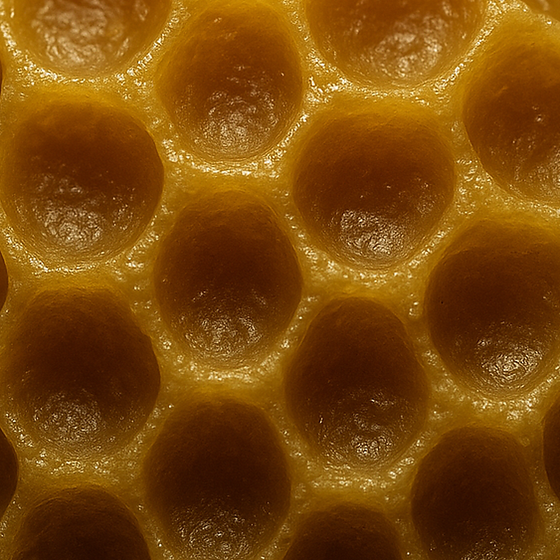
Бджолиний віск

НатуральнийМУСКУС, АМБРОВИЙ АКОРД, ТВАРИННІ ЗАПАХИсолодкий · теплий · насичений

Сім ароматівОдин із них дивиться на вас

Базові нотиПіраміда
3/5Сила
400годСтійкість
5Походження
Зразок
Бджолиний віск як парфумерна сировина
Базові ноти
Визначення

Beeswax is a natural wax produced by honey bees of the genus Apis. Its absolute smells sweet and honeyed, with balsamic, waxy, hay, tobacco and spice notes.

КВІТКОВИЙ ЗЕМЛИСТИЙ СОЛОДКИЙ ТВАРИННИЙ ТЕПЛИЙ ВЕРШКОВИЙ ВОСКОВИЙ СМОЛИСТИЙ
cera alba, white beeswax, white wax
Type
Складник
Olfactive family
Амброві й мускусні
Source
animal-derived
Chemical class
complex natural (wax)
Інструменти
Піраміда
ВВерхні ноти
СНоти серця
ББазові ноти
3/5Сила
Середня
інтенсивність запаху
Стійкість на блотері
400годин · 17 днів
1 год6 год24 год3 дн.7 дн.400 год
за 100 %
Країни-виробники
Індія Ефіопія Аргентина Туреччина Південна Корея

Запах

Beeswax absolute smells sweet, honeyed and balsamic, with waxy, hay, tobacco and spice notes. It is also described as sweet, dried-fruit, brown, hay- and tobacco-like, and herbal, with davana and honey notes. A further profile is ambery and vanillic, with honey, nuts, yellow fruits and dried fruits and a chocolate facet. Another is balsamic and redolent of honey, with an animalic facet. Others describe a rich, deep, sweet chocolate note with a fruity honey smell, tobacco, floral cassie and broom. The initial aroma is mild honey, sweet and floral, followed by tenacious middle notes reminiscent of new-mown hay with waxy undertones.

Походження, етика й замінники

Докладно

Origin in the hive

Worker bees secrete beeswax from eight wax-producing mirror glands on abdominal segments 4 to 7. Honeycomb is built by worker bees 12 to 18 days old from the secretions of their abdominal wax glands. The hive workers use the wax to form cells for honey storage and for the protection of larvae and pupae. Sugars from honey are metabolized into beeswax in fat cells associated with the wax glands.

The wax scales are about three millimetres across and 0.1 mm thick. For the bees to secrete wax, the ambient temperature in the hive must be 33 to 36 °C. The new wax is initially clear and colorless. It becomes opaque after the workers chew it and mix it with pollen, and turns yellower or browner as pollen oils and propolis are incorporated.

Chemistry

Chemically, beeswax consists mainly of esters of fatty acids and various long-chain alcohols. Triacontanyl palmitate, a wax ester, is a major component. The main constituents are palmitate, palmitoleate and oleate esters of long-chain aliphatic alcohols with 30 to 32 carbons. The ratio of triacontanyl palmitate to cerotic acid, the two principal constituents, is 6:1. The wax is also described as consisting primarily of myricyl palmitate, cerotic acid esters and some high-carbon paraffins.

Mono esters make up 35 percent of the wax, hydrocarbons and diesters 14 percent each, and free fatty acids 12 percent. Beeswax can be classified generally into European and Oriental types.

Aldehydes are the main class of volatile compounds in ethanol extracts of Apis mellifera beeswax. The volatile profile of the beeswax is marked particularly by linear aldehydes such as octanal, nonanal and decanal. Octanal and decanal both show high contents in A. mellifera beeswax, with octanal the highest.

Physical characteristics

Beeswax is a fragrant solid at room temperature. Its melting point range is 62 to 64 °C, and it discolors if heated above 85 °C. At room temperature it is tenacious, and it softens further at human body temperature. Its colour varies from nearly white to brownish, but is most often a shade of yellow. Wax from the brood comb tends to be darker than wax from the honeycomb, because impurities accumulate more quickly in the brood comb. The absolute is soluble in alcohol and hot dipropylene glycol and insoluble in water. It should be stored in a cool, dry place in tightly sealed containers, protected from heat and light.

Uses

Beeswax has been used since prehistory as the first plastic, and as a lubricant and waterproofing agent. It is also used in lost wax casting of metals and glass, as a polish for wood and leather, in cosmetics and as an artistic medium in encaustic painting. Candle-making has long involved beeswax, which burns readily and cleanly, and the material was traditionally prescribed for the Paschal candle. Supplier specifications give the functions of beeswax absolute as emollient, emulsifying, film-forming and perfuming.

Beeswax is edible and is approved for food use in most countries and in the European Union under the E number E901. The human digestive system cannot break it down, so it has insignificant nutritional value.

World production

In 2020, world production of beeswax was 62,116 tonnes, led by India with 38% of the total.

—

Related: Aldambre · Ambrarome · Ambrein · Ambreine · Ambrettolide · Ambronova · Ammonia · Animal Notes

Отримання й хімія

Спосіб отримання

Beeswax for human use may come from cappings cut off the cells during honey extraction, from scrapped old comb, or from burr comb and brace comb removed from a hive. Because of impurities, the wax must be rendered before further use. Beeswax absolute is an alcohol-soluble extract of crude yellow beeswax. Extraction is usually performed as a direct alcohol washing of the beeswax. It is extracted with solvents from the stripped honeycomb or from cakes of wax made by melting the honeycomb.

Формула
Complex natural mixture (key constituents: triacontanyl palmitate CH₃(CH₂)₂₉O-CO-(CH₂)₁₄CH₃; cerotic acid CH₃(CH₂)₂₄COOH)
CAS
8012-89-3
Зовнішній вигляд
yellow brown to brown red semi-solid to solid
Сила запаху
Середня
Стійкість
400 hours at 100.00 %
Синоніми
cera alba, white beeswax, white wax
Статус IFRA
Див. примітку

No IFRA Standard for the material itself (51st Amendment)

Фізичні властивості
Температура плавлення
61.00 to 63.00 °C. @ 760.00 mm Hg
Температура спалаху
> 212.00 °F. TCC ( > 100.00 °C. )
Відносна густина
0.94000 to 1.00000 @ 25.00 °C.
Показник заломлення
1.42000 to 1.49000 @ 20.00 °C.

У парфумерії

Beeswax absolute is a solid, wax-like, ethanol-soluble product used in natural perfumery and cosmetics. It brings natural honey facets and boosts floral notes. The honeycomb type, rich in honey, enhances the honey-like and floral notes and gives a gourmand, sweet and warm effect. In flavours it is used especially for brown notes, as a sweetness enhancer, and in vanilla and caramel.

Роль у формулі
01фіксатор
02модифікатор
03кістяк
04фірмова нота
05натуралізатор
06формувач об’єму
Форми випуску
неочищений жовтий бджолиний віск абсолют

Див. також

6 ноти