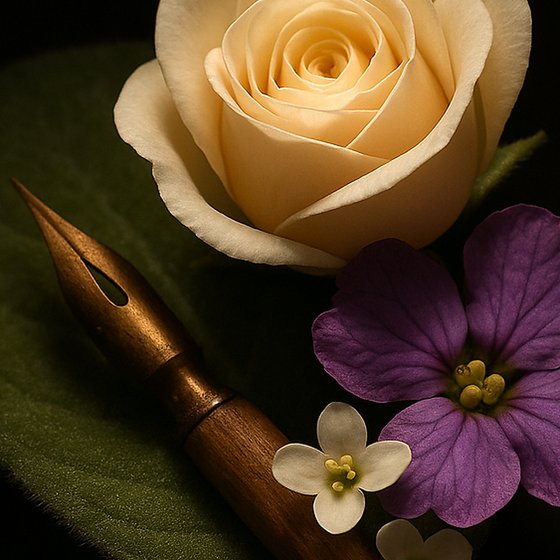
Квіткові ноти

АкордКВІТИквітковий · свіжий · насичений
Ноти серцяПіраміда
—Сила
—Стійкість
—Походження
Зразок
Квіткові ноти як парфумерна сировина
Ноти серця
Фантазійний/концептуальний
Визначення

Floral notes belong to the floral family, one of the broad groupings of perfumery alongside amber, woody and fresh.

КВІТКОВИЙ СОЛОДКИЙ ПУДРОВИЙ СВІЖИЙ ВЕРШКОВИЙ
Type
Акорд
Olfactive family
Квіткові
Source
Flowers (volatile organic compounds emitted by floral tissue)
Інструменти
Піраміда
ВВерхні ноти
СНоти серця
ББазові ноти

Запах

Indole has an intense faecal odour; at very low concentrations its smell is flowery, or jasmine-like. Hydroxycitronellal is described as sweet floral, lily, green, waxy and tropical, with slight melon and citrus undertones. The aroma of beta-damascenone is described as apple, rose, honey, tobacco and sweet. The fragrance of ylang-ylang is rich and deep, with notes of rubber and custard, and bright, with hints of jasmine and neroli. The flowers of lily of the valley are sweetly scented.

Докладно

In Michael Edwards's fragrance wheel, Floral is one of the primary scent families. In its 2010 version, the wheel illustrates Floral with fresh cut flowers, Soft Floral with aldehydes and powdery notes, and Floral Amber with orange blossom and sweet spices. The first fragrance wheel was conceived by the perfumer Paul Jellinek and published in the original German edition of his book in 1949. Michael Edwards created his Fragrance Wheel in 1992.

A single floral is a fragrance dominated by the scent of a particular flower, such as rose, carnation or iris, and is called a soliflore in French. A floral bouquet is a compound of several flower scents. Bright floral, one of the categories that have emerged since 1945, combines the single floral and floral bouquet categories.

Floral scent is composed of all the volatile organic compounds emitted by floral tissue, such as flower petals. The scent of most flowering plant species holds a diversity of these compounds, sometimes up to several hundred. Terpenoids represent the majority of floral volatile compounds; the second chemical class is the fatty acid derivatives, and the third is the benzenoids and phenylpropanoids. The primary functions of floral scent are to deter herbivores and to attract pollinators. The flowers of Lonicera japonica emit a sweet, subtle fragrance mainly composed of linalool.

Rose oil has citronellol (20-34%), geraniol (15-22%) and nonadecane (8-15%) as its major components. Its key components, which include β-damascenone, β-damascone, beta-ionone and rose oxide, usually make up less than 1% of the oil yet slightly more than 90% of its odour content, owing to their low odour detection thresholds. The presence of beta-damascenone is considered the marker for the quality of rose oil. The damascenones belong to the rose ketones, a family of chemicals that also includes damascones and ionones. Beta-damascenone is a major contributor to the aroma of roses despite its very low concentration. β-Ionone is also a significant contributor to the aroma of roses despite its relatively low concentration. Rosa centifolia does not have a rose oil because of the delicate nature of its petals, and its absolute is composed of more than 50% phenylethyl alcohol.

Jasmine is a genus of shrubs and vines in the olive family, Oleaceae, with around 200 species native to tropical and warm temperate regions of Asia, Africa and Oceania. Methyl jasmonate isolated from the oil of Jasminum grandiflorum led to the discovery of the molecular structure of the jasmonates. Lily of the valley, Convallaria majalis, is a Eurasian woodland plant with sweetly scented white flowers, and its French name, muguet, sometimes appears in the names of perfumes imitating the flower's scent. Ylang-ylang, Cananga odorata, is a species in the custard apple family Annonaceae and is valued for its essential oil, which is extracted from the flowers.

—

Related: Acerola Blossom · Albizia · Anisaldehyde · Apple Blossom · Babys Breath · Campion Flower · Cannonball Flower · Cotton Flower

Отримання й хімія

Спосіб отримання

Essential oils are produced by distillation, boiling or pressing, whereas absolutes are produced through solvent extraction or, more traditionally, through enfleurage. Rose otto is extracted by steam distillation, and rose absolute by solvent extraction. Ylang-ylang essential oil is obtained through steam distillation of the flowers. In solvent extraction, plant material is extracted with a hydrocarbon solvent such as hexane to yield a concrete, which is then extracted with ethanol. When the ethanol evaporates, the absolute is left behind. Absolutes in demand include rose, jasmine, tuberose, jonquil, ylang-ylang and mimosa. Some raw materials, jasmine among them, are too delicate or too inert to be steam-distilled and can only yield their aroma through solvent extraction. Enfleurage uses odorless fats that are solid at room temperature to capture the fragrant compounds produced by plants. It was the sole method of extracting the fragrant compounds of delicate flowers such as jasmine and tuberose, which would be destroyed or denatured by the high temperatures of other methods such as steam distillation. Supercritical carbon dioxide extraction takes place at a low temperature and leaves the aromatics unaltered by heat.

Статус IFRA
Див. примітку

No IFRA Standard for the material itself (51st Amendment)

У парфумерії

Rose scent, like lavender, is a typical middle note. Of rose ottos and rose absolutes, the absolute is used more commonly in perfumery. Rose oils remain perhaps the essential oil most often used in perfumery, despite their high price and the advent of organic synthesis. The combination of α-ionone and β-ionone is characteristic of the scent of violets; perfumery and flavouring use it with other components to recreate that scent. Hydroxycitronellal is an odorant used in perfumery. The Schiff base of hydroxycitronellal and methyl anthranilate, known as Aurantiol, is extensively used in floral notes such as orange-blossom, linden-blossom and tuberose. Indole is a constituent of many perfumes. Beta-damascenone is an important fragrance chemical used in perfumery. Ylang-ylang blends well with most floral, fruit, and wood scents.

Роль у формулі
01підсилювач дифузії
02модифікатор
03компонент піднесення
04сполучний компонент
05формувач об’єму
Форми випуску
парфумерний акорд

Див. також

6 ноти