


HerzPyramide
3/5Intensität
—Haltbarkeit
4Herkünfte
Exemplar
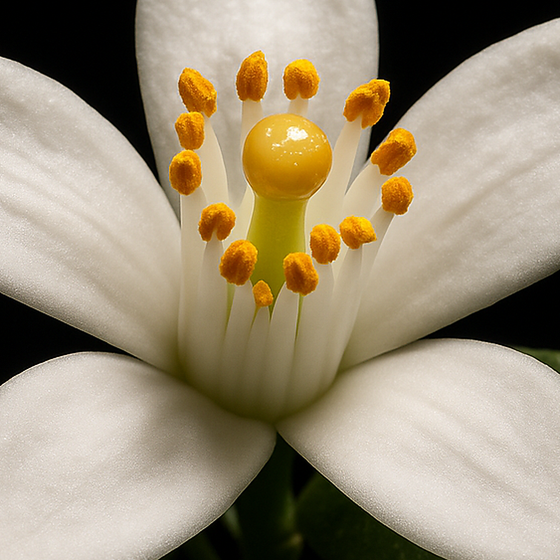
Citrus reticulata
Definition
Mandarinenblüte ist die Blüte von Citrus reticulata. Methylanthranilat kommt natürlich in der Mandarine und im Neroli vor.
Floral96
Indolique73
Vert53
Doux57
Crémeux30
Animalique30
Mandarinblüte, Zitrusblüte
- Typ
- Zutat
- Duftfamilie
- Blumiges
- Quelle
- Blumen
- Chemische Klasse
- komplexer Naturstoff (ätherisches Öl)
Messwerte
Pyramide
TKopf
HHerz
BBasis
3/5Intensität
Mittel
Geruchsintensität
Erzeugerländer
China Türkei Spanien Ägypten
Bei PREMIEREPEAU
Terroir & Herkünfte
Die ganze Geschichte
Extraktion & Chemie
Extraktionsmethode
Die Mandarinenschalenöle werden aus der Schale der Frucht gepresst.
- Formel
- Komplexe natürliche Mischung (Hauptbestandteile: Linalool C₁₀H₁₈O; Methylanthranilat C₈H₉NO₂)
- CAS
- 8014-17-3 (Citrus reticulata flower oil)
- Botanische Bezeichnung
- Citrus reticulata
- Aussehen
- Blassgelbe bis goldene Flüssigkeit mit süßem floral-zitrischem Geruch
- Geruchsintensität
- Mittel
- Synonyme
- Mandarinblüte, Zitrusblüte
IFRA-Status
Siehe HinweisKein IFRA-Standard für den Stoff selbst (51. Änderung)
Physikalische Eigenschaften
- Flammpunkt
- 138,00 °F. TCC (58,89 °C.)
- Dichte
- 0,86500 bis 0,89000 bei 25,00 °C.
Siehe auch
9 NotenQuellen
8- Methyl AnthranilatePubChem
- IFRA Standards, 51st AmendmentIFRA
- Citrus reticulataGBIF
- Mandarin orangeWikipedia
- Methyl anthranilateWikipedia
- Citrus × sinensisWikipedia
- PetitgrainWikipedia
- Citrus reticulata BlancoInternational Plant Names Index (IPNI)
