


Bijvoet
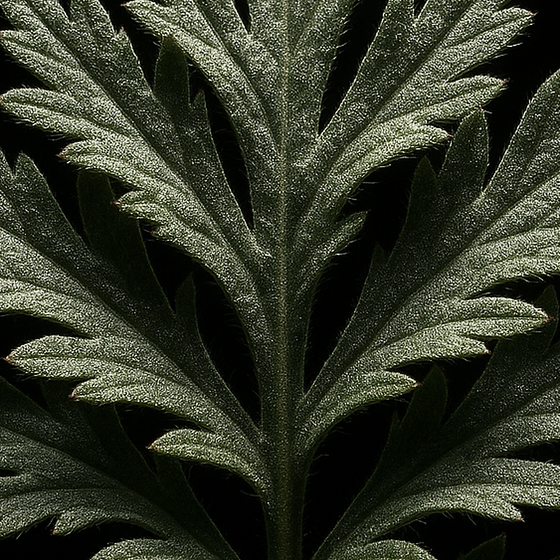
Bijvoet is Artemisia vulgaris, een plant waarvan de met stoom gedistilleerde olie een kruidige, kamferachtige, salieachtige geur heeft.
- Type
- Ingrediënt
- Geurfamilie
- Aromatisch
- Bron
- Bovengrondse delen van Artemisia vulgaris; de oliesamenstelling varieert naargelang het plantdeel en de populatie.
- Chemische klasse
- complex natuurlijk (etherische olie)
Geur
Terroir & verwerking
Het hele verhaal
Wist u dat?
In een tekst van Gotland uit 1875, bewaard in het landmålsarkiv van Uppsala, vraagt de bijvoet om Luna genoemd te worden voordat hij zijn genezende krachten verleent. Het vers zegt dat als je hem bijvoet noemt, hij noch vrouw noch koe geneest, maar als je hem Luna noemt, hij zowel koe als vrouw geneest. De Oekraïense naam voor bijvoet, chornóbyl', betekent 'zwarte stengel', en de Oekraïense stad Tsjernobyl ontleent haar naam aan de plant.
Extractie & chemie
Extractiemethode
De etherische olie van Artemisia vulgaris wordt verkregen door stoomdestillatie.
- Formule
- Complex natuurlijk mengsel; de gerapporteerde bestanddelen verschillen per olie en omvatten 1,8-cineol, kamfer, germacreen D en thujon (C₁₀H₁₆O).
- CAS
- 68991-20-8
- Botanische naam
- Artemisia vulgaris
- Uiterlijk
- Gele vloeistof (gerapporteerd voor oliën uit Litouwse wilde populaties)
- Geurkracht
- Medium
- Synoniemen
- Gewone bijvoet, felonkruid, chrysantenonkruid, wilde alsem, old Uncle Henry, zeemanstabak, stoute man, oude man
Het thujongehalte is onderworpen aan IFRA-beperkingen, inclusief bijdragen van natuurlijke ingrediënten (51e amendement).
- Vlampunt
- 131 °F (55 °C) TCC
- Soortelijk gewicht
- 0,91700 tot 0,93500 @ 25 °C
- Brekingsindex
- 1,46000 tot 1,47200 @ 20 °C
In de parfumerie
Armoise vulgaris-olie geeft een geur een kruidachtig, fris, kamferachtig karakter. Het gebruiksniveau hangt af van de samenstelling van de olie en de categorie van het eindproduct, inclusief de geldende IFRA-limieten voor thujon. Een gebruiksniveau in parfum zegt niets over de geschiktheid voor levensmiddelenaroma's.
Zie ook
8 notenBronnen
28- The Genus Artemisia: a 2012-2017 Literature Review on Chemical Composition, Antimicrobial, Insecticidal and Antioxidant Activities of Essential OilsMedicines (2017)
- Allelopathic Potential of Artemisia absinthium and Artemisia vulgaris from Serbia: Chemical Composition and Bioactivity on WeedsPlants (2025)
- ThujonePubChem
- IFRA Standards, 51st AmendmentIFRA
- armoise oilPerflavory
- Artemisia vulgarisGBIF
- Artemisia vulgarisWikipedia
- ThujoneWikipedia
- Nine Herbs CharmWikipedia
- Artemisia absinthiumWikipedia
- Artemisia vulgaris L. — species accountBotanical Society of Britain and Ireland, Fermanagh Flora
- Mugwort or Chrysanthemum Weed (Artemisia vulgaris)NC State Extension
- IFRA Standard: ThujoneInternational Fragrance Association — Amendment 49 (2020), retained in the 51st-Amendment framework
- Compositional Variability and Toxic Activity of Mugwort (Artemisia vulgaris) Essential OilsAsta Judzentiene and Rasa Garjonyte — Natural Product Communications (2016); State Research Institute, Center for Physical Sciences and Technology, Lithuania
- Artemisia vulgaris L.Plants of the World Online — Royal Botanic Gardens, Kew
- Artemisia vulgaris L. — taxonomic report, TSN 35505Integrated Taxonomic Information System
- Composition of the Essential Oil of Wild Growing Artemisia vulgaris from Erie, PennsylvaniaJack D. Williams, Ayman M. Saleh and Dom N. Acharya — Natural Product Communications (2012)
- Fragrance Ingredient Glossary — Armoise vulgaris oilInformation derived from the IFRA Fragrance Ingredient Glossary, developed by The International Fragrance Association (April 2020)
- Allergic contact dermatitis associated with mugwort (Artemisia vulgaris)Sik Haw, Hee-Ryung Cho and Mu-Hyoung Lee — Contact Dermatitis (2010)
- Harley MS 585, ff 130r–193r — LacnungaBritish Library Archives and Manuscripts Catalogue
- Old English Medical ProseIrene Tenchini — University of Oxford, Resources for Old English Prose
- Chemical Profile and Biological Activities of Essential Oil from Artemisia vulgaris L. Cultivated in BrazilSonia Malik et al. — Pharmaceuticals (2019)
- Mugwort: Usefulness and SafetyNational Center for Complementary and Integrative Health, US National Institutes of Health
- Oils, Artemisia vulgaris — CAS 68991-20-8US Environmental Protection Agency — CompTox Chemicals Dashboard
- Compendium — Artemisia vulgaris monographMonograph hosted by the Department of Biotechnology, Government of India
- Artemisia vulgaris — morphology and species profileNC State Extension Gardener Plant Toolbox
- Wormwood Forest: A Natural History of Chernobyl — Chapter 1Mary Mycio — Joseph Henry Press / National Academies (2005)
- Variations in Chemical Compositions and Biological Activities of Artemisia vulgaris L. (Common Mugwort) Essential Oils at Different Growth StagesIlker Demirbolat, Ebrar Inal, Seyma Ulusoy and Murat Kartal — Journal of Essential Oil Bearing Plants 25(2), 393–402 (2022); DOI 10.1080/0972060X.2022.2084348; Bezmialem Vakif University repository

