


Decalepis hamiltonii
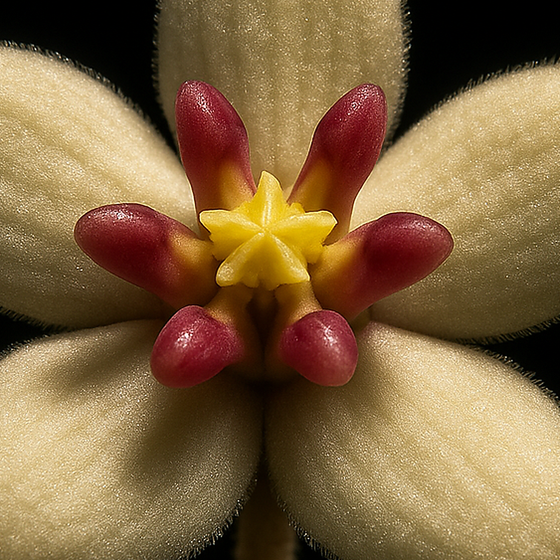
Sweet, vanillic, faintly anisic. The smell of splitting open a sun-dried root and finding crystallised vanilla inside — except warmer, less green, and with a soft medicinal edge. The key molecule is 2-hydroxy-4-methoxybenzaldehyde, a structural isomer of vanillin that occurs at 96 percent of the root volatile oil.
- Type
- Складник
- Olfactive family
- Фруктові
- Source
- root (tuberous)
- Chemical class
- complex natural (essential oil)
Запах
Теруар і післязбиральна обробка
Докладно
Цікавий факт
2-Hydroxy-4-methoxybenzaldehyde, the molecule that gives Decalepis hamiltonii its vanilla-like aroma, is a positional isomer of vanillin — same atoms (C8H8O3), different arrangement. Vanillin is 4-hydroxy-3-methoxybenzaldehyde; the Decalepis compound swaps the hydroxyl and methoxy positions on the ring. This minor structural rearrangement shifts the odor from caramellic-vanilla toward anisic-medicinal. The FDA revoked food-use authorisation for the synthetic form of seven flavoring substances including this compound, though the natural occurrence in plant roots remains GRAS under FEMA 4283.
Отримання й хімія
Спосіб отримання
Steam distillation of fresh fleshy roots yields a volatile oil at 0.68% (Nagarajan et al., Flavour and Fragrance Journal, 2001). The major component — 2-hydroxy-4-methoxybenzaldehyde — crystallises directly from the oil at 96% concentration. For absolute production, dried powdered roots are subjected to solvent extraction (hexane or ethanol), followed by evaporation of the solvent to yield a dark, resinous concentrate. Harvesting is destructive: the entire plant must be uprooted to access the tuberous roots, which is the primary driver of the species IUCN Endangered classification. Cultivated sources exist in Karnataka and Tamil Nadu, but wild harvesting from the Eastern and Western Ghats remains prevalent. The root bark contains the highest concentration of 2H4MB (approximately 74 mg per gram of dry tissue in the medullary portion).
- Формула
- Complex mixture — key component: 2-hydroxy-4-methoxybenzaldehyde (C₈H₈O₃)
- CAS
- 853947-36-1
- Ботанічна назва
- Decalepis hamiltonii Wight & Arn. (Apocynaceae, subfam. Periplocoideae)
- Зовнішній вигляд
- Pale yellow to amber liquid
- Сила запаху
- Середня
- Стійкість
- 6–12 hours
- Синоніми
- SWALLOW ROOT MAKALI BERU MAGALI KIZHANGU MAREDU KOMMULU NANNARI KOMMULU
Not classified for fragrance use. TGSC designation: flavoring agent only. FEMA 4283 (GRAS for food use). No IFRA Standard exists for this material.
- Нота
- Root contains 2-Hydroxy-4-methoxybenzaldehyde (HMBA) as key aroma compound; boiling point ~260 °C; sweet vanillic-anisic odor
У парфумерії
Decalepis hamiltonii extract is classified by FEMA (number 4283) as a flavoring agent and is listed by TGSC as not for fragrance use. Its presence in perfumery glossaries reflects its aromatic interest rather than widespread formulation use. The root absolute offers a natural vanillin-isomer profile — sweet, anisic, lightly medicinal — that differs from standard vanillin or ethyl vanillin in both character and regulatory pathway. The dominant molecule, 2-hydroxy-4-methoxybenzaldehyde (CAS 673-22-3, MW 152.15, mp 41-43 C, bp 269-270 C), is structurally closer to anisaldehyde than to vanillin in its odor behavior: less caramellic, more phenolic-sweet, with a clean medicinal undertone. In flavor work, it functions as a modifier and sweetness enhancer. In fragrance-adjacent applications (room sprays, candles, potpourri where IFRA restrictions do not apply), the absolute provides a warm, gourmand base with natural provenance. The root also contains trace amounts of vanillin (0.45%), benzaldehyde, methyl salicylate, and 2-phenylethyl alcohol — a minor terpene-aldehyde palette that adds textural complexity to the dominant 2H4MB note.
Див. також
8 ноти